The Dacian Wars: Rome’s Campaigns of Conquest and Consolidation Under Emperor Trajan
The Dacian Wars represent one of Rome’s most ambitious military efforts during the imperial period. Fought between the Roman Empire and the Dacian Kingdom under King Decebalus, these conflicts reshaped the balance of power in Eastern Europe. The wars tested Roman military strength, administrative ability, and economic ambition. Their outcome reinforced Roman dominance — but at significant cost.
Roman legionaries in full armor clash with Dacian warriors in melee combat, illustrating the intensity and discipline of close-quarter battles during the Dacian Wars.
Background to Conflict — Rising Tensions on the Danube Frontier
Dacia and Its Strategic Significance
Dacia lay north of the Danube River, in the region of modern Romania. Rich in natural resources — particularly gold — it possessed strong defensive terrain of mountains, forests, and fortresses. Under King Decebalus, Dacia emerged as a powerful and organized state capable of resisting Roman encroachment.
Rome viewed Dacia as both a threat and an opportunity. The kingdom had previously defeated Roman forces, exposing weaknesses along the Danube frontier. A strong, independent Dacia risked inspiring unrest among neighboring tribes. Control of the region promised security — and immense economic reward.
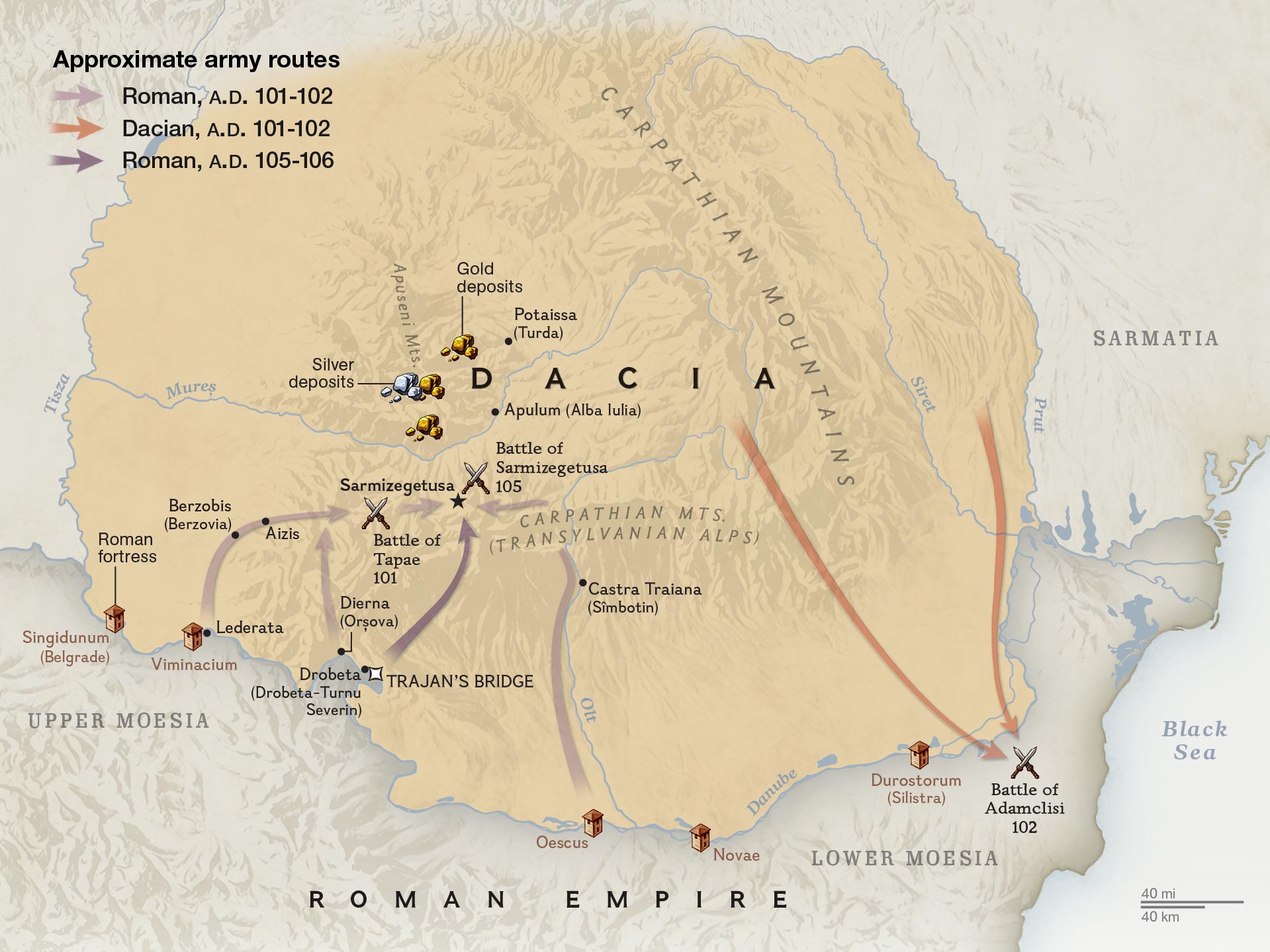
Here’s the SEO and concise description for the Dacia map image:
SEO Alt Text
Map of Dacia during 101–106 A.D., showing Roman campaigns and territorial boundaries during the Dacian Wars
Reader-Facing Image Description
This map depicts Dacia between 101 and 106 A.D., highlighting Roman military campaigns, key fortifications, and the region’s geography during the conquest.
Earlier Roman Engagements and the Road to War
Prior to Trajan, Emperor Domitian fought inconclusive campaigns against Dacia. Rome secured temporary peace through tribute payments — a political humiliation that highlighted unfinished business. When Trajan became emperor, he sought both security and prestige through decisive military action.
War became a means to:
eliminate a hostile power
strengthen frontier stability
display imperial authority
secure valuable resources
The stage was set for one of Rome’s largest coordinated military operations.
This marble statue portrays Trajan, highlighting his role as a Roman emperor celebrated for military victories, including the conquest of Dacia, and expanding the empire to its greatest territorial extent.
Key Ideas — Background
Dacia was wealthy, powerful, and strategically important
Decebalus built a strong centralized kingdom
Trajan sought permanent resolution through conquest
The First Dacian War (101–102 CE) — Roman Advance and Conditional Victory
Roman Strategy and Military Operations
Trajan mobilized multiple legions and advanced across the Danube using impressive engineering — including the construction of fortified bridges and supply systems. Roman armies penetrated deep into Dacian territory through coordinated assaults.
Battles were hard-fought. Dacian forces used terrain, surprise, and fortified positions to resist. Nevertheless, Roman discipline, training, and logistics gradually turned the tide.
A Dacian noble raises his voice in a battle cry, taunting the Romans and demonstrating the courage and ferocity of Dacian warriors.
Defeat and Submission of Decebalus
Eventually, Dacian resistance collapsed under pressure. Decebalus sued for peace, accepting Roman terms. These included surrendering territory, fortifications, and military capabilities — though Dacia remained nominally independent.
For Trajan, this marked success but not closure. Decebalus soon violated agreements, rebuilding defenses and strengthening alliances. Peace proved temporary and unstable.
The rock statue of Decebalus honors the Dacian king who resisted Roman conquest, symbolizing his strength and historical legacy.
Key Ideas — First War
Rome achieved military success but allowed Dacia to remain independent
Decebalus accepted harsh terms, then later broke them
Trajan viewed renewed war as inevitable
The Second Dacian War (105–106 CE) — Conquest, Annexation, and Final Defeat
Renewed Hostilities and Roman Determination
When Decebalus resumed resistance, Trajan responded with overwhelming force. This war aimed not at submission but at total annexation. Roman legions advanced systematically, crushing resistance and seizing strongholds.
Engineering feats again played a central role. Roman logistics ensured sustained campaigning deep inside Dacia.
Roman legionaries launch pila at charging Dacian warriors, demonstrating the disciplined tactics and battlefield strategy of Rome during the Dacian Wars.
Fall of Sarmizegetusa and Death of Decebalus
The decisive blow came with the siege and destruction of Sarmizegetusa, the Dacian capital. Roman forces dismantled defensive rings and eliminated command structures. Facing defeat, Decebalus committed suicide rather than accept capture.
With leadership destroyed, Dacia became a Roman province. Colonization, taxation, mining, and infrastructure development followed rapidly.
A stone inscription depicts King Decebalus speaking to his people before taking his own life, marking the dramatic end of Dacia during the Roman conquest.
Key Ideas — Second War
Rome pursued full conquest rather than limited victory
The Dacian capital fell after intense siege warfare
Dacia was annexed into the Roman Empire
Impact and Legacy — Wealth, Strength, and Cultural Transformation
Economic and Political Consequences
The conquest of Dacia brought enormous wealth to Rome — particularly gold used to fund public works, military expenditures, and urban development. Trajan’s reputation soared. Rome gained secure control of the Danube frontier.
However, annexation also required permanent garrisons and administrative oversight. While profitable, Dacia demanded constant defense against external pressure.
Here’s the SEO and short description for that image:
SEO Alt Text
Ancient stone inscription depicting Roman soldiers constructing a fort during the Dacian Wars, illustrating military engineering in Roman campaigns
Reader-Facing Image Description
A stone carving shows Roman soldiers building a fort during the Dacian Wars, highlighting the empire’s skill in military engineering and fortification construction.
Cultural Integration and Provincial Development
Roman colonists settled the new province, introducing language, architecture, law, and urban systems. Dacian culture did not vanish but blended with Roman norms. The region became deeply Romanized — a legacy still visible centuries later.
Representation in Roman Memory
The Dacian Wars were immortalized in Trajan’s Column, an extraordinary sculpted monument in Rome depicting the campaigns in vivid narrative relief. It served not only as art but as imperial propaganda, celebrating discipline, engineering, and conquest.
Key Ideas — Impact and Legacy
Dacia provided Rome with immense economic resources
The region became a thoroughly Romanized province
The wars reinforced Trajan’s status as a successful military emperor