How Powerful Was the Roman Army Really? Organization, Strategy, and Military Dominance
The Roman army is widely regarded as one of the most powerful military forces of the ancient world, yet its strength extended far beyond mere numbers or weaponry. Rome’s military supremacy was the result of meticulous organization, rigorous discipline, advanced engineering, adaptability, and strategic foresight. Over centuries, it evolved into a professional war machine capable of defeating highly diverse enemies across Europe, North Africa, and the Near East. Its enduring power derived from a combination of institutional continuity, tactical innovation, and social integration, which allowed Rome to maintain control over territories that other states could not. Understanding the army’s true power requires examining its structure, training, equipment, logistics, leadership, psychological warfare, adaptability, and limitations in detail.
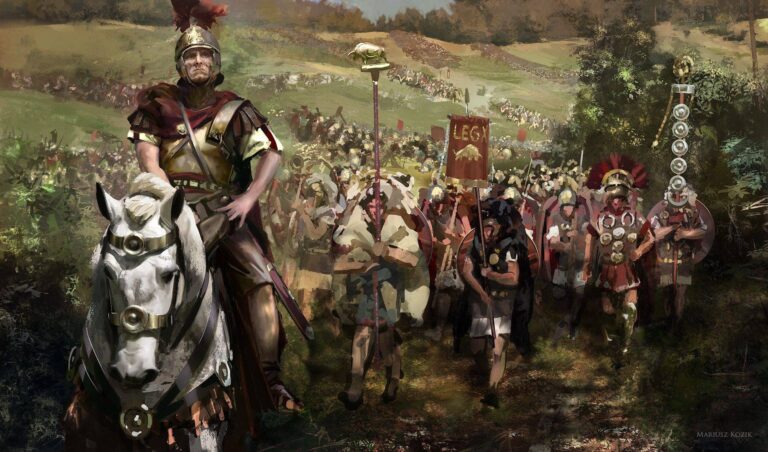
This image depicts Julius Caesar leading his elite Tenth Legion through Gaul, reflecting Roman discipline and the systematic expansion of Roman power during the Gallic Wars.
Organization and Structure
The Roman army’s organization was its primary strength, setting it apart from virtually all contemporary military forces. Unlike most ancient armies, which were temporary levies or citizen militias raised for single campaigns, the Roman army was a permanent institution. Each legion was standardized, composed of roughly 4,800 heavy infantry, subdivided into centuries led by centurions, and further grouped into cohorts. This allowed Rome to rotate units, replace losses efficiently, and conduct long-term campaigns without disruption.
Beyond legions, Rome relied on auxiliary troops (auxilia), recruited from conquered peoples, who provided cavalry, archers, slingers, and other specialized roles. These auxiliaries were trained to integrate seamlessly with legions, multiplying tactical flexibility. Standardized ranks, clear chains of command, and codified procedures ensured operational cohesion even under stress or in the event of a general’s death.
Rome also implemented administrative protocols for recruitment, pensions, pay, and logistics. Soldiers were more than fighters; they were part of a bureaucracy that monitored health, training, and readiness. This allowed the army to function as an enduring institution rather than a collection of mercenary units. The combination of legions, auxiliaries, and command structure made the Roman army highly adaptable, reliable, and lethal over centuries.
Key Ideas
Permanent, professional institution
Flexible, hierarchical structure
Legions supported by auxiliaries for specialized roles
This image illustrates the organization of a Roman legion, highlighting how soldiers were structured into cohorts and centuries under a clear chain of command.
Training and Discipline
Roman soldiers were not simply drilled occasionally—they were trained daily, year-round, and under strict supervision. Even in times of peace, legionaries practiced marching long distances, formation drills, weapon handling, and mock combat. Physical endurance was emphasized over brute strength, with soldiers carrying heavy packs (up to 20-30 kg) for forced marches. Training included running, swimming, fencing with wooden swords (rudis), and building temporary fortifications to simulate battlefield conditions.
Discipline in the Roman army was legendary. Penalties for infractions ranged from extra labor to execution, yet this severe system produced soldiers capable of facing extreme danger without breaking formation. Units drilled together, ate together, and lived in shared barracks, building loyalty and cohesion. Soldiers were also educated in battlefield communication, signals, and strategy, which allowed even lower-ranking troops to respond effectively to changing conditions.
The result of such training was not only physically capable soldiers, but highly coordinated units that could execute complex maneuvers under stress. This discipline made the Roman army predictable to its commanders but terrifying to its enemies, capable of maintaining formation even under the fiercest assault.
Key Ideas
Continuous training built endurance and skill
Severe discipline ensured obedience
Cohesion and teamwork were central to battlefield success
Caesars Army Marching to the Battle of Pharsalus (48 BCE)
Equipment and Tactics: Practical, Lethal, and Adaptable
Roman soldiers were equipped for functionality and effectiveness, not luxury. The scutum (shield) and gladius (short sword) were designed for close combat, while the pilum (javelin) allowed pre-emptive strikes to disrupt enemy formations. Armor, helmets, and greaves protected soldiers without compromising mobility. Equipment was standardized across legions to simplify logistics and training.
Tactics emphasized flexibility and adaptability. The manipular formation allowed small units to advance, retreat, or reinforce gaps without collapsing. Romans could combine missile attacks with melee, coordinate reserves, and respond dynamically to enemy maneuvers. They also borrowed effective techniques from adversaries, including cavalry tactics from the Gauls and phalanx counters from Greek mercenaries.
Rome’s ability to adapt equipment and tactics to enemy strengths ensured that no single battlefield scenario could consistently defeat the legions. Combined with discipline and training, these factors made the Roman army a versatile, almost scientific force capable of facing vastly different enemies successfully.
Key Ideas
Equipment designed for protection and tactical advantage
Adaptability ensured effectiveness against diverse foes
Roman legionaries launch pila at charging Dacian warriors, demonstrating the disciplined tactics and battlefield strategy of Rome during the Dacian Wars.
Logistics and Engineering: Winning Wars Before Battles Began
Roman power was not determined solely on the battlefield. Its armies relied on engineering and logistics to dominate campaigns long before engaging the enemy. Soldiers built roads, bridges, and fortifications, enabling rapid movement and reliable supply lines. Legionary camps were constructed daily in precise, defensive layouts, protecting troops and supplies.
Rome’s logistical systems allowed armies to remain in the field for months or years, outlasting opponents who lacked structured support. Supply chains for food, weapons, and medical care were carefully managed, allowing campaigns deep into enemy territory. The combination of military engineering, road networks, and organized logistics meant the Roman army could force engagements on favorable terms and sustain operations longer than almost any contemporary force.
Key Ideas
Logistics sustained long, extended campaigns
Engineering multiplied battlefield efficiency and security
Movement and supply superiority gave Rome a strategic edge
Romans building a stone road.
Leadership and Command: Competence Over Brilliance
While legendary generals like Scipio, Caesar, and Trajan are well remembered, the army’s strength lay in systemic leadership, not exceptional individuals alone. Commanders delegated authority to centurions, trained officers, and engineers who could operate autonomously, ensuring continuity even when generals fell.
Clear protocols for communication, signals, and decision-making allowed the army to execute complex maneuvers reliably. Leadership emphasized initiative within structure: soldiers were empowered to act, but only in ways consistent with overarching strategy. This professionalized command system reduced the dependence on extraordinary individual brilliance and created resilience against leadership failures.
Officers were trained and empowered within strict guidelines
Resilience did not rely on single commanders
The surrender of Gaul to Caesar
Psychological Warfare and Reputation
Roman military power was as much psychological as physical. Rome’s reputation alone intimidated enemies before battles began. Strategies included:
Publicly displaying discipline and training
Punishing enemies decisively to instill fear
Using military standards and ceremonies to project authority
Fear was an intentional weapon. Many opponents surrendered without fighting because the Roman army’s discipline and past victories created a psychological edge that often determined the outcome of conflicts even before combat started.
Key Ideas
Reputation amplified tactical power
Psychological impact influenced enemy behavior
Discipline and ceremony were part of the strategic arsenal
A Marble Statue of Octavian Later Known as Augustus
Adaptability Across Centuries and Enemies
The Roman army’s longevity depended on adaptation across centuries. From early phalanx-style formations to manipular legions and later cohorts, it continuously evolved. Rome defeated:
Greek city-states with phalanxes
Gauls using guerrilla tactics
Carthaginian armies with elephants
Eastern cavalry empires
The army’s ability to absorb foreign tactics, reorganize formations, and integrate new troop types allowed Rome to remain dominant for centuries despite changing enemies and technologies.
Key Ideas
Tactical evolution ensured sustained dominance
Adaptation allowed success against varied foes
Flexibility preserved military supremacy
Map showing Roman roads
Limitations and Decline of Roman Military Power
Despite its strengths, the army was not invincible. By the late Empire, it faced:
Overextension of borders
Political interference in command
Reliance on non-Roman recruits with weaker loyalty
These issues reduced discipline, lowered training standards, and eventually contributed to the gradual weakening of Roman military dominance. Yet even at its decline, the system remained formidable compared to most contemporary armies.
Key Ideas
Military power depended on political stability
Civil wars and corruption weakened discipline
Decline was gradual, not sudden
This image shows Roman troops being pushed back by Briton warriors, highlighting the challenges Rome faced during its early campaigns in Britain.
Conclusion: The True Source of Roman Military Power
The Roman army’s power lay not in individual heroics but in its organization, discipline, adaptability, logistics, and psychological impact. It created a system capable of conquering and holding vast territories for centuries. Rome did not rely on luck or temporary armies; it built a professional, enduring institution that reshaped the ancient world.
Key Ideas
Power came from systemic organization, not individual brilliance
Discipline, logistics, and training were central
Rome’s military dominance was earned through structure, innovation, and consistency