
Actuaria
The actuaria was one of the lightest and most versatile vessels employed by the Roman military, primarily serving logistical, transport, and communication functions rather than participating directly in heavy naval combat. Unlike large polyreme warships designed for ramming and boarding, the actuaria emphasized speed, flexibility, and operational efficiency. It was equipped with both sails and oars, allowing commanders to adapt to varying wind conditions and maintain consistent movement even in unfavorable weather. This hybrid propulsion system ensured reliability in urgent missions where timing was critical.
Structurally, the actuaria was narrower and lighter than battle-oriented ships, enabling it to travel swiftly across coastal waters and between fleet positions. Its relatively shallow draft allowed access to harbors, river mouths, and supply depots that larger vessels could not easily reach. In large-scale campaigns, particularly during the late Republic and early Empire, coordination between fleets, provincial governors, and frontier commanders required dependable maritime communication. The actuaria fulfilled this role by transporting dispatches, officers, reinforcements, and essential supplies.
Although lightly armed, it could defend itself against small-scale threats such as pirates or raiders. Its importance lay not in brute force but in maintaining the flow of information and resources, which was fundamental to Roman military organization. Without vessels like the actuaria, Rome’s massive fleets would have lacked the cohesion necessary for sustained operations. The ship demonstrates that Roman naval power relied as much on logistics and coordination as on battlefield dominance.
Key Ideas
Light vessel using sails and oars
Designed for transport and communication
Shallow draft for coastal and river access
Maintained operational coordination
Critical for logistical efficiency
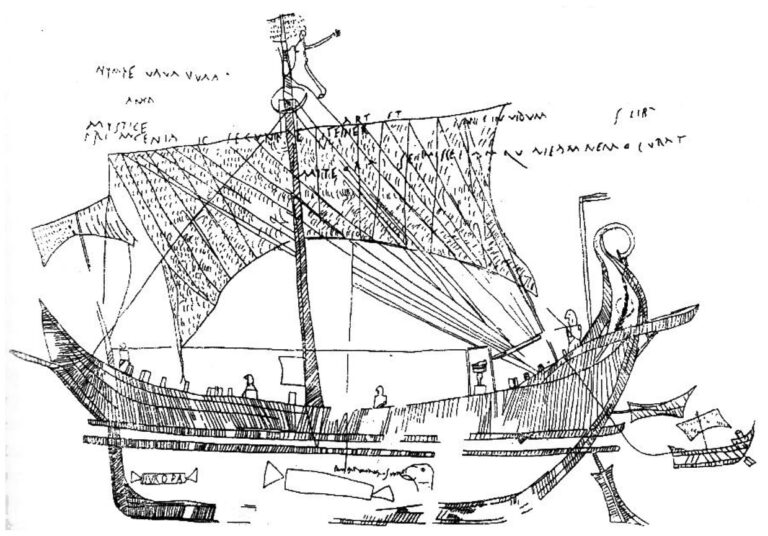
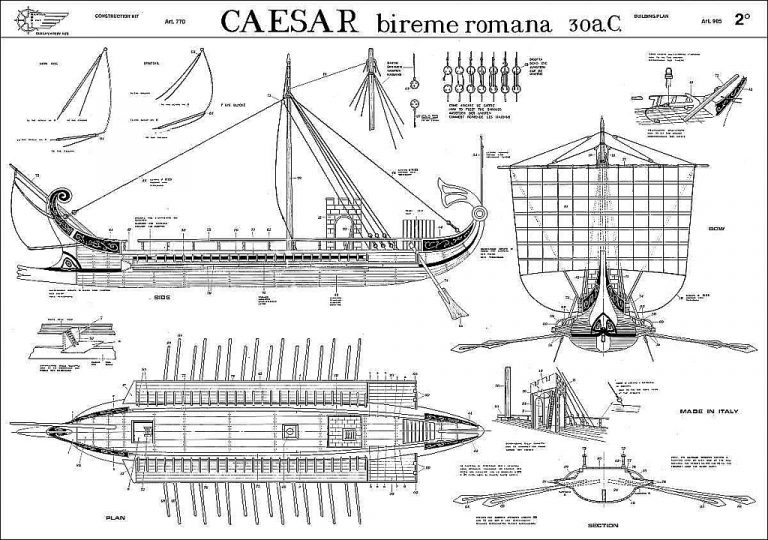
Bireme (Biremis)
The bireme represented a modest yet effective class of Roman warship, featuring two horizontal banks of oars that provided balanced propulsion and manageable crew coordination. Compared to heavier polyremes, biremes required fewer rowers and marines, making them more economical to construct and operate. This practicality allowed Rome to deploy them widely in regional assignments where constant maritime presence was necessary.
Biremes were particularly suited to coastal patrol duties, convoy escort missions, and protection of harbor approaches. Their lighter construction allowed them to maneuver effectively in confined waters, such as narrow straits and river mouths. While they lacked the overwhelming mass required for decisive fleet engagements, they remained capable of conducting limited ramming attacks and supporting boarding operations when necessary.
In the broader structure of the Roman navy, biremes contributed to a layered defense system. Large warships were reserved for major confrontations, while biremes ensured everyday maritime security. Their reduced manpower requirements made long-term patrols sustainable without excessive strain on resources.
The bireme illustrates Rome’s pragmatic approach to naval organization. Instead of relying solely on massive ships, the Romans diversified their fleet composition to match operational needs. By balancing cost, mobility, and moderate combat strength, biremes reinforced Roman maritime dominance through continuous enforcement rather than singular displays of force.
Key Ideas
Two banks of oars
Economical and sustainable design
Effective in coastal patrol and escort
Limited but functional combat capacity
Supported layered naval strategy
Liburnian (Liburna)
The liburnian was a light and highly maneuverable warship adopted from Illyrian maritime traditions and became increasingly prominent during the late Republic and early Empire. Unlike heavier polyremes built for massive fleet battles, the liburnian prioritized speed, agility, and rapid response capability. Typically equipped with two rows of oars and a streamlined hull, it could outmaneuver larger ships and pursue smaller hostile vessels effectively.
Following Rome’s consolidation of naval supremacy after major conflicts, the Mediterranean required constant surveillance rather than large-scale confrontation. Trade routes, grain shipments from Egypt, and provincial supply chains depended on secure sea lanes. The liburnian became the ideal vessel for anti-piracy operations, reconnaissance missions, and escort duties. Its quick acceleration and tight turning radius allowed it to intercept threats before they could disrupt commerce.
Despite its smaller size, the liburnian could carry marines and light missile troops, ensuring defensive capability. Its widespread adoption reflects Rome’s transition from expansionist naval warfare to sustained maritime governance. The liburnian embodied the strategic principle that mobility ensures control, reinforcing Roman dominance across thousands of kilometers of coastline.
Key Ideas
Light and highly maneuverable warship
Used for anti-piracy and reconnaissance
Protected trade routes
Faster than heavy polyremes
Essential for sustained maritime control
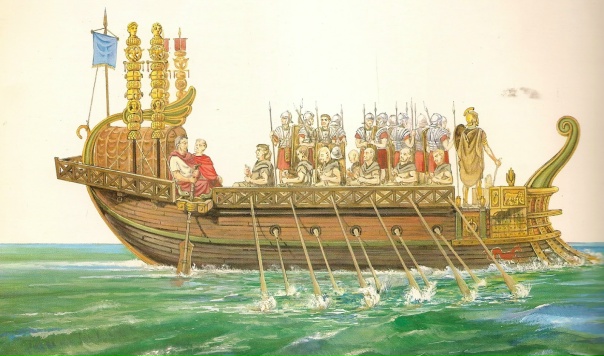
Trireme (Triremis)
The trireme represented a decisive development in ancient naval warfare and marked Rome’s transition from limited maritime capability to organized fleet combat. Characterized by three vertically arranged tiers of oarsmen on each side, the trireme required approximately 170 rowers working in strict coordination. This arrangement allowed the vessel to achieve high speeds while maintaining maneuverability, making it particularly effective in open-water engagements. The long, narrow hull was designed to reduce drag and maximize acceleration, while the bronze rostrum (ram) mounted at the prow served as its primary offensive weapon.
Originally perfected by Greek naval powers, especially Athens, the trireme was adopted by Rome during its early naval expansion. The Romans, though initially inexperienced at sea, rapidly standardized construction after studying captured enemy ships. The trireme became a foundational warship during early confrontations in the western Mediterranean. Its effectiveness depended not only on design but also on crew discipline. Rowers had to move in precise rhythm, as even minor disorganization reduced speed and maneuver precision.
In battle, triremes relied on tactical formations and calculated ramming maneuvers aimed at disabling enemy hulls or snapping oars. While later overshadowed by heavier polyremes, the trireme established the operational principles of Roman naval warfare. It demonstrated Rome’s ability to absorb foreign maritime technology and apply its characteristic discipline, organization, and standardization to naval strategy. The trireme stands as the structural and tactical foundation upon which later Roman naval dominance was constructed.
Key Ideas
Three tiers of oarsmen
Equipped with a bronze rostrum (ram)
Required strict crew coordination
Adapted from Greek naval design
Foundation of organized Roman fleet warfare
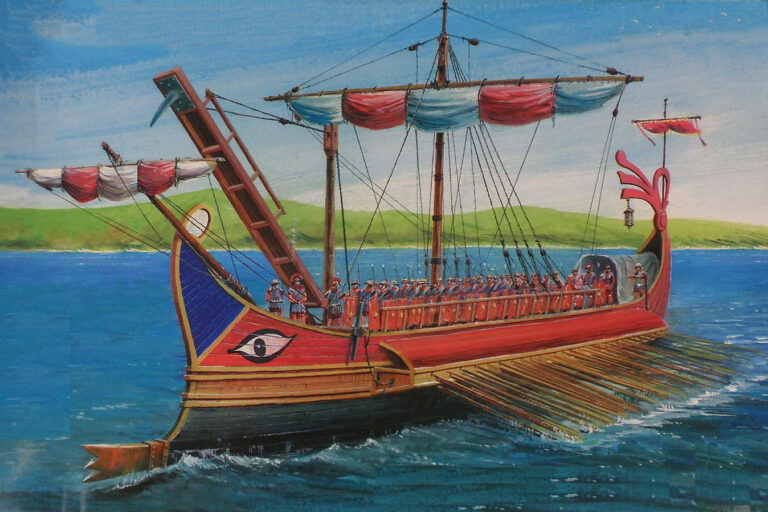
Quadrireme (Quadriremis)
The quadrireme represented a structural and tactical evolution beyond the trireme. Contrary to literal interpretation, the name does not necessarily indicate four vertical tiers of oars but rather a four-man rowing configuration per vertical section, increasing propulsion power without dramatically increasing height. This development allowed for a broader and more stable hull, enhancing durability in sustained engagements.
Compared to the trireme, the quadrireme carried more marines and missile troops, reflecting Rome’s gradual shift toward boarding combat and infantry-style engagements at sea. The wider deck space provided greater tactical flexibility, allowing archers and javelin throwers to soften enemy vessels before close contact. Its reinforced structure improved survivability during collisions, whether ramming or absorbing impact from opposing ships.
Quadriremes occupied a middle position within the Roman fleet hierarchy. They were powerful enough for large-scale confrontations yet maneuverable enough for operational versatility. In expanding Mediterranean theaters, this balance made them highly practical. They supported both offensive campaigns and maritime security operations.
The quadrireme reflects Rome’s incremental naval innovation. Rather than revolutionary redesign, Roman engineers improved upon existing models to enhance propulsion, stability, and combat effectiveness. This measured adaptation ensured that naval forces evolved alongside strategic demands while maintaining operational reliability.
Key Ideas
Four-man rowing configuration
Broader, more stable hull
Supported boarding and missile combat
Balanced strength and maneuverability
Demonstrated incremental naval innovation
Quinquereme (Quinqueremis)
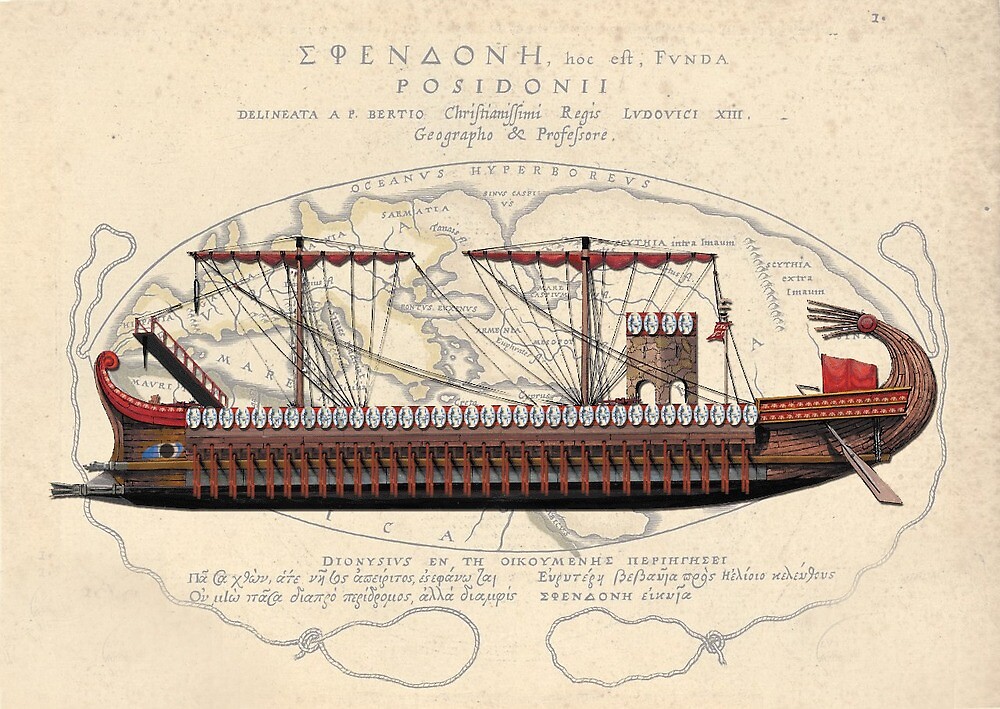
The quinquereme was the principal heavy warship of the Roman Republic and formed the operational core of fleet warfare during Rome’s major maritime conflicts. Its name refers not to five vertical tiers of oars, but to a five-man rowing configuration arranged across multiple levels, which significantly increased propulsion power without excessively raising the ship’s profile. A standard quinquereme carried approximately 300 rowers, supported by sailors, officers, and typically more than 100 marines. This large complement allowed it to combine speed, striking force, and sustained combat capability in a single platform.
Structurally, the quinquereme possessed a reinforced hull and a powerful bronze rostrum (ram) designed to punch through enemy ships at the waterline. However, Rome’s most significant innovation associated with this vessel was the corvus boarding bridge. The corvus was a rotating gangplank fitted with a heavy spike that could be dropped onto an opposing deck, locking the ships together. This device transformed naval combat into close-quarters infantry fighting, where Roman legionaries held a decisive advantage due to discipline and training.
The quinquereme’s size provided deck space for missile troops and heavy infantry, allowing layered offensive tactics: missile exchange, ramming, and boarding. It became the backbone of Roman fleet formations, operating in coordinated squadrons to maximize impact. Although costly and manpower-intensive, its battlefield dominance justified large-scale production. The quinquereme symbolizes Rome’s transition from inexperienced maritime power to a state capable of engineering systematic naval supremacy through adaptation and disciplined organization.
Key Ideas
Five-man rowing configuration
Reinforced hull with bronze rostrum
Integrated the corvus boarding bridge
Large marine complement for infantry combat
Backbone of Roman fleet warfare
Hexareme (Hexaremis)
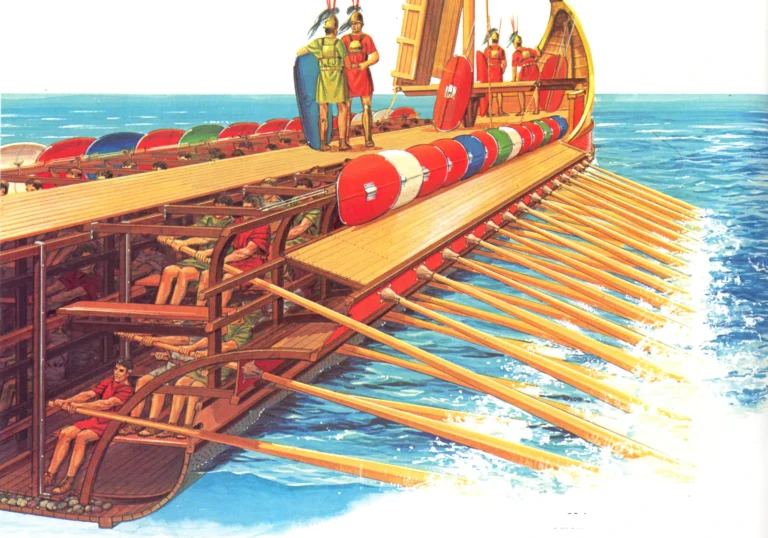
The hexareme represented a further escalation in naval scale and structural strength beyond the quinquereme. Designed with a more complex rowing arrangement and expanded hull dimensions, it carried greater numbers of rowers and marines, increasing both propulsion strength and offensive capacity. While the precise internal configuration varied, the essential principle was amplification: more power, more deck space, and greater battlefield presence.
Hexaremes were often deployed as flagships, serving as command centers within fleet formations. Their elevated deck structures provided superior visibility, enabling admirals to oversee maneuvers and relay signals across squadrons. In large confrontations, command and coordination were decisive; thus, the hexareme’s structural height and size offered practical as well as symbolic advantages.
Though heavier and less maneuverable than smaller ships, hexaremes compensated with durability and intimidation. Their reinforced hulls allowed them to absorb impact during ramming exchanges, and their expanded decks accommodated missile troops and boarding forces. In coordinated formations, they functioned as central pillars around which lighter vessels maneuvered.
The hexareme reflects Rome’s recognition that naval warfare required not only mobility but also command infrastructure and visible dominance. While not produced in the same numbers as quinqueremes, these ships projected authority and reinforced the perception of Roman maritime superiority during critical confrontations.
Key Ideas
Larger and more powerful than quinqueremes
Frequently used as flagships
Elevated deck for improved command visibility
Increased marine and missile capacity
Combined durability with symbolic dominance
Deceres (Ten-Banked Ships)
The deceres were the largest and most imposing category of Roman warship, representing the extreme end of polyreme development. The designation implies a complex multi-row rowing configuration requiring enormous manpower. These vessels demanded extraordinary coordination among rowers and sailors, as propulsion systems were layered and mechanically intricate. Their construction required substantial financial investment and access to significant timber and labor resources, limiting their production to rare and strategic circumstances.
In physical scale, the deceres dwarfed standard battle ships. Their expansive decks accommodated large contingents of marines, archers, and command personnel, effectively turning them into floating fortresses. The reinforced hull structure was built to endure heavy ramming exchanges and prolonged engagement. Their size alone projected intimidation, often influencing morale before combat began.
Despite their formidable presence, deceres were not practical for routine naval patrol or widespread deployment. They required vast crews and logistical support, making them suitable only for decisive confrontations where overwhelming force justified the cost. In fleet formations, they served as central power platforms, anchoring battle lines and projecting authority.
The deceres represent the culmination of ancient naval ambition: maximum size, maximum manpower, and maximum force projection. They symbolize the peak of Roman maritime engineering and the strategic principle that in certain contexts, sheer scale itself becomes a weapon.
Key Ideas
Largest Roman warships constructed
Complex multi-row propulsion system
Extremely high manpower and resource demand
Functioned as floating fortresses
Represented the pinnacle of Roman naval engineering