Construction and Engineering of the Colosseum
The Colosseum, originally known as the Amphitheatrum Flavium, represents one of the most advanced architectural achievements of the Roman Empire. Construction began in 72 CE under Emperor Vespasian and was completed in 80 CE under his son Titus, with further modifications carried out during the reign of Domitian. The project formed part of the Flavian dynasty’s political strategy, as it replaced the private lake of Nero’s Domus Aurea with a massive public entertainment complex. By transforming land once reserved for imperial luxury into a public monument, the Flavians reinforced their legitimacy and restored public trust after the instability of the previous regime.
The Colosseum was constructed primarily using travertine limestone, volcanic tuff, and Roman concrete, materials chosen for durability and structural efficiency. Approximately 100,000 cubic meters of travertine were transported from quarries in Tivoli, roughly 30 kilometers from Rome. Iron clamps were used to secure the massive stone blocks, although many of these metal connectors were removed in later centuries. The structural skeleton combined concrete vaulting systems with a rigid stone exterior, creating a building capable of supporting enormous weight while maintaining open internal corridors for movement.
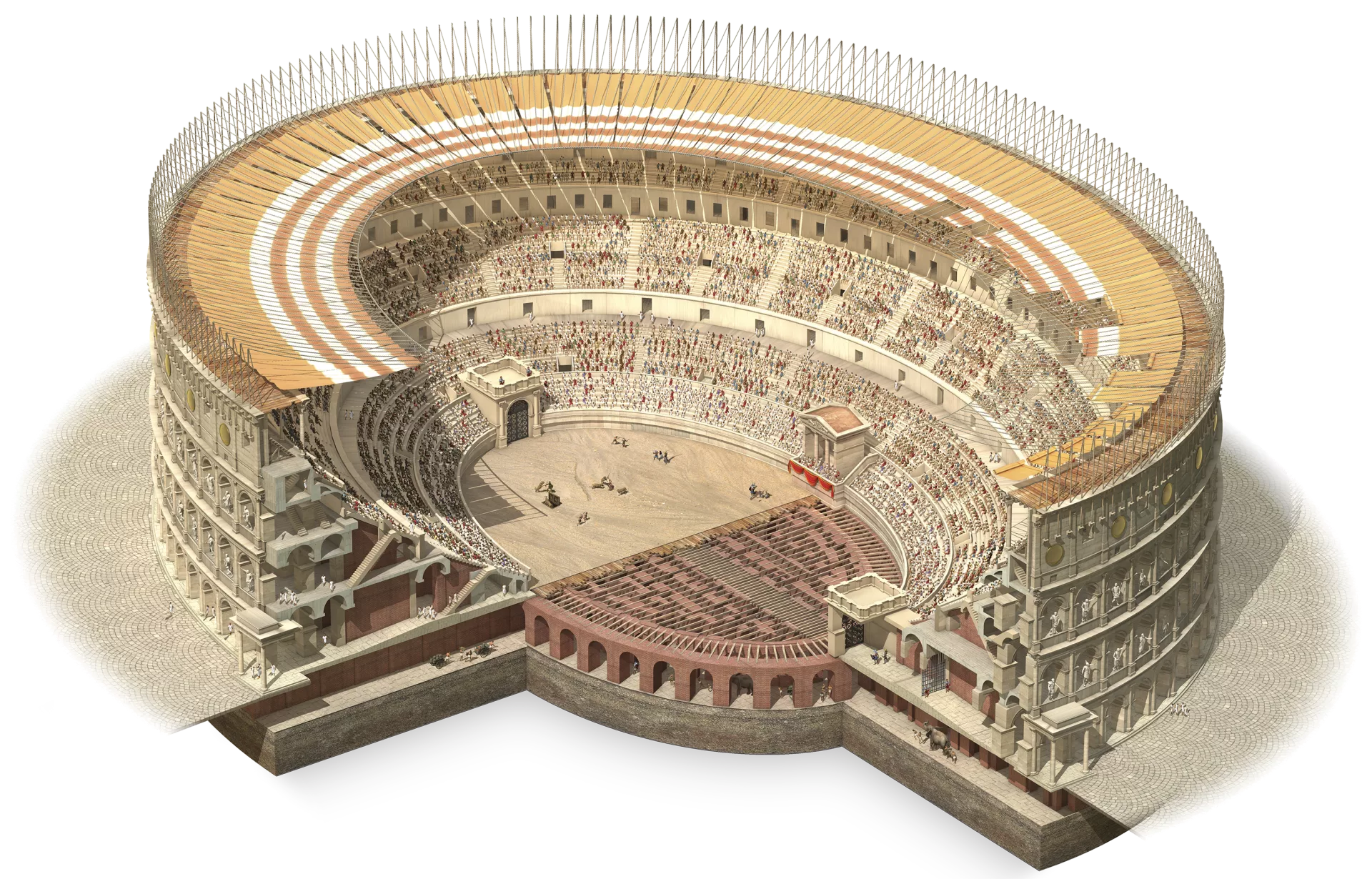
The amphitheater measured roughly 189 meters in length, 156 meters in width, and about 48 meters in height, making it the largest amphitheater ever constructed in the Roman world. The elliptical shape was deliberately chosen to maximize spectator visibility while ensuring the structural stability of the outer walls. Beneath the arena floor lay a complex network of corridors and chambers known as the hypogeum, which housed animals, gladiators, stage machinery, and lifting platforms.
Roman engineers also integrated a sophisticated system of barrel vaults and groin vaults that distributed weight across multiple arches. This allowed for the construction of a structure capable of holding an estimated 50,000–65,000 spectators. Entrances were arranged through 80 numbered arches, enabling large crowds to enter and exit rapidly. This circulation system demonstrates the Roman mastery of large-scale public infrastructure.
The Colosseum therefore stands not only as a monument to entertainment but as a clear demonstration of Roman engineering efficiency, urban planning, and architectural innovation.
Key Ideas
Constructed between 72–80 CE under the Flavian emperors
Built with travertine, tuff, and Roman concrete
Capacity of 50,000–65,000 spectators
Advanced vaulting systems for structural stability
Included the underground hypogeum machinery network
Structure, Seating System, and Social Hierarchy
The interior organization of the Colosseum reflected the strict social hierarchy of Roman society. Seating arrangements were carefully designed so that each social class occupied a designated section, reinforcing Rome’s deeply structured political and cultural order. The amphitheater therefore functioned not only as a place of entertainment but also as a physical representation of Roman social structure.
The lowest and most prestigious seats surrounded the arena and were reserved for the Roman elite. Senators occupied the podium, the front row closest to the combat area, where stone seats often carried engraved inscriptions identifying the individual who held the place. These positions provided the clearest view of the arena and symbolized the political dominance of the senatorial class. Just above them sat the equestrian order, wealthy citizens who ranked directly below the senatorial elite.
The next sections accommodated ordinary male Roman citizens. These spectators were arranged according to wealth and social status, ensuring that more prosperous citizens occupied lower levels while poorer citizens were seated further upward. This arrangement ensured that every individual’s location within the building corresponded precisely to their position within Roman society.
Women, with the exception of Vestal Virgins, were generally restricted to the highest seating tiers, farthest from the arena floor. These upper sections were constructed largely from wooden seating rather than stone, reflecting their lower prestige. The very top areas were also used by slaves, foreigners, and the urban poor, individuals who occupied the lowest levels of Roman civic status.
The architecture itself facilitated rapid movement and crowd control. The Colosseum incorporated a complex network of vomitoria, passageways that allowed thousands of spectators to enter or leave the structure within minutes. Staircases and corridors were carefully arranged so that social groups moved through separate routes, preventing disorder.
Through this seating system, the Colosseum became a powerful demonstration of Roman ideology. The audience itself formed a visible hierarchy, mirroring the political, economic, and social order of the empire.
Key Ideas
Seating reflected Roman social hierarchy
Senators and elites occupied the front podium
Citizens arranged by wealth and class
Women and lower classes seated in upper tiers
Efficient circulation through vomitoria corridors
Gladiatorial Games and Arena Spectacles
The primary function of the Colosseum was the staging of large-scale public spectacles, most famously gladiatorial combat. These events were organized by emperors or magistrates as part of the political practice known as “bread and circuses” (panem et circenses), in which entertainment and food distribution helped maintain public loyalty and social stability.
Gladiatorial games involved trained fighters who belonged to professional schools known as ludi. Gladiators came from various backgrounds, including prisoners of war, slaves, criminals, and occasionally volunteers seeking fame or financial reward. They fought in carefully structured combat styles based on specific equipment sets. Examples include the murmillo, equipped with a heavy shield and gladius, and the retiarius, who used a net and trident. These contrasting fighting styles created dramatic and strategic matchups designed to entertain large audiences.
Events in the Colosseum extended beyond gladiatorial duels. Spectacles often began with venationes, staged hunts involving exotic animals such as lions, leopards, elephants, and bears imported from across the empire. Specialized hunters known as bestiarii confronted these animals in elaborate displays of skill and bravery. Large numbers of animals were sometimes killed during these events, demonstrating both Roman dominance over nature and the vast reach of imperial trade networks.
Public executions also formed part of the arena program. Criminals condemned to death were sometimes executed through dramatic reenactments of mythological punishments or through exposure to wild animals. These executions reinforced Roman legal authority and served as public warnings.
The complexity of these spectacles relied heavily on the hypogeum, where elevators, trapdoors, and mechanical lifts allowed animals and performers to emerge suddenly into the arena. This underground machinery system created theatrical effects that astonished spectators.
Through these spectacles, the Colosseum became a center of imperial propaganda, social control, and mass entertainment, demonstrating the power and organizational capacity of the Roman state.
Key Ideas
Gladiatorial combat as the central spectacle
Fighters trained in specialized combat styles
Venationes featured exotic animal hunts
Executions used as public punishment
Hypogeum machinery enabled dramatic arena effects

The Decline, Transformation, and Legacy of the Colosseum
Despite its prominence during the height of the Roman Empire, the Colosseum gradually declined as political and cultural conditions changed. By the 4th and 5th centuries CE, the economic strain on the empire and the growing influence of Christianity led to significant changes in public entertainment. Gladiatorial combat, once a defining feature of Roman culture, became increasingly controversial and was eventually abolished in 404 CE after centuries of tradition.
Animal hunts continued for some time, but the scale and frequency of spectacles declined sharply. Maintaining the enormous structure required significant financial resources, and as imperial authority weakened in the Western Roman Empire, large-scale public games became increasingly rare. Natural disasters also contributed to the amphitheater’s deterioration. Earthquakes in the 5th and 14th centuries caused sections of the outer walls to collapse, exposing the internal framework of arches and corridors.
During the medieval period, the Colosseum was repurposed for a variety of practical uses. Portions of the structure were converted into fortified residences, workshops, and even small chapels. Large quantities of stone were removed and reused in the construction of other buildings throughout Rome, including churches and palaces. This process of spolia, or reuse of building materials, significantly altered the original appearance of the monument.
Despite these losses, the Colosseum remained a powerful symbol of Rome’s historical legacy. By the 18th century, preservation efforts began to protect the remaining structure, and the site was recognized as an important historical monument. Modern restoration work has stabilized the building and allowed visitors to explore both the arena and sections of the hypogeum.
Today, the Colosseum stands as one of the most recognizable monuments of the ancient world. It represents not only the architectural genius of Roman engineers but also the cultural, political, and social forces that shaped Roman civilization. Its enduring presence illustrates the lasting impact of Roman urban design and monumental architecture.
Key Ideas
Gladiatorial games ended in 404 CE
Decline due to economic and cultural changes
Earthquakes damaged major sections
Stones reused through spolia construction
Remains a global symbol of Roman civilization