1. Why the Colosseum Was Built: Power, Politics, and Public Control
The construction of the Colosseum was not simply an architectural project—it was a carefully calculated political move designed to reshape Rome after a period of instability and excess. To understand why it was built, you have to look at the events that came before it, particularly the rule of Nero and the chaotic period that followed his death. The Colosseum was, in many ways, a response to both tyranny and civil war—a symbol of renewal, control, and imperial authority.
Before the Colosseum existed, the land it occupies was part of Nero’s enormous palace complex, the Domus Aurea (Golden House). This palace included artificial lakes, gardens, and luxurious buildings that were meant for the emperor’s private enjoyment. While it demonstrated Nero’s wealth and power, it also created resentment among the Roman people. Large sections of the city had been taken over for personal use, especially after the Great Fire of Rome in 64 CE, which many Romans blamed on Nero himself. The emperor appeared to be prioritizing personal luxury over public welfare, damaging his reputation.
When Nero died in 68 CE, Rome entered a period of civil war known as the Year of the Four Emperors. This instability eventually led to the rise of Vespasian, the founder of the Flavian dynasty. Vespasian understood that in order to secure his rule, he needed more than military victory—he needed public support and legitimacy. One of his most effective strategies was to reverse Nero’s legacy.
Instead of keeping the land for himself, Vespasian chose to give it back to the people. He ordered the draining of Nero’s artificial lake and began construction of a massive public amphitheater—the Colosseum. This decision carried powerful symbolism. It showed that the new emperor was restoring Rome to its citizens, replacing private luxury with public entertainment. The message was clear: the era of selfish rulers was over, and a new, more responsible leadership had begun.
The Colosseum was therefore not just a building—it was a political statement carved in stone. It demonstrated the power of the Flavian dynasty while also presenting that power as beneficial to the public. By funding and constructing such a massive structure, Vespasian showed that he had both the resources and the authority to lead Rome effectively. At the same time, he used the Colosseum to strengthen his connection with the population.
Entertainment played a crucial role in this strategy. Roman leaders understood that providing spectacles—games, fights, and public events—was an effective way to maintain social stability. This concept is often summarized as “bread and circuses”, meaning that as long as the population was fed and entertained, it would be less likely to rebel. The Colosseum became the center of this system, hosting events that could attract tens of thousands of spectators.
By offering free or heavily subsidized entertainment, emperors could win loyalty and distract the population from political tensions or economic problems. The Colosseum allowed rulers to control not just what people saw, but how they felt. Victories in the arena, displays of power, and dramatic spectacles reinforced the idea that Rome—and its emperor—was strong and unstoppable.
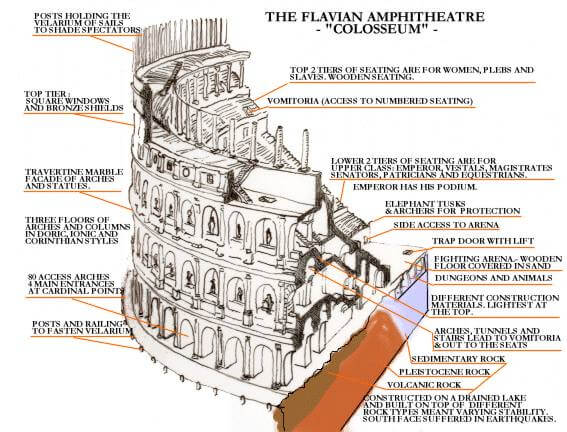
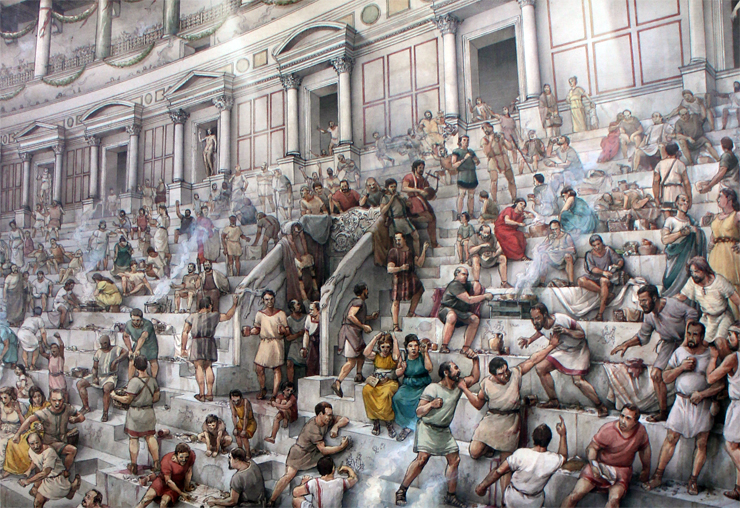
Another important aspect of the Colosseum’s purpose was social organization. The structure itself reflected Roman society. Seating was arranged according to social class, with the emperor and elite in the best positions and lower classes seated further away. This physical arrangement reinforced the hierarchy of Roman society every time an event took place. People were constantly reminded of their place within the system, helping to maintain order and structure.
The Colosseum also served as a stage for imperial propaganda. Events held there often celebrated military victories, honored the gods, or demonstrated Roman dominance over nature and enemies. Exotic animals from distant lands, captured prisoners, and skilled gladiators all contributed to a narrative of Roman superiority. The arena became a place where the empire’s power was not just seen, but experienced by the population.
It is also important to note that the construction of the Colosseum was made possible by Rome’s vast resources. Much of the funding came from spoils of war, particularly from campaigns in Judea. This meant that the building itself was a product of Roman conquest. Every stone represented not just engineering skill, but also the empire’s ability to extract wealth from its territories.
In conclusion, the Colosseum was built for far more than entertainment. It was a symbol of political change, a tool of social control, and a demonstration of imperial power. Under Vespasian, it transformed land once used for personal luxury into a space for public spectacle, reinforcing the idea that the emperor served the people—while also ensuring their loyalty. The Colosseum was not just an arena; it was a carefully designed instrument of control that helped shape Roman society and maintain the stability of the empire.
Key Ideas
- Built to replace Nero’s private palace with a public monument
- Commissioned by Vespasian to gain legitimacy
- Symbolized return of power to the people
- Used as tool for “bread and circuses” strategy
- Helped maintain social stability and control
- Seating reflected Roman social hierarchy
- Hosted events that promoted Roman dominance and propaganda
- Funded by spoils of war and imperial wealth
- Reinforced emperor’s image as provider and leader
- Served as both entertainment center and political instrument
2. The Construction of the Colosseum: Engineering a Monument of Stone and Steel
The construction of the Colosseum stands as one of the greatest engineering achievements of the ancient world. Built in the heart of Rome during the rule of Vespasian and completed under his son Titus, the Colosseum was not only massive in scale but also incredibly advanced in design. It represented the peak of Roman engineering, combining architecture, organization, and innovation into a structure that could hold tens of thousands of spectators and host complex events.
The project began around 70–72 CE, shortly after Vespasian came to power. As mentioned earlier, the chosen location had deep political significance—it was built on the site of Nero’s former lake, part of his luxurious Domus Aurea. Transforming this space into a public arena required enormous effort. The lake had to be drained, the ground stabilized, and the foundations carefully laid to support the weight of the massive structure. This alone was a major engineering challenge, but Roman builders approached it with precision and experience.
The Colosseum was constructed primarily from travertine stone, volcanic rock (tuff), and concrete, materials that were both durable and relatively accessible. Travertine, a type of limestone, was used for the outer walls and structural supports, giving the building its strength and iconic appearance. Roman concrete, one of the empire’s most important innovations, allowed builders to create strong internal structures and complex shapes that would have been difficult with stone alone.
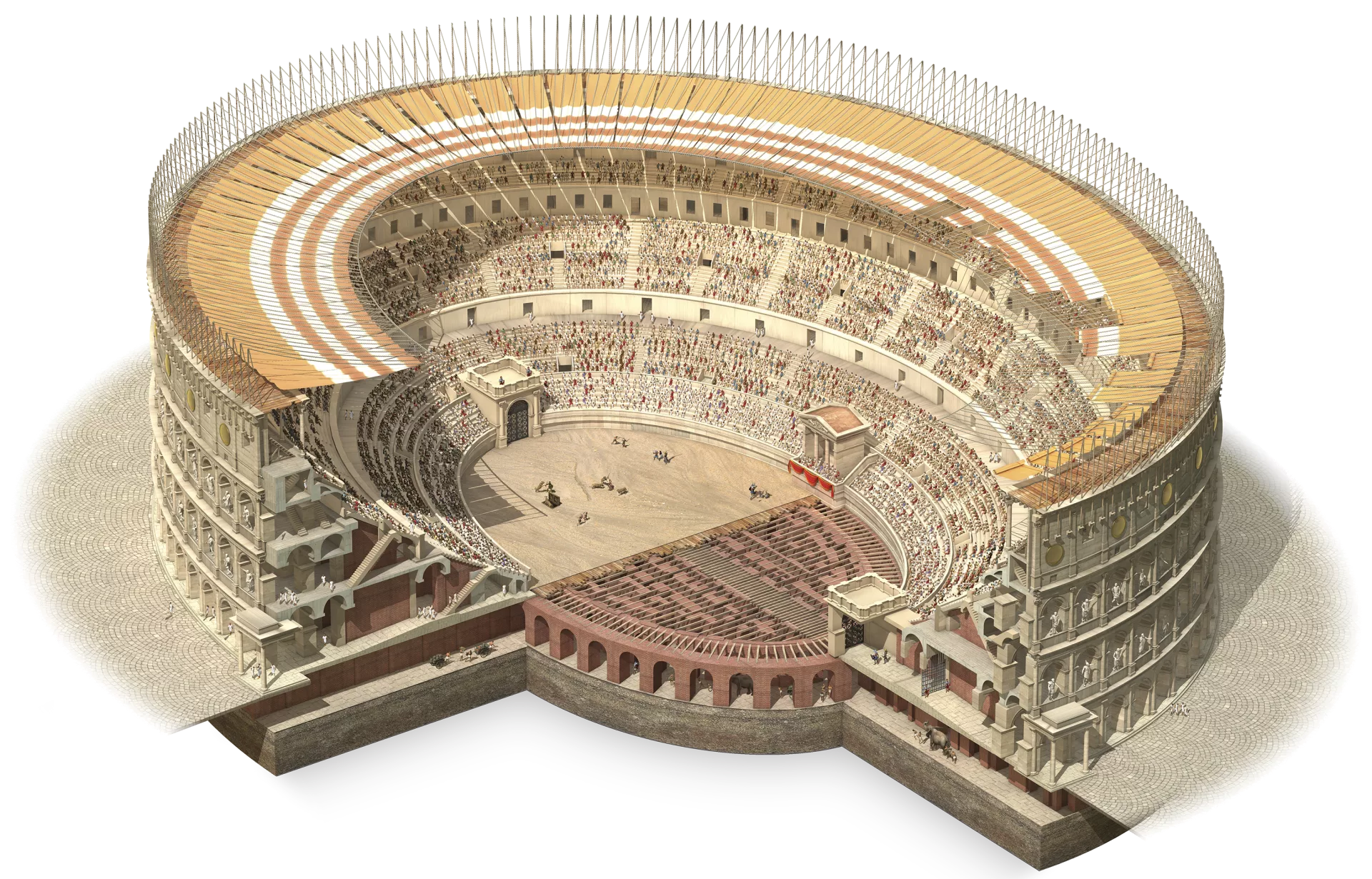
One of the most impressive aspects of the Colosseum was its elliptical design. Unlike earlier amphitheaters, which were often built into hillsides for support, the Colosseum was a completely freestanding structure. This meant that its stability depended entirely on its internal framework. The elliptical shape was not just aesthetic—it allowed for better visibility from all seating areas and helped distribute the weight of the building evenly.
The structure stood approximately 48 meters tall and could hold an estimated 50,000 to 65,000 spectators. To support such a massive crowd, Roman engineers developed a highly organized system of arches and vaults. These arches were crucial, as they distributed weight efficiently and allowed for large open spaces within the structure. This system made the Colosseum both strong and flexible, capable of withstanding heavy use over time.
Another remarkable feature was the network of corridors, staircases, and entrances. The Colosseum had around 80 entrances, allowing spectators to enter and exit quickly and efficiently. This design ensured that large crowds could be managed without chaos. The Romans even numbered entrances and seating sections, making it easier for people to find their assigned places. This level of organization was far ahead of its time and is still reflected in modern stadium design today.
Beneath the arena floor was the hypogeum, an underground complex of tunnels, chambers, and mechanical systems. This area was used to house animals, gladiators, and stage equipment before they were brought into the arena. The hypogeum included elevators, trapdoors, and pulleys that allowed for dramatic entrances and sudden appearances during events. This system turned the arena into a dynamic stage, where surprises could be carefully controlled and executed.
The construction of the Colosseum also required a massive workforce. Thousands of laborers, engineers, architects, and craftsmen were involved in the project. Many of these workers were slaves or prisoners of war, particularly from regions conquered by Rome. This highlights another aspect of the Colosseum’s construction: it was not just an engineering achievement, but also a product of Roman imperial power and resources.
Transporting materials to the site was another logistical challenge. Large blocks of travertine were quarried from areas outside Rome and transported using carts and possibly river systems. The coordination required to manage these resources, along with the workforce, demonstrates the organizational strength of the Roman state.
The Colosseum was completed relatively quickly, with its main structure finished in less than a decade—a remarkable achievement for a project of this size. It was officially inaugurated in 80 CE by Titus with a series of grand games that lasted for 100 days. These events showcased not only the entertainment value of the arena but also the success of its construction.
One often overlooked feature of the Colosseum is the velarium, a large retractable awning that covered parts of the seating area. This system protected spectators from the sun and demonstrated the Romans’ attention to comfort and practicality. Operating the velarium required skilled sailors, who managed the ropes and rigging needed to extend and retract the massive fabric covering.
In conclusion, the construction of the Colosseum was a masterpiece of ancient engineering. It combined innovative materials, advanced design, and precise organization to create a structure that could handle massive crowds and complex events. Built under Vespasian and completed by Titus, the Colosseum was more than just a building—it was a demonstration of Rome’s technical skill, logistical power, and ability to turn vision into reality. Its influence can still be seen in modern stadiums, making it one of the most enduring achievements of the ancient world.
Key Ideas
- Built under Vespasian and completed by Titus
- Constructed using travertine, tuff, and Roman concrete
- Elliptical design improved visibility and structural balance
- Could hold 50,000–65,000 spectators
- Used advanced arches and vault systems
- Included 80 entrances for efficient crowd movement
- Hypogeum allowed complex staging and surprises
- Built by massive workforce, including slaves
- Materials transported with high logistical organization
- Featured velarium for spectator comfort
3. The Grand Opening Games: Spectacle on an Unprecedented Scale
When the Colosseum was finally completed, it needed an opening that matched its size, power, and purpose. This was not going to be a simple celebration—it was designed to be a massive display of Roman strength, wealth, and entertainment. In 80 CE, the emperor Titus inaugurated the Colosseum with games so extraordinary that they would become legendary. These opening celebrations lasted for around 100 days, making them one of the longest and most extravagant public spectacles in Roman history.
The purpose of these games went far beyond entertainment. They were a carefully planned demonstration of imperial generosity and authority. By organizing such a grand event, Titus aimed to strengthen his connection with the Roman people, reinforce the legitimacy of the Flavian dynasty, and show that Rome had fully recovered from earlier instability. The games sent a clear message: the empire was strong, united, and capable of providing unmatched spectacle.
The scale of the opening games was enormous. Ancient sources describe the killing of thousands of animals, the participation of countless gladiators, and a wide variety of events designed to keep the audience engaged. These included gladiatorial combats, wild animal hunts (venationes), staged executions, and possibly even naval-style displays. Every event was designed to impress, shock, and entertain the crowd.
One of the most striking features of the opening games was the use of exotic animals. Creatures from across the Roman Empire were brought to Rome, including lions, elephants, bears, leopards, and even more unusual species from Africa and the East. These animals were displayed, hunted, and often killed in front of the audience. This served multiple purposes. It entertained the crowd, but it also demonstrated the vast reach of the Roman Empire. The presence of animals from distant lands symbolized Rome’s control over nature and foreign territories.
Gladiatorial combat was another central part of the spectacle. Trained fighters entered the arena to battle each other in contests that combined skill, endurance, and brutality. These matches were carefully organized, often pairing different types of gladiators with distinct weapons and fighting styles. The goal was to create dramatic and balanced fights that would captivate the audience. While the violence was real, the structure of the combat was designed to maximize excitement and engagement.
Executions also played a role in the opening games, reflecting the Roman practice of using public punishment as a form of entertainment. Criminals and prisoners were sometimes forced to fight animals or participate in staged scenarios that ended in their deaths. These events reinforced the power of the state, showing what happened to those who defied Roman law. At the same time, they added another layer of spectacle to the games.
There is also some evidence—though debated by historians—that the Colosseum may have hosted mock naval battles (naumachiae) during its early use. This would have required flooding the arena, a technically complex task. Whether or not full naval battles took place, the idea itself reflects the ambition of the opening games. The goal was to push the limits of what was possible in entertainment, turning the Colosseum into a stage for unprecedented performances.
The organization behind these games was just as impressive as the events themselves. Coordinating hundreds of participants, thousands of animals, and massive crowds required careful planning and logistical precision. The hypogeum, with its tunnels and mechanisms, allowed for dramatic entrances and quick changes between events. Trapdoors could release animals suddenly into the arena, while elevators could lift gladiators into view. This created an element of surprise that kept the audience constantly engaged.
For the spectators, the experience was overwhelming. The Colosseum’s design ensured that everyone had a clear view of the action, while the scale of the events created a sense of awe. The crowd was not just watching—they were participating emotionally, reacting to victories, defeats, and dramatic moments. The games created a shared experience that united people from different social classes, even if they were seated separately according to status.
Importantly, these games were often free to attend, funded by the emperor. This reinforced the idea that the ruler was a provider, offering both entertainment and generosity to the population. It also ensured large crowds, maximizing the impact of the spectacle. The more people who attended, the stronger the political message became.
In conclusion, the grand opening games of the Colosseum were a defining moment in Roman history. Organized by Titus, they showcased the full potential of the arena and set the standard for future events. Through massive scale, diverse spectacles, and careful organization, these games demonstrated the power of Rome and the role of entertainment in maintaining social and political stability. They were not just celebrations—they were a statement of what Rome was capable of achieving.
Key Ideas
- Opening games held in 80 CE under Titus
- Lasted around 100 days
- Designed to show Roman power and imperial generosity
- Included gladiator fights, animal hunts, and executions
- Exotic animals symbolized empire’s global reach
- Possible use of mock naval battles
- Hypogeum enabled complex staging and surprises
- Required massive organization and logistics
- Free entry reinforced emperor’s popularity
- Created a shared experience across Roman society
4. Gladiators in the Arena: Life, Training, and Combat
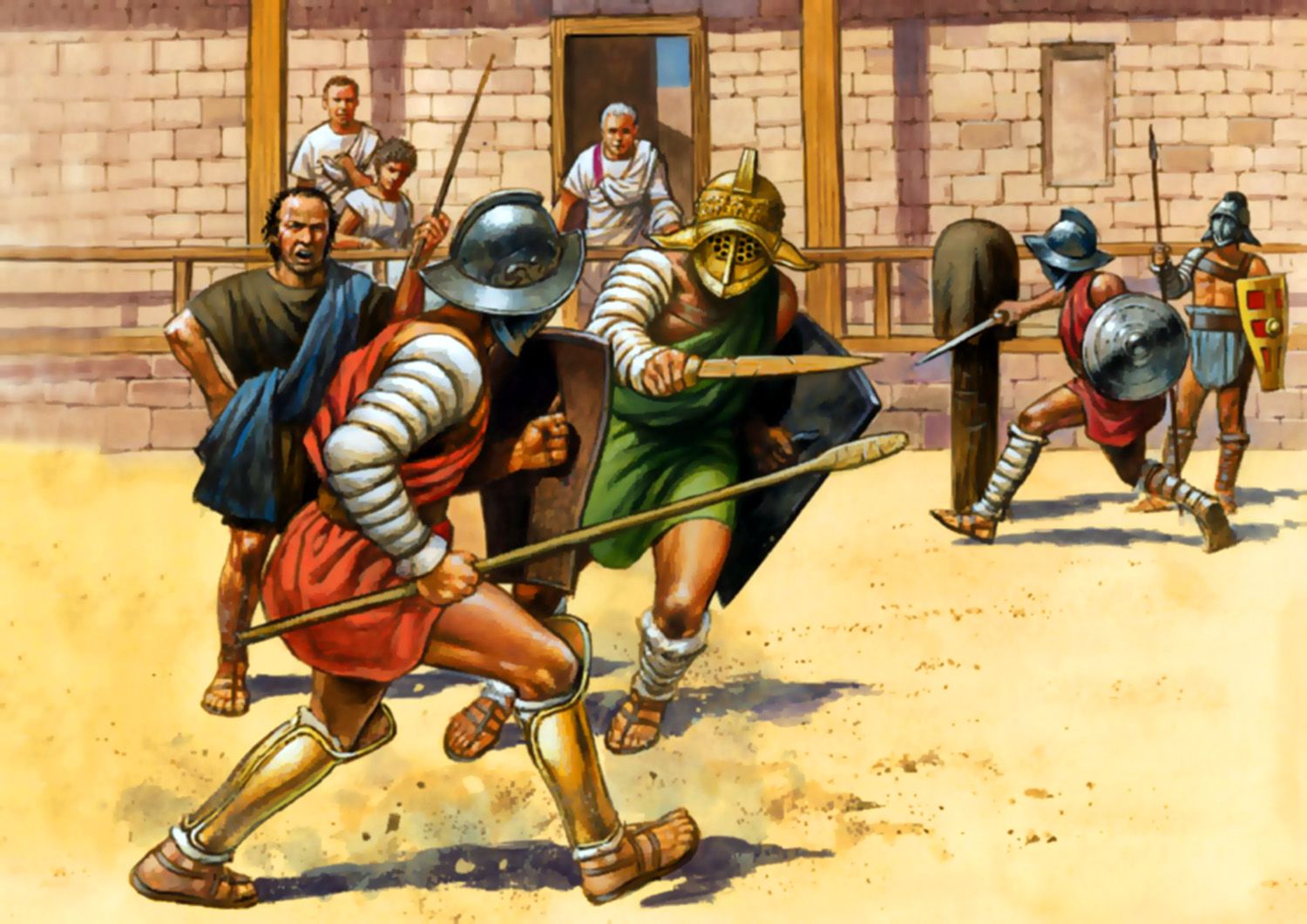
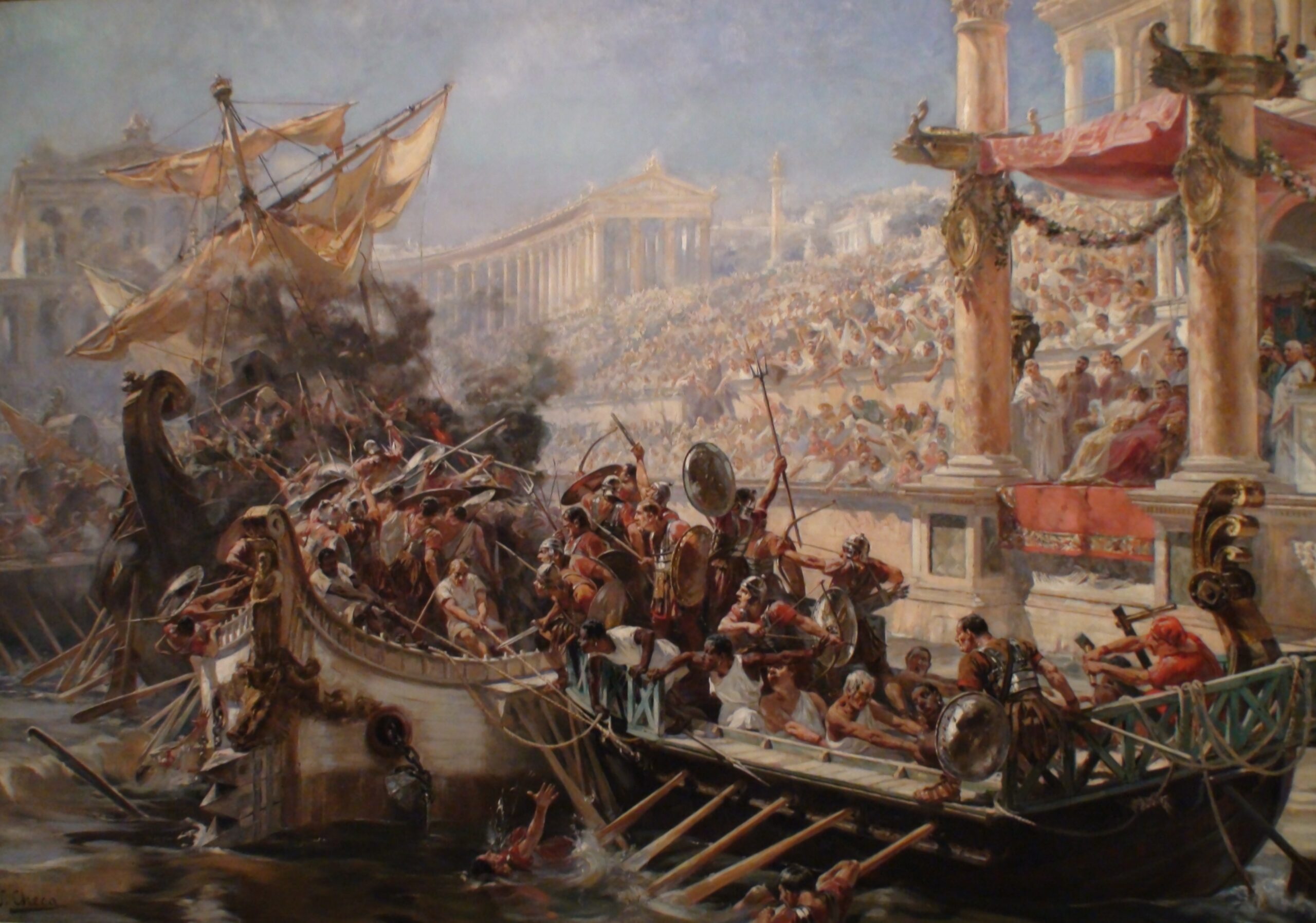
When people think of the Colosseum, the first image that comes to mind is often the clash of gladiators in brutal combat. These fighters were the centerpiece of Roman entertainment, embodying courage, skill, and raw violence. However, behind the dramatic battles in the arena was a complex system of training, discipline, and social structure that shaped the lives of gladiators long before they ever stepped into the spotlight.
Gladiators were not all the same. They came from different backgrounds, including slaves, prisoners of war, criminals, and even volunteers. While many were forced into this life, some free men chose to become gladiators, often driven by the promise of fame, money, or a chance to escape debt. Regardless of their origin, once they entered the gladiatorial system, they became part of a highly controlled and organized profession.
Training was a critical part of a gladiator’s life. They were sent to special schools known as ludi, where they were trained under the supervision of experienced instructors. These schools were run by managers called lanistae, who were responsible for preparing gladiators for combat and ensuring they were physically and mentally ready. Training was intense and focused on discipline, endurance, and mastery of specific fighting styles. Gladiators practiced with wooden weapons before using real ones, allowing them to develop technique without constant risk of injury.
Different types of gladiators were trained to fight in specific ways, creating variety and balance in combat. For example, some gladiators were heavily armored, using large shields and short swords, while others were lightly equipped, relying on speed and agility. Matchmakers carefully paired opponents to create exciting and competitive battles. The goal was not just to fight, but to entertain the audience with dramatic and unpredictable encounters.
Life inside the gladiator schools was strict but not necessarily miserable. Gladiators were valuable investments, and their owners wanted to keep them in good condition. They were provided with food, medical care, and training facilities. In fact, their diet was carefully managed, often consisting of grains and legumes to build strength and endurance. This level of care highlights an important reality: gladiators were both fighters and assets, and their survival was often economically important.
When it came time to fight in the arena, the experience was intense and highly structured. Before entering the Colosseum, gladiators would prepare themselves mentally and physically. They understood that every fight carried the risk of injury or death, but they also knew that success could bring fame, rewards, and even freedom. Some gladiators became celebrities, admired by the public and remembered for their victories.
The combat itself was not always a chaotic free-for-all. Fights were organized and overseen by officials who ensured that rules were followed. While the violence was real, it was also controlled to maintain a balance between danger and entertainment. The crowd played a significant role in the outcome of a fight. Spectators reacted to the action, cheering for their favorites and influencing decisions made by the event organizers or even the emperor.
One of the most famous aspects of gladiatorial combat is the idea that the crowd could decide the fate of a defeated fighter. While this is often simplified in modern portrayals, it is true that public opinion could influence whether a gladiator was spared or killed. Victorious fighters could be rewarded with prizes, money, and recognition, while those who performed poorly faced harsher consequences.
Despite the danger, not all fights ended in death. In fact, many gladiators survived multiple matches, building reputations and gaining experience over time. This was partly because training a gladiator was expensive, and it made little sense to waste that investment unnecessarily. Instead, the focus was on creating sustained entertainment through ongoing rivalries and repeated performances.
The role of gladiators extended beyond the arena. They became symbols of Roman values such as bravery, resilience, and discipline. Their fights were seen as demonstrations of what it meant to face danger with courage. At the same time, they also reflected the darker aspects of Roman society, where violence and spectacle were used as forms of public entertainment.
In conclusion, gladiators were far more than simple fighters—they were trained professionals, performers, and symbols of Roman culture. Their lives were shaped by strict discipline, intense preparation, and the constant presence of danger. In the Colosseum, they provided the drama and excitement that defined Roman entertainment, while also serving as a powerful reminder of the empire’s values and contradictions.
Key Ideas
- Gladiators came from slaves, prisoners, and volunteers
- Trained in special schools (ludi) under strict discipline
- Different types created variety in combat styles
- Provided with food and medical care as valuable assets
- Fights were organized for maximum entertainment
- Crowd reactions influenced outcomes
- Not all fights ended in death
- Successful gladiators could gain fame and rewards
- Represented Roman values of courage and strength
- Central attraction of the

5. Wild Beasts and Exotic Hunts: The Venationes Explained
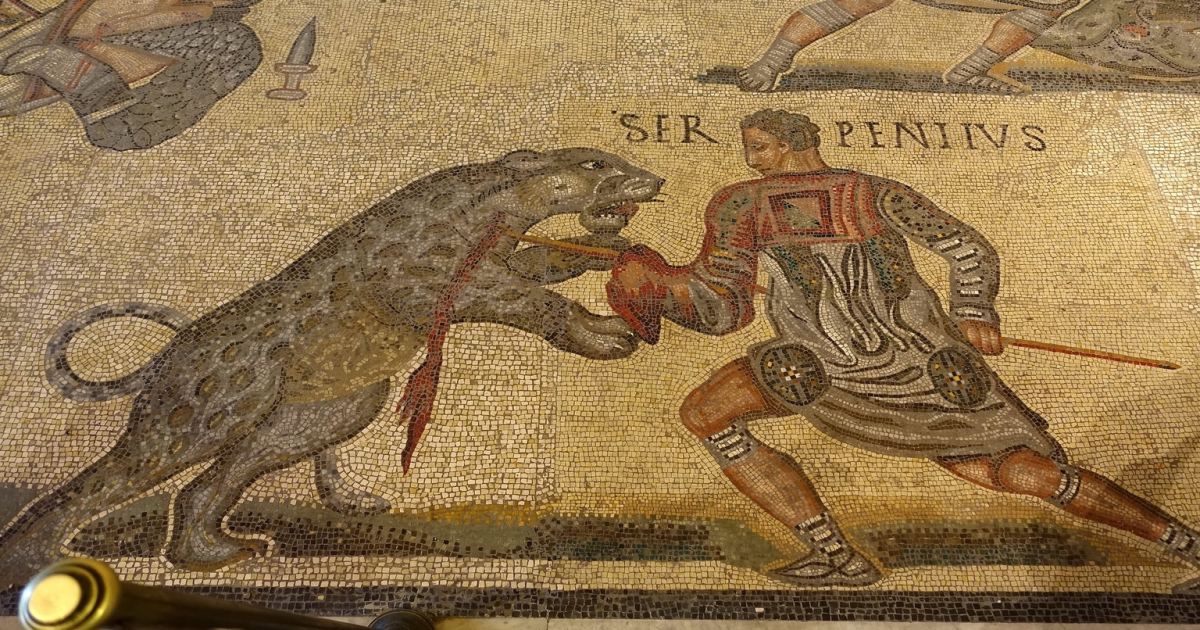
While gladiator fights were the most famous spectacles of the Colosseum, they were only one part of the entertainment. Another major attraction was the venationes, or wild beast hunts. These events showcased the killing, capturing, and display of exotic animals from across the Roman Empire. To the Roman audience, these hunts were not just entertainment—they were a powerful demonstration of Rome’s dominance over nature and the wider world.
The venationes typically took place in the morning, before the gladiatorial combats of the afternoon. This structure allowed for a full day of entertainment, with different types of spectacles keeping the audience engaged. During these hunts, trained fighters known as venatores or bestiarii would enter the arena to confront animals in carefully staged encounters. Unlike gladiators, whose fights followed structured rules and pairings, venationes were often more unpredictable, emphasizing danger, spectacle, and surprise.
One of the most striking aspects of the venationes was the variety of animals involved. The Romans imported creatures from all corners of their empire and beyond. Lions, leopards, bears, elephants, rhinoceroses, crocodiles, and even giraffes were brought to Rome for these events. For many spectators, this was their first and only chance to see such animals. The arena became a place where the empire’s vast reach was put on display, reinforcing the idea that Rome controlled lands far beyond its borders.
Capturing and transporting these animals was an enormous undertaking. Hunters and trappers had to capture them alive, often at great risk. Once captured, the animals were transported over long distances by land and sea, requiring careful planning and logistical coordination. Many animals did not survive the journey, which made those that reached Rome even more valuable. This process highlights the immense resources and organization required to sustain the venationes.
Inside the Colosseum, the presentation of these animals was highly theatrical. The hypogeum—the underground system of tunnels and chambers—played a key role. Animals could be kept hidden below the arena and then suddenly released through trapdoors, creating moments of surprise and excitement. This element of unpredictability kept the audience engaged and added to the dramatic tension of the events.
The hunts themselves varied in style. Some were straightforward confrontations between humans and animals, where venatores used spears, bows, or other weapons to kill their opponents. Others were more elaborate, involving staged scenarios that mimicked hunting scenes from different parts of the empire. In some cases, animals were set against each other, creating chaotic and violent spectacles that emphasized the raw power of nature.
However, the venationes were not just about entertainment—they also carried symbolic meaning. By displaying and killing exotic animals, the Romans reinforced their belief in their own superiority. The arena became a microcosm of the empire, where distant lands and their wildlife were brought under Roman control. Each hunt was a reminder that Rome had the power to dominate not only people, but also the natural world.
There was also a darker aspect to these events. The sheer number of animals killed in the Colosseum was staggering. Ancient sources suggest that thousands of animals could be slaughtered during major games. Over time, this had a significant impact on wildlife populations in certain regions. While the Romans likely did not consider environmental consequences, the venationes represent one of the earliest examples of large-scale exploitation of wildlife for entertainment.
The role of the venatores themselves is also worth noting. These fighters were skilled professionals, trained to handle dangerous animals. Unlike gladiators, who fought other humans, venatores faced unpredictable and often uncontrollable opponents. This required quick reflexes, courage, and specialized techniques. Despite their skill, the risks were enormous, and injuries or death were common.
For the audience, the venationes offered a different kind of excitement compared to gladiatorial combat. While gladiator fights were about skill, strategy, and rivalry, the hunts focused on chaos, danger, and spectacle. The unpredictability of animals made each event unique, ensuring that no two performances were exactly the same.
In conclusion, the venationes were a central part of the entertainment in the Colosseum, combining violence, spectacle, and symbolism. They showcased the vast reach of the Roman Empire, the skill of its performers, and its ability to control even the wildest elements of nature. At the same time, they reveal a darker side of Roman culture, where the destruction of life—both human and animal—was transformed into public entertainment.
Key Ideas
- Venationes were wild animal hunts held in the Colosseum
- Featured exotic animals from across the empire
- Demonstrated Rome’s power over nature and territories
- Required complex capture and transport logistics
- Hypogeum enabled dramatic animal releases
- Included human vs animal and animal vs animal fights
- Venatores were trained specialists
- Events emphasized danger and unpredictability
- Large numbers of animals killed
- Combined entertainment with imperial propaganda
6. Executions and Public Punishment: Justice as Entertainment
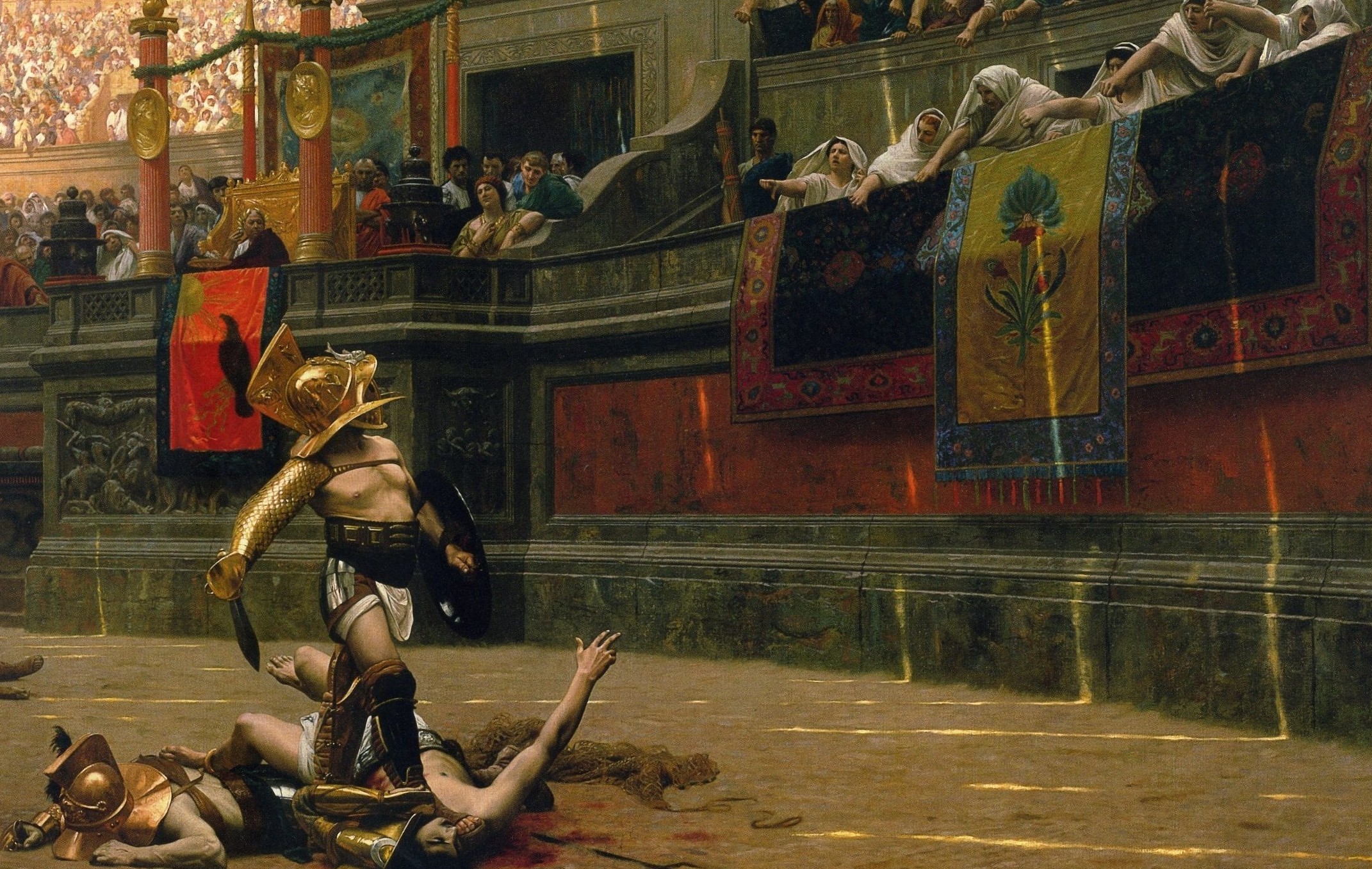
Among the many spectacles held in the Colosseum, one of the darkest and most revealing aspects of Roman society was the use of executions as public entertainment. While gladiator fights and animal hunts were designed to thrill and amaze, executions served a different purpose: they were meant to demonstrate the power of the state, enforce social order, and send a clear warning to anyone who challenged Roman authority. In the Colosseum, justice was not hidden—it was displayed openly, dramatically, and often brutally.
These executions usually took place around midday, between the morning venationes (animal hunts) and the afternoon gladiatorial games. This timing created a continuous flow of entertainment throughout the day, but it also reflected a hierarchy of spectacle. Executions were seen as less prestigious than gladiator combat, yet they were still an important part of the overall experience. For the audience, they offered a combination of shock, fear, and fascination.
The people subjected to these punishments were typically criminals, prisoners of war, slaves, or individuals considered enemies of the state. Their fate was often determined not only by their crimes but also by their social status. Roman law was not applied equally to all citizens, and those at the bottom of society faced far harsher penalties. The Colosseum became a stage where these inequalities were made visible to thousands of spectators.
One of the most infamous forms of execution was damnatio ad bestias, which translates to “condemnation to the beasts.” In this punishment, individuals were thrown into the arena to be attacked and killed by wild animals. These events were often staged to maximize drama. Victims might be dressed in costumes, placed in elaborate settings, or forced to reenact mythological stories before being killed. This theatrical element transformed execution into a form of performance, blurring the line between justice and entertainment.
Other methods of execution included burning, crucifixion, and forced combat. Some prisoners were made to fight each other with little or no training, ensuring a violent and one-sided outcome. These events were not meant to be fair—they were designed to demonstrate the absolute power of Rome over life and death. The message was clear: defying the state would lead to public humiliation and destruction.
The use of theatrical storytelling in executions is particularly important. Roman audiences were familiar with myths and legends, and executions often incorporated these narratives. For example, a condemned person might be forced to play the role of a mythological character who meets a tragic end. This added a layer of meaning to the spectacle, making it more engaging for the audience while reinforcing cultural stories and values.
From a political perspective, these public punishments were extremely effective. By displaying the consequences of crime and rebellion in such a dramatic way, Roman authorities could maintain control and discourage dissent. Fear was a powerful tool, and the Colosseum allowed that fear to be shared collectively. Watching these events reminded spectators of the consequences of stepping outside the accepted order.
However, the popularity of these spectacles also reveals something deeper about Roman society. The fact that large crowds gathered to watch executions suggests that violence had become normalized as a form of entertainment. The emotional response of the audience—cheering, reacting, and engaging with the spectacle—turned punishment into a shared social experience. This raises important questions about how the Romans viewed justice, morality, and human life.
It is also worth noting that not all spectators reacted in the same way. While many enjoyed the spectacle, others may have felt discomfort or unease. Ancient sources sometimes hint at mixed reactions, suggesting that even in Rome, there were different perspectives on the ethics of such events. Nevertheless, the system continued because it served the interests of those in power.
The connection between executions and imperial authority cannot be overstated. Emperors often sponsored games in the Colosseum, including executions, as a way to demonstrate their role as guardians of order and justice. By controlling who lived and who died in the arena, they reinforced their position at the top of Roman society. The Colosseum thus became not only a place of entertainment but also a symbol of state power.
In conclusion, executions in the Colosseum were a disturbing yet central part of Roman public life. They combined law, spectacle, and political control into a single experience that reinforced the authority of the empire. While they provided entertainment for the crowd, they also served as a powerful reminder of the consequences of defying Rome. This dual role—both entertaining and intimidating—makes executions one of the most revealing aspects of how the Colosseum functioned within Roman society.
Key Ideas
- Executions were part of public entertainment in the Colosseum
- Took place around midday between other events
- Victims included criminals, slaves, and prisoners of war
- Damnatio ad bestias involved death by wild animals
- Executions often staged with theatrical elements
- Served to demonstrate Roman power and enforce order
- Reflected social inequalities in Roman law
- Violence became normalized as entertainment
- Reinforced authority of emperors and the state
- Combined justice, fear, and spectacle
7. Mock Naval Battles: Did the Colosseum Really Flood?
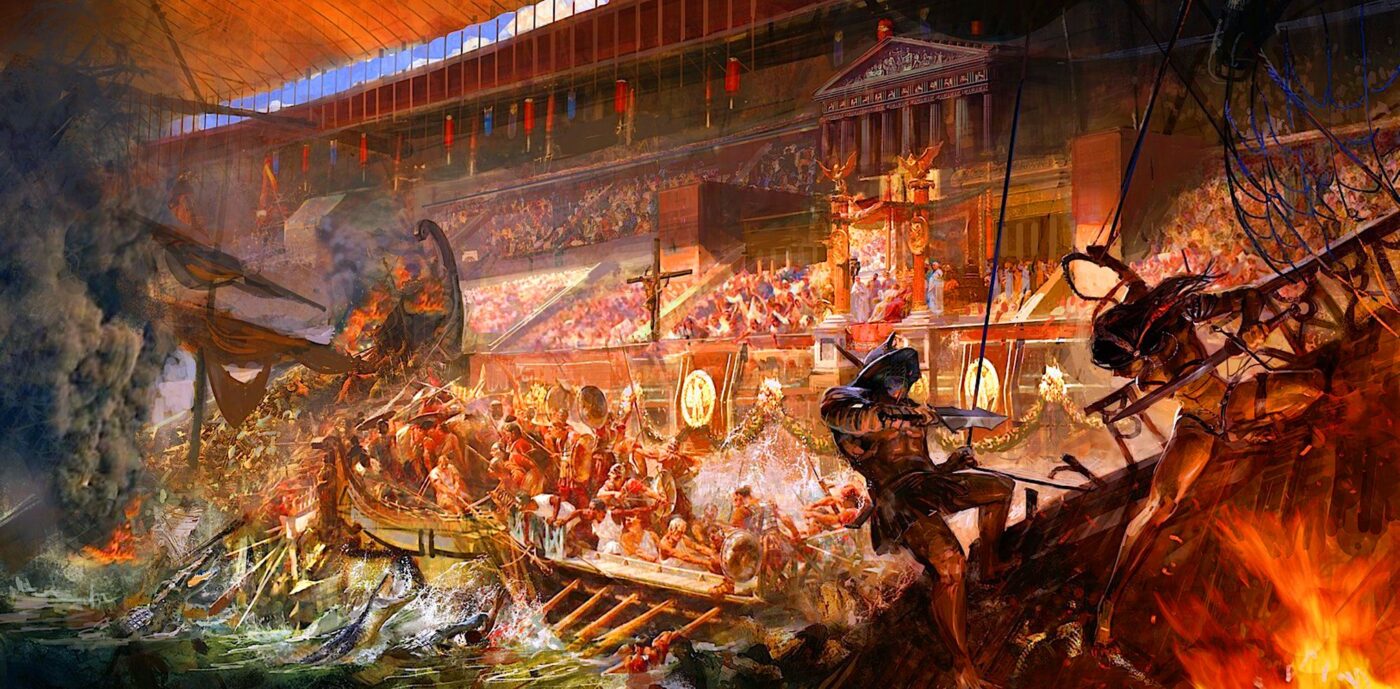
Among the most fascinating and debated spectacles associated with the Colosseum are the so-called mock naval battles, known in Latin as naumachiae. These events, if they truly took place inside the Colosseum, would represent one of the most extraordinary feats of Roman engineering and entertainment. The idea of turning a massive stone arena into a temporary body of water where ships could maneuver and fight seems almost unbelievable—but ancient sources suggest that such spectacles may have occurred, at least during the early years of the Colosseum’s use.
To understand this possibility, it is important to look at the context of Roman entertainment. The Romans were constantly trying to push the limits of spectacle, creating larger, more complex, and more dramatic events to impress the public. Emperors competed with one another to provide the most memorable games, using entertainment as a way to gain popularity and demonstrate power. In this environment, the concept of staging naval battles inside an amphitheater fits perfectly with the Roman desire for innovation and excess.
Historical accounts, particularly from Roman writers, describe events during the opening games of the Colosseum under Titus that may have included water-based spectacles. These descriptions mention the arena being filled with water and used for performances that resembled naval combat. However, historians continue to debate whether these were full-scale battles with ships or smaller, more symbolic displays. The lack of detailed technical explanations leaves room for interpretation.
From an engineering perspective, flooding the Colosseum would have been extremely challenging—but not impossible. The Romans were masters of water management, as seen in their aqueducts, baths, and drainage systems. To create a temporary basin inside the arena, engineers would have needed a system to channel water in and out efficiently, as well as a way to seal the arena floor to prevent leakage. Early in the Colosseum’s history, before the construction of the hypogeum (the underground tunnel system), the arena floor may have been simpler and more adaptable for such purposes.
This detail is crucial. The hypogeum, which was later added beneath the arena, included tunnels, cages, and mechanical lifts used for gladiators and animals. Once this complex system was in place, flooding the arena would have become extremely difficult, if not impossible. This suggests that any naval-style events likely occurred only during the initial phase of the Colosseum’s use, before these underground structures were fully developed.
If mock naval battles did take place, they were probably not as large as those held in specially constructed basins elsewhere in Rome. For example, earlier emperors had organized massive naumachiae in artificial lakes designed specifically for such events. In comparison, the Colosseum’s version would have been more limited in scale. Still, even a smaller water-based spectacle would have been impressive to the audience, especially when combined with theatrical elements and storytelling.
These performances were likely designed to recreate famous naval battles or mythological scenes. Participants—often prisoners or condemned individuals—would have taken part in staged conflicts, sometimes using small boats or platforms. The goal was not necessarily realism, but dramatic impact. The sight of water filling the arena, combined with movement, combat, and spectacle, would have created a unique and memorable experience for spectators.
The idea of flooding the Colosseum also highlights the Roman obsession with control over the environment. Just as they brought exotic animals from distant lands and constructed massive architectural projects, they sought to manipulate natural elements like water for entertainment. Turning a dry arena into a temporary sea symbolized the empire’s ability to reshape the world according to its will.
However, it is important to approach this topic with some caution. Modern historians continue to debate the extent to which these naval battles actually occurred inside the Colosseum. Some argue that the logistical challenges would have made them impractical, while others believe that early versions of the arena could have supported such events. What is certain is that the idea itself reflects the ambition and creativity of Roman entertainment.
Even if full-scale naval battles were rare or limited, the concept of naumachiae contributed to the overall image of the Colosseum as a place where anything seemed possible. The arena was not just a site for combat—it was a stage for innovation, where new forms of spectacle could be tested and displayed. This constant evolution helped keep audiences engaged and ensured that the Colosseum remained at the center of Roman public life.
In conclusion, the question of whether the Colosseum truly hosted mock naval battles remains partially unanswered. What we do know is that the Romans were capable of extraordinary engineering feats and were driven by a desire to create unforgettable spectacles. Whether through actual flooding or symbolic performances, the idea of naval battles in the Colosseum reflects the empire’s commitment to pushing the boundaries of entertainment and demonstrating its power in every possible way.
Key Ideas
- Mock naval battles (naumachiae) possibly held in the Colosseum
- Linked to Roman desire for innovation and spectacle
- Early accounts from reign of Titus
- Flooding arena required advanced water engineering systems
- Likely occurred before construction of hypogeum
- Probably smaller in scale than dedicated naval arenas
- Included theatrical and symbolic performances
- Demonstrated Roman control over environment
- Still debated by historians
- Represents ambition and creativity of Roman entertainment
8. The Crowd Experience: Seating, Social Classes, and Atmosphere
The experience inside the Colosseum was not random or chaotic. It was carefully designed to reflect Roman society itself. Every seat, every entrance, and every reaction from the crowd formed part of a structured system that showed how Rome organized power, status, and entertainment. Watching a spectacle there was not just about the event in the arena—it was also about understanding your place in the empire.
One of the most important features of the Colosseum was its strict seating hierarchy. Roman society was divided into clear social classes, and this structure was physically built into the arena. The emperor had a special viewing box positioned for maximum visibility and authority. Nearby sat senators and the highest-ranking officials of Rome. These seats were the most comfortable and offered the best view of the action.
Below them were the equestrians, wealthy citizens who held significant influence but were still below the senatorial class. Further away sat ordinary Roman citizens. At the very top, in the least desirable seats, were the lower classes, including the poor and sometimes women depending on the event. This arrangement meant that the closer you were to the arena, the higher your social status. In a very real sense, your position in society was displayed through your physical position in the building.
This system was not accidental. It was a deliberate way to reinforce Roman social order. Every spectator could see the structure of society around them, constantly reminding them of hierarchy and rank. Even in a moment of shared entertainment, inequality was visible and organized.
The movement of people into the Colosseum was also highly controlled. The building had around 80 entrances, allowing huge crowds to enter and exit quickly. These entrances were numbered and connected to specific seating sections, so people knew exactly where to go. Tickets or tokens were used to guide spectators, making the system surprisingly efficient for such a massive venue. Even with tens of thousands of people attending, the process remained orderly.
Once inside, the atmosphere was intense and highly emotional. The crowd was not passive. People shouted, cheered, and reacted strongly to everything happening in the arena. The energy of the audience played a major role in shaping the experience. A single moment in a gladiator fight or animal hunt could cause the entire crowd to erupt in noise or fall silent.
Different groups of spectators often supported different fighters or types of entertainment. This created rivalries and excitement similar to modern sports events. Fans would cheer for their preferred gladiators, and the crowd’s reaction could influence the mood of the event. In some cases, public opinion even affected decisions about a defeated fighter’s fate.
Another important feature of the Colosseum experience was comfort. The arena included a system called the velarium, a large retractable awning that provided shade for spectators. This was operated by trained sailors who managed ropes and pulleys. It helped protect the audience from the sun and made long events more bearable.
Food and drink were also part of the experience. Vendors likely moved through or around the seating areas selling refreshments. Since events could last for hours or even an entire day, spectators needed ways to stay comfortable and engaged. This turned the Colosseum into more than just a stadium—it became a full-day social environment.
The crowd itself was extremely diverse. People from many different backgrounds gathered in the same space, even though they were separated by seating. This created a unique situation where Roman society was both divided and united at the same time. Everyone experienced the same events, but from different levels of comfort and privilege.
The emotional impact of the crowd was powerful. Being surrounded by tens of thousands of people created a shared energy that amplified reactions. Excitement, fear, and tension were all intensified by the size of the audience. This made the events feel larger than life and deeply memorable for those who attended.
At the same time, the system ensured control. The structured seating, organized entrances, and strict social divisions prevented chaos. The Colosseum was designed to handle massive crowds without disorder, showing the efficiency of Roman planning and engineering not just in buildings, but in managing people.
In conclusion, the crowd experience in the Colosseum was a carefully controlled mix of social hierarchy, emotional intensity, and organized movement. It reflected Roman society in physical form, reinforcing status while creating shared entertainment. The arena was not only a place to watch events—it was a place where Roman order, identity, and power were constantly displayed and experienced.
Key Ideas
- Seating reflected strict Roman social hierarchy
- Emperor and elites had the best seats
- Lower classes sat in higher, less comfortable areas
- 80 entrances ensured efficient crowd control
- Audience actively reacted and influenced atmosphere
- Strong emotional energy from large crowds
- Velarium provided shade and comfort
- Food and drink available during events
- Society was both divided and united in one space
- Colosseum reinforced Roman order and control
9. Ticket Prices and Access: How Much Did It Cost to Enter the Colosseum?
One of the most surprising things about the Colosseum is that, for most of its history, entry was free for Roman citizens. Unlike modern stadiums or theatres where tickets are sold for profit, the Colosseum was part of a political system where entertainment was used as a tool of control. Instead of charging the public, Roman emperors paid for the games themselves, making access a form of state-sponsored entertainment.
This system was closely tied to the Roman political strategy known as “bread and circuses”. The idea was simple: if the population was fed and entertained, it would be less likely to rebel. The Colosseum played a central role in this strategy. By offering free access to massive spectacles, emperors could gain popularity, reduce unrest, and strengthen their political position.
However, “free” does not mean there was no system of access or control. Attendance at the Colosseum was carefully organized. Roman citizens were given tokens, tickets, or entry passes that indicated where they were allowed to sit. These were often distributed according to social class, political status, or administrative systems. So while people did not pay money, they still needed authorization to enter and be seated correctly.
The seating system was strictly hierarchical, and access depended heavily on social rank. The emperor had a reserved viewing box. Senators and elite officials had designated seats closest to the arena. Wealthy equestrians followed, then ordinary citizens, and finally the lower classes in the upper sections. This meant that “access” was not just about entering the building—it was about where you were allowed to stand within Roman society.
For foreigners, slaves, and non-citizens, access could be more complicated. Slaves might attend only if their owners allowed it, while foreigners’ rights depended on their legal status in the empire. In many cases, the Colosseum was primarily a space for Roman citizens, reinforcing a sense of identity and belonging within the empire.
Even though entry was free, the cost of running the games was enormous. Emperors and wealthy elites paid for everything: the gladiators, the animals, the logistics, and the infrastructure. Funding came from state revenues, war spoils, and imperial wealth. For example, part of the funding for the Colosseum itself came from the plunder of Jerusalem after the Jewish War under Vespasian. This meant that the arena was essentially built and maintained through conquest and taxation.
While citizens did not pay to enter, the system still had economic implications. Organizing games was extremely expensive, and emperors used them to display generosity and power. Hosting large events was a way to invest in political popularity. In other words, the “cost” of the Colosseum was paid not by the audience, but by the state and its leaders, who used entertainment as a form of political currency.
There were also indirect costs for the people. Although entry was free, attending events required time, and sometimes connections or early arrival to secure good seating. The most desirable seats were reserved, and gaining access to better positions often depended on status or influence rather than payment. This reinforced social inequality even within a “free” system.
Another important aspect of access was crowd management. The Colosseum was designed to handle tens of thousands of people efficiently. The 80 entrances allowed for controlled movement, and each section was assigned specific entry points. This system prevented chaos and ensured that people were directed to their correct social zones. The organization of access itself reflected Roman values of order, hierarchy, and discipline.
Over time, access to the Colosseum also became a way for emperors to communicate directly with the people. By appearing in the arena or sponsoring games, rulers could present themselves as generous and connected to the population. The crowd, in turn, could express approval or disapproval, making the Colosseum a space of political interaction as well as entertainment.
It is also important to note that not all events in Roman entertainment culture were free. Other venues or private games could involve invitations, patronage systems, or restricted access. But the Colosseum remained a public institution, symbolizing the idea that the emperor provided entertainment for the people as part of his duty.
In conclusion, entry to the Colosseum was generally free for Roman citizens, but carefully controlled through tickets, seating systems, and social hierarchy. While the crowd did not pay money, the true cost was absorbed by the empire itself, funded through taxation, conquest, and imperial wealth. Access to the Colosseum was not just about entertainment—it was a reflection of Roman politics, social structure, and the relationship between the emperor and the people.
Key Ideas
- Entry to the Colosseum was generally free for Roman citizens
- Controlled through tickets or entry tokens
- Seating reflected strict social hierarchy
- Emperor and elites had reserved access
- Funding came from state, taxes, and war spoils
- Built partly from wealth after conquest (e.g. under Vespasian)
- “Bread and circuses” used entertainment for political control
- Access reinforced Roman identity and citizenship
- Crowd management ensured order and efficiency
- True “cost” was political and economic, not personal payment
10. The Legacy of the Colosseum: From Ancient Arena to Eternal Symbol
The Colosseum is not just a monument of the ancient world—it is one of the most powerful symbols of Rome itself. Even today, nearly two thousand years after it was built, it represents Roman engineering, political power, entertainment culture, and social control. Its legacy is complex, combining admiration for its brilliance with reflection on the violence that took place inside it.
When it was first completed under Titus and later expanded in use under emperors like Vespasian, the Colosseum stood as a statement of imperial strength. It showed that Rome could build on a massive scale, organize enormous public events, and bring together tens of thousands of people in a single space. It was both a technological achievement and a political tool.
However, as the Roman Empire changed, so did the use of the Colosseum. Over time, the frequency of games decreased. Economic pressure, political instability, and changing cultural values all contributed to the decline of large-scale gladiatorial events. As Christianity spread through the empire, attitudes toward violent public entertainment also began to shift. The idea of killing for sport became increasingly controversial.
By the late Roman Empire, the Colosseum was no longer the center of public life it once was. Some events still took place, but they became less frequent and less important. Eventually, gladiatorial combat was officially banned in the 5th century CE. This marked the end of the arena’s original purpose as a place of blood sport and spectacle.
After the fall of the Western Roman Empire, the Colosseum entered a long period of transformation. It was no longer maintained as an arena and began to be used for different purposes. Parts of the structure were damaged by earthquakes, and many of its stones were reused in other buildings across Rome. In this way, the Colosseum became a quarry for new construction, slowly being dismantled over time.
Despite this decline, the structure never disappeared from Roman identity. It remained a visible reminder of the city’s ancient power. Even in a damaged state, it was still recognized as one of the greatest buildings ever created. People continued to associate it with the glory—and brutality—of ancient Rome.
During the Middle Ages, the Colosseum was sometimes used for housing, workshops, and even religious purposes. Its meaning shifted again, becoming less about entertainment and more about survival and reuse. Over time, however, there was growing awareness of its historical importance. Scholars, artists, and travelers began to study and admire it as a relic of a lost civilization.
In the modern era, the Colosseum has become one of the most famous landmarks in the world. It attracts millions of visitors every year and is recognized globally as a symbol of ancient Rome. Its image appears in books, films, documentaries, and even modern architecture. It represents not only history, but also the lasting influence of Roman culture on the world.
At the same time, the Colosseum also serves as a reminder of the darker aspects of Roman society. The games, executions, and animal hunts that took place inside it reveal a civilization that combined incredible innovation with extreme violence. This dual identity is part of what makes the Colosseum so powerful today. It forces people to reflect on both the achievements and the moral complexities of ancient Rome.
Archaeological studies of the Colosseum continue to uncover new information about how it was built and used. Excavations of the hypogeum, the underground system beneath the arena, have revealed more about how events were staged. These discoveries help historians better understand Roman engineering and the organization of public entertainment.
In addition, preservation efforts have transformed the Colosseum into a protected cultural heritage site. Restoration projects aim to stabilize the structure, prevent further damage, and allow future generations to experience it. These efforts show how important the monument remains in the modern world, not just as a tourist attraction, but as a symbol of shared human history.
In conclusion, the legacy of the Colosseum is one of transformation and endurance. From its origins as a stage for imperial spectacle under emperors like Vespasian and Titus, to its modern role as a global landmark, it has continually changed meaning over time. It stands today as a reminder of Roman power, creativity, and complexity—a structure that reflects both the brilliance and the contradictions of one of history’s greatest civilizations.
Key Ideas
- Built under Vespasian and completed by Titus
- Originally symbolized Roman power and entertainment culture
- Gradual decline as empire changed and Christianity spread
- Gladiatorial games ended in the 5th century CE
- Structure reused as quarry and later repurposed
- Became symbol of ancient Rome’s legacy and identity
- Now a global tourist and cultural landmark
- Archaeology continues to reveal new details
- Represents both Roman achievement and brutality
- Enduring symbol of history, engineering, and civilization