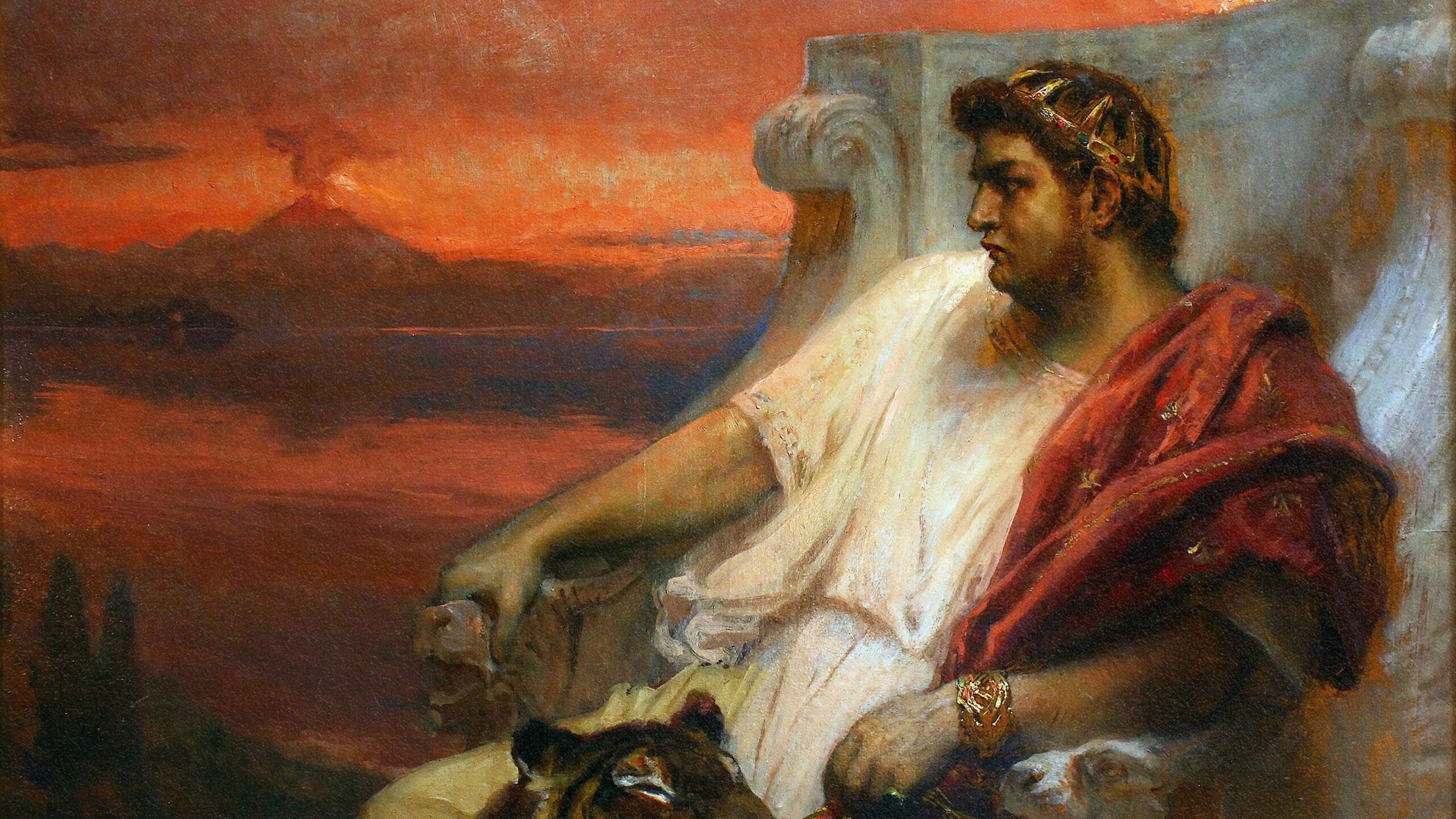
The Great Fire of Rome in AD 64 was one of the most famous disasters in Roman history, but the story is about far more than flames destroying buildings. The fire became closely connected with the emperor Nero, accusations that he had somehow been involved in the disaster, the persecution of Christians, massive rebuilding projects, and a lasting debate over what actually happened.
The fire began in July AD 64 and burned through large parts of Rome for several days. Ancient sources disagree about its exact course and about Nero’s actions during the disaster. Some later accounts portray Nero as deliberately causing the fire because he wanted to rebuild Rome according to his own plans. Others emphasize his relief efforts and the measures he took to help people who had lost their homes.
One of the most important parts of the story is the accusation that Nero himself started the fire. This claim became famous, but the surviving evidence does not establish that Nero ordered or personally started the fire. The ancient historian Tacitus, writing decades later, explicitly discusses rumors that Nero was responsible while also describing efforts by the emperor to assist the displaced population.
The disaster also became connected with the early Christian community in Rome. According to Tacitus, Nero blamed Christians for the fire and subjected some of them to punishment. This is one of the earliest Roman accounts connecting the Christian movement with imperial persecution.
The aftermath transformed parts of Rome. Nero’s government organized reconstruction, introduced new building regulations, and developed plans for parts of the city. At the same time, Nero’s enormous Domus Aurea, or Golden House, became associated with the emperor’s rebuilding program and contributed to criticism of his rule.
The Great Fire therefore sits at the intersection of Roman society, politics, religion, architecture, and imperial power. It is a story about a catastrophe, but also about rumors, propaganda, political legitimacy, religious persecution, urban reconstruction, and the complicated reputation of one of Rome’s most controversial emperors.
I. The Great Fire Begins: How Rome Was Overwhelmed by Fire in AD 64
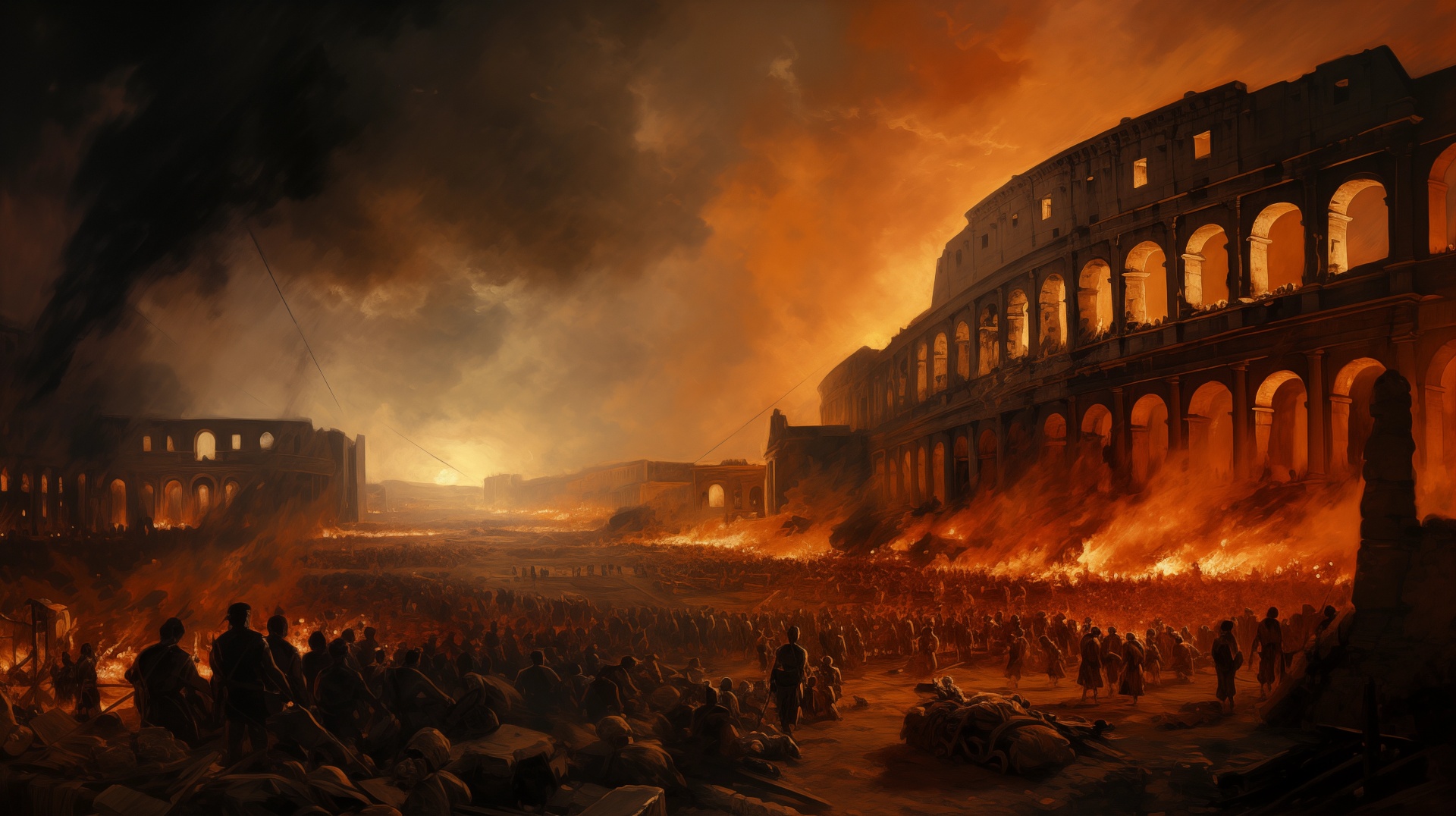
The Great Fire of Rome began in July AD 64, during the reign of Emperor Nero, and quickly became one of the most destructive disasters in the history of imperial Rome. The event is famous not simply because so much of the city burned, but because the fire became connected to Nero’s reputation, political rumors, the persecution of Christians, and the enormous rebuilding program that followed.
Rome was particularly vulnerable to large fires. The capital had grown into an enormous and crowded city, with neighborhoods containing multi-story apartment buildings, shops, workshops, warehouses, temples, public buildings, and wealthy private houses. Many buildings used timber and other materials that could burn. Everyday activities such as cooking, heating, lighting lamps, and operating workshops also created potential sources of fire.
According to the Roman historian Tacitus, the fire began in the area around the Circus Maximus, where there were numerous shops and businesses. The flames spread rapidly through the surrounding streets. Wind helped carry the fire, while the dense arrangement of buildings made it difficult for people to escape and for firefighters to create effective barriers.
The city’s layout was a major problem. Narrow streets and closely packed buildings allowed flames to move from one structure to another. Some buildings collapsed, creating additional obstacles, while other structures helped carry the fire into neighboring areas. Rome had experienced serious fires before, so its inhabitants were familiar with the danger, but the scale of the AD 64 disaster was exceptional.
The fire continued for several days, and ancient accounts describe it spreading across different sections of the city. Tacitus states that the fire eventually died down before starting again in another area. Modern historians cannot reconstruct every stage with certainty, and some details in the ancient accounts may be exaggerated or difficult to verify. Nevertheless, the evidence indicates that large portions of Rome were destroyed or severely damaged.
The disaster caused enormous disruption to ordinary Roman life. People fled their homes, searched for relatives, attempted to rescue possessions, and looked for places where they could escape the advancing flames. Thousands of residents were left without homes, although the exact number of casualties and homeless people is unknown.
Nero was not actually in Rome when the fire began. According to Tacitus, the emperor was at Antium, a coastal location south of Rome. When news of the disaster reached him, he eventually returned to the capital. Tacitus describes Nero taking measures to assist the population, including opening areas where displaced people could stay and arranging for food to be supplied.
However, Nero’s response would become one of the most controversial parts of the entire story. Rumors began circulating that Nero himself had ordered the fire. The reasons given in later traditions varied. Some stories suggested that Nero wanted to destroy parts of Rome so that he could rebuild the city according to his own vision. Others connected the fire with his desire for a magnificent palace complex.
This is where it becomes essential to separate historical evidence from later legend. There is no reliable evidence proving that Nero deliberately started the Great Fire. Tacitus, who is one of the most important sources for the event, records the rumors but does not present Nero’s responsibility as an established fact. He also describes Nero’s efforts to provide assistance to people affected by the disaster.
At the same time, the rumors cannot simply be ignored. Nero’s later building projects made the accusations more believable to some Romans and later writers. After the fire, he undertook major reconstruction projects, and the enormous Domus Aurea, or Golden House, became particularly associated with his reign. The palace occupied a large area and was extraordinarily elaborate, helping create the impression that Nero had benefited from the destruction.
The Great Fire therefore immediately became more than an urban disaster. It became a political and public-relations crisis for Nero. The emperor needed to restore the city, house displaced residents, and demonstrate that the government remained in control. At the same time, he had to deal with rumors that he had caused the catastrophe.
The fire also created the circumstances for one of the most important religious episodes associated with Nero’s reign: the persecution of Christians in Rome. As the rumors about Nero’s responsibility spread, the emperor eventually directed blame toward members of the Christian community, according to Tacitus. This would connect the Great Fire with the history of Christianity and give the disaster an importance far beyond the physical destruction of Rome.
Thus, the opening of the Great Fire was only the beginning of a much larger story. The flames damaged Rome, but the political consequences would continue long after the fire had gone out.
5 Main Ideas
I. The Great Fire began in July AD 64 and spread rapidly through densely populated parts of Rome.
II. Rome’s crowded neighborhoods, multi-story buildings, narrow streets, shops, and combustible materials made the city extremely vulnerable to major fires.
III. The fire lasted for several days and caused enormous destruction, leaving many residents without homes.
IV. Nero was away from Rome when the fire began but returned and organized measures to assist people affected by the disaster.
V. Rumors that Nero had deliberately caused the fire became central to his reputation, although the surviving evidence does not prove that he ordered or started it.
II. Nero and the Great Fire: Why Romans Began Suspecting the Emperor
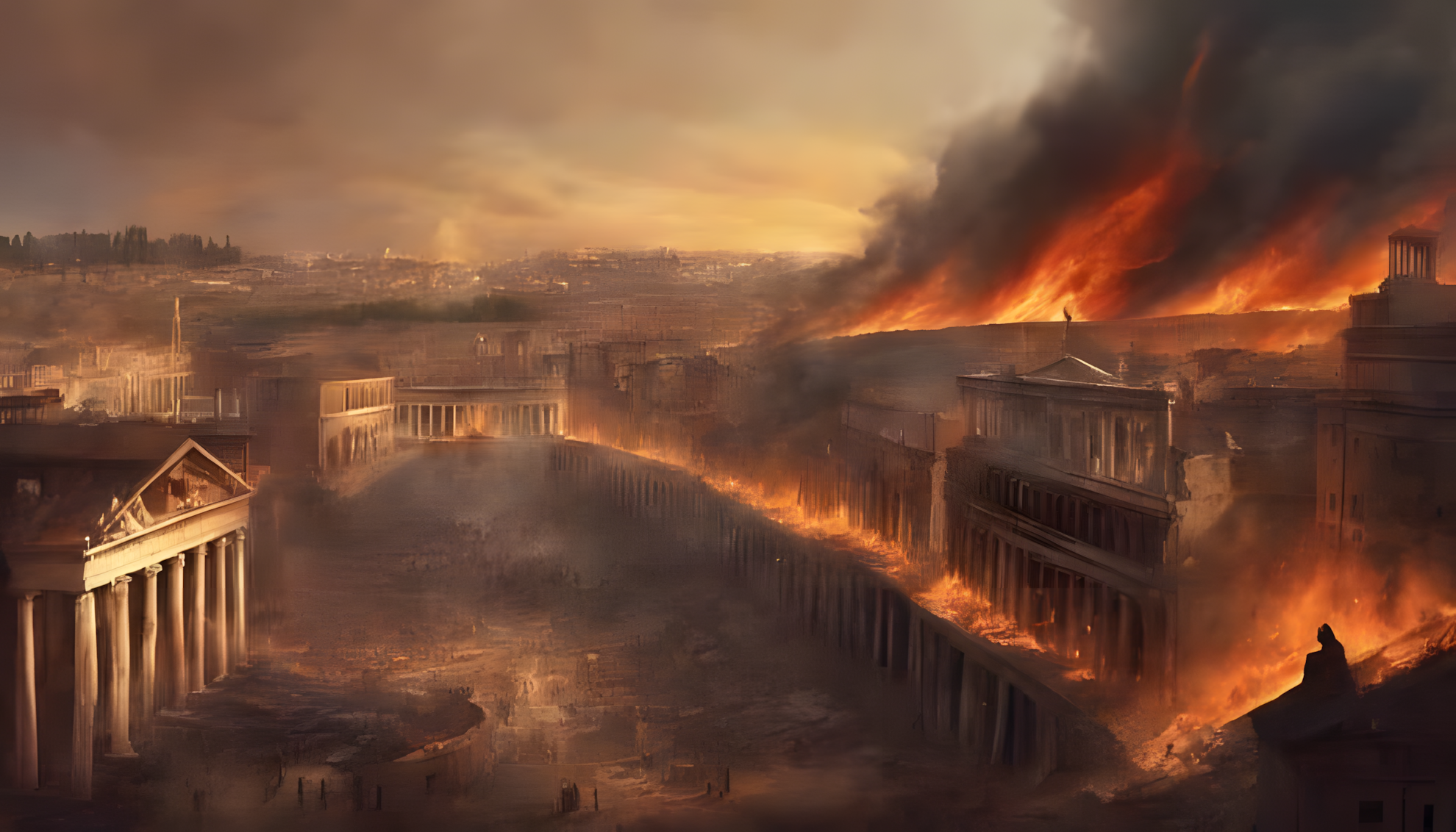
The connection between Nero and the Great Fire of Rome is one of the most famous controversies in Roman history. For centuries, stories have claimed that Nero deliberately caused the fire because he wanted to destroy the old city and rebuild it according to his own vision. Some later traditions even transformed the story into the image of Nero watching Rome burn while entertaining himself. However, the historical evidence is much more complicated.
The most important surviving account comes from Tacitus, who wrote his Annals several decades after the fire. Tacitus explains that rumors were circulating that Nero was responsible. According to these rumors, Nero had ordered the fire because he wanted to create space for a magnificent new city or palace. Tacitus, however, does not establish this as fact. His account actually provides evidence that Nero took practical measures to help the population after the disaster.
Nero’s location when the fire started was also important. He was at Antium rather than in Rome, meaning the popular image of Nero personally standing in Rome and watching the city burn is not supported by the main historical account. Nero eventually returned to Rome and became involved in the response.
Why, then, did people suspect him?
One reason was the scale of Nero’s rebuilding projects after the fire. The destruction gave the emperor an opportunity to reshape parts of Rome. New construction regulations were introduced, streets were widened in some areas, and buildings were subject to rules intended to reduce the danger of future fires. These changes could be presented as sensible responses to the disaster, but Nero’s personal building ambitions made the situation politically sensitive.
Most importantly, Nero began developing the enormous Domus Aurea, or Golden House. This vast palace complex included luxurious buildings, gardens, and large areas of imperial property. Although the full complex was developed after the fire, not every part of it can simply be described as a direct product of the disaster. Nevertheless, its enormous scale contributed to the perception that Nero had used the destruction of Rome to expand his own imperial residence.
Another problem was Nero’s reputation. The emperor had already become controversial among parts of Rome’s political elite. His relationship with the Senate, his artistic interests, his public performances, and his increasingly personalized style of rule created opposition among some members of the aristocracy. As a result, stories portraying Nero as selfish or destructive could spread more easily.
The ancient sources themselves must also be treated carefully. Tacitus was not a neutral observer of Nero’s reign, and other ancient writers, including Suetonius and Cassius Dio, wrote accounts that contributed to the emperor’s extremely negative reputation. These writers lived under later emperors and belonged to Roman elite circles that had their own political perspectives.
The famous story that Nero “played the fiddle while Rome burned” is particularly misleading. The violin did not exist in ancient Rome, and the specific popular image of Nero playing an instrument while watching the city burn is not supported by the evidence in the simple form often repeated today. Ancient sources do discuss Nero’s interest in music and performance, but the famous modern phrase combines different traditions.
There is also an important distinction between “Nero caused the fire” and “Nero benefited politically or architecturally from the rebuilding.” The first is an allegation that cannot be proven from surviving evidence. The second is much easier to establish: Nero certainly used the period after the fire to pursue major reconstruction and architectural projects.
The fire therefore created a dangerous situation for Nero. He had to convince Romans that he was protecting them while also dealing with accusations that he had caused the disaster. His rebuilding program could demonstrate leadership, but its enormous scale could simultaneously strengthen suspicion.
This tension would become even more important when Nero decided to blame Christians for the disaster.
5 Main Ideas
I. Ancient sources report rumors that Nero deliberately caused the Great Fire, but they do not provide conclusive proof that he ordered it.
II. Nero was at Antium when the fire began and later returned to Rome to respond to the disaster.
III. His enormous rebuilding projects, especially the Domus Aurea, helped fuel suspicions that he had benefited from the destruction.
IV. The famous image of Nero casually playing music while Rome burned is a later simplification and does not accurately represent the surviving evidence.
V. Nero’s controversial reputation, his relationship with Rome’s political elite, and his ambitious rebuilding program made the fire a major political controversy.
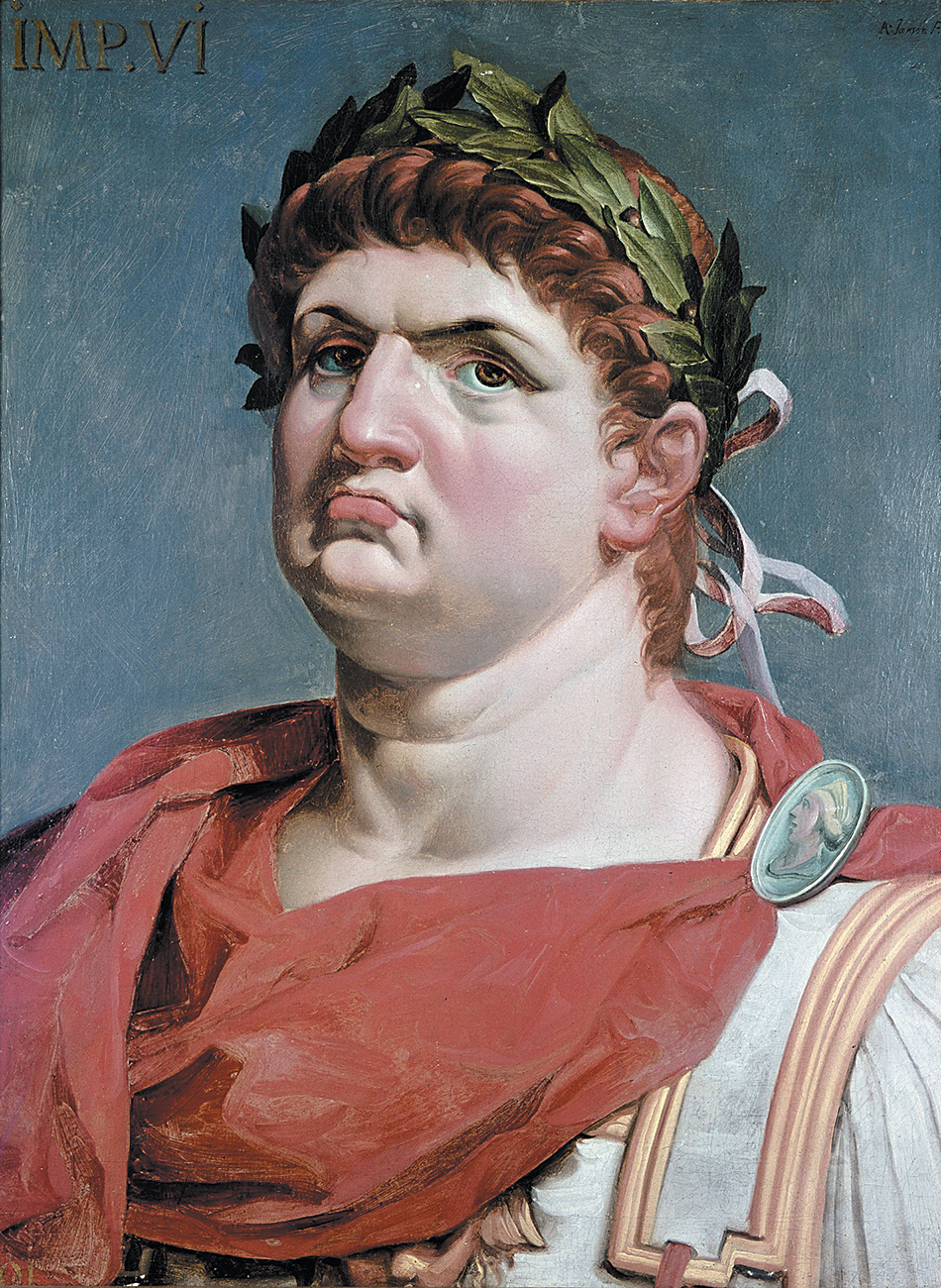
III. The Christians and Nero: How the Great Fire Led to Persecution in Rome
One of the most important consequences of the Great Fire of Rome was its connection with the early Christian community. After the disaster, rumors continued to circulate that Nero himself had been responsible. According to the Roman historian Tacitus, Nero responded by directing suspicion toward Christians, a relatively small and unfamiliar religious group in Rome at the time. This decision made the Great Fire an important event not only in Roman political history but also in the early history of Christianity.
Christianity was still a small religious movement during the reign of Nero. Christians worshipped one God and followed the teachings of Jesus, while Roman religious life was generally characterized by many gods, traditional rituals, and public religious practices connected to the state. Because Christians did not participate in certain traditional Roman religious activities, they could appear unusual or suspicious to some Roman observers.
Tacitus explains that Nero blamed the Christians for the disaster in an attempt to stop rumors that the emperor himself had started the fire. This is an important detail because it suggests that the persecution was connected directly to the political crisis created by the fire.
The accusation did not mean that Christians were actually responsible for starting the fire. There is no reliable evidence that Christians caused the Great Fire. Instead, they appear to have been used as a group onto which blame could be placed.
Tacitus describes the persecution as taking place in Rome after the fire. His account indicates that Christians were identified, arrested, and punished. The exact number of people affected is unknown, and later Christian traditions sometimes expanded or dramatized the story. Modern historians therefore distinguish between what Tacitus actually reports and later traditions that developed around Nero and the Roman Christians.
The persecution was significant because it shows how religious identity could become connected with political accusations in the Roman Empire. Christians were not being punished because Roman authorities had discovered that they had caused the fire. Rather, Nero’s government appears to have used them as a convenient target for public blame.
The episode also reveals something about Roman attitudes toward new religious groups. Roman authorities generally had considerable experience with different cults and religious traditions. However, religious practices were closely connected to community identity, public rituals, and loyalty to the Roman order. A group that refused certain traditional practices could attract suspicion, particularly during a period of crisis.
It is also important not to imagine that Nero’s persecution of Christians immediately resulted in a permanent empire-wide policy against Christianity. The persecution described by Tacitus was centered on Rome, and the evidence does not show that Nero launched a systematic persecution of Christians throughout the entire Roman Empire.
Nevertheless, the event became extremely important in Christian memory. Later Christian writers remembered Nero as one of the earliest Roman emperors to persecute Christians. Over time, stories about Nero, the Great Fire, and the Christians became increasingly connected.
The Great Fire also contributed to the later image of Nero as a cruel and dangerous ruler. Tacitus describes the persecution in a way that emphasizes Nero’s attempt to silence rumors and shift blame. Later writers added additional stories about Nero’s behavior, contributing to the emperor’s extraordinarily negative reputation.
The episode should therefore be understood within its historical context. The Christians were not responsible for the fire, but Nero’s government accused them after the disaster. The accusation appears to have served a political purpose by providing an alternative target for public suspicion.
This makes the persecution one of the most significant consequences of the Great Fire. The disaster damaged Rome physically, but it also changed relationships between the imperial government and a small religious community that would eventually become one of the most important forces in Roman history.
5 Main Ideas
I. Christians were a small and relatively unfamiliar religious community in Rome during Nero’s reign.
II. According to Tacitus, Nero blamed Christians for the Great Fire in order to counter rumors that he himself was responsible.
III. There is no reliable evidence that Christians actually caused the fire.
IV. The persecution was centered on Rome and should not be confused with a permanent empire-wide persecution under Nero.
V. The events of AD 64 became an important part of both Nero’s negative reputation and the early history of Christianity.
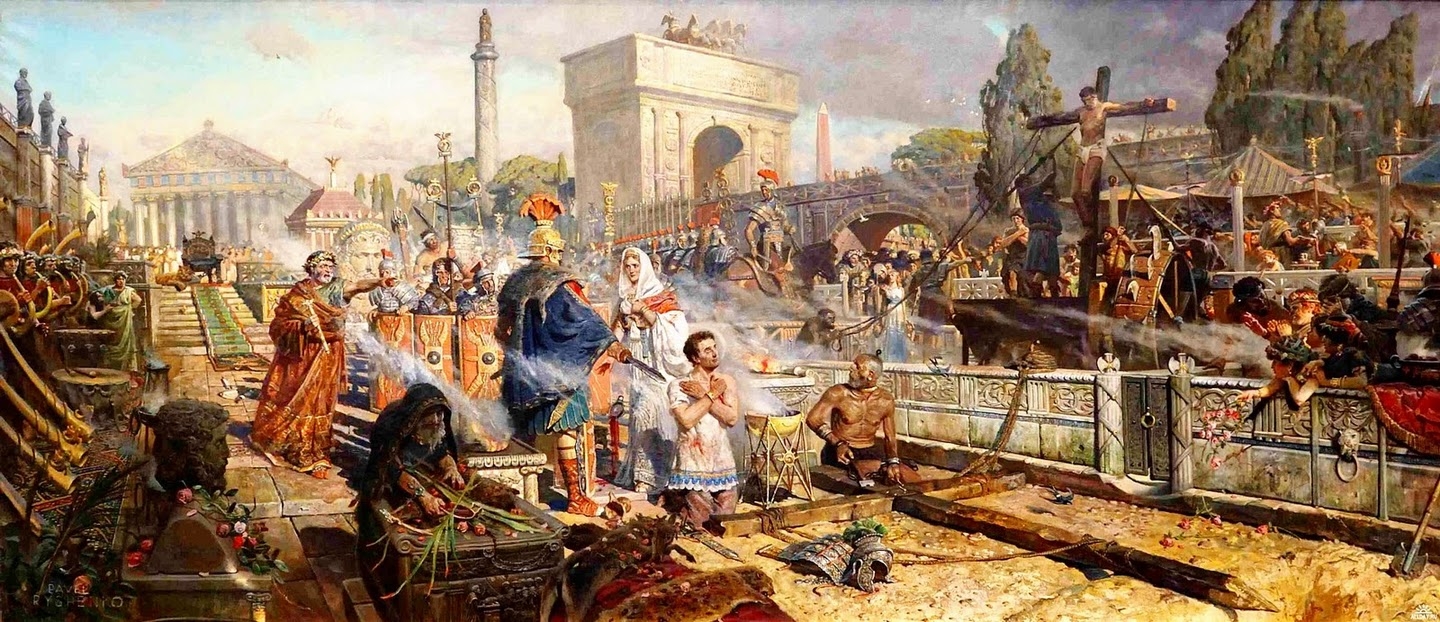
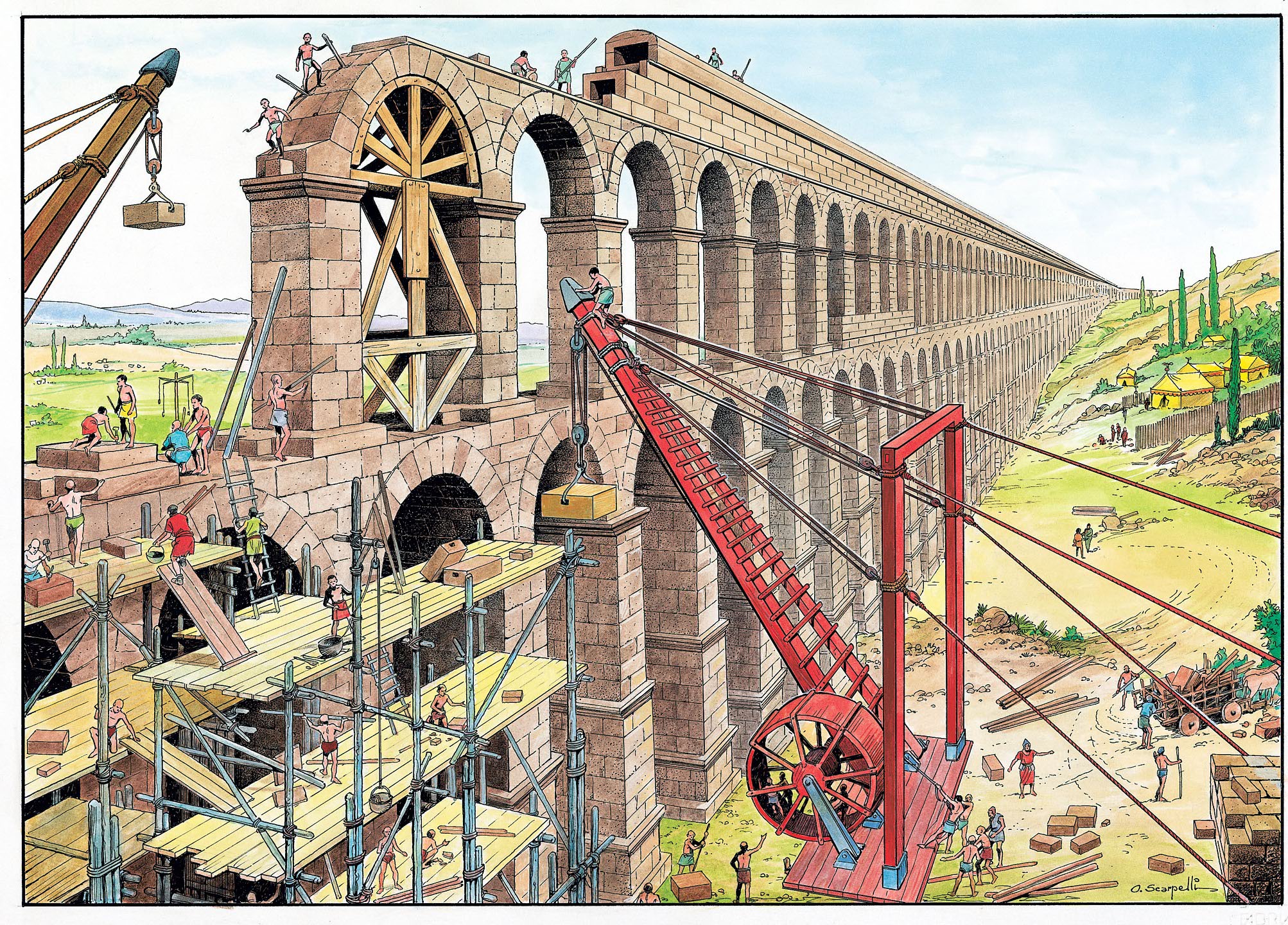
IV. Nero's Response to the Disaster: Relief, Rebuilding, and the Beginning of a New Rome
The Great Fire created an enormous practical problem for Nero’s government: Rome had to be rebuilt while thousands of residents needed somewhere to live. Whatever the truth behind the rumors about Nero and the fire, the emperor now had to demonstrate that his government could respond to the disaster. The measures taken after the fire became an important part of Nero’s reign and eventually changed the appearance of parts of Rome.
According to Tacitus, Nero returned to Rome and organized assistance for people who had lost their homes. Areas such as the Campus Martius and imperial properties were made available for displaced residents, while food was brought in to help those affected. Tacitus also describes efforts to keep food prices under control. These actions suggest that the imperial government did not simply ignore the population after the catastrophe.
The response was particularly important because Rome’s population depended heavily on the city’s infrastructure and food supply. A disaster affecting large sections of the capital could quickly create shortages and social unrest. Providing food and temporary shelter therefore had both humanitarian and political importance.
Nero’s government also introduced new rules for reconstruction. Tacitus describes regulations concerning the construction of buildings, including measures intended to make the city safer from future fires. Buildings were to have greater separation in some areas, streets were widened, and certain construction practices were restricted. Firefighting arrangements and access between buildings also received greater attention.
These changes were significant because the fire provided an opportunity to address some of the weaknesses that had existed in Rome’s urban design. The disaster became a reason to reorganize parts of the capital. Rome would not simply be reconstructed exactly as it had been before.
However, Nero’s rebuilding program also created controversy.
The emperor had enormous ambitions for Rome. He wanted the capital to reflect the grandeur of the imperial regime, and the destruction caused by the fire gave him an opportunity to pursue major architectural projects. One of the most famous was the Domus Aurea, or Golden House.
The Domus Aurea was not simply a normal Roman residence. It was an enormous imperial complex containing buildings, gardens, decorative spaces, and extensive grounds. Its scale became one of the strongest reasons later writers portrayed Nero as an emperor who had exploited the fire for his own benefit.
There is an important historical distinction here. The existence of the Domus Aurea does not prove that Nero deliberately started the Great Fire. The palace was built after the disaster, but the evidence does not establish that the fire was planned specifically to create space for it.
Nevertheless, the timing created an obvious political problem. Ordinary Romans had lost homes and possessions, while the emperor was associated with an enormous new palace complex. Even if Nero’s reconstruction policies benefited the city in certain ways, his personal architectural ambitions could make those achievements look self-serving.
The rebuilding also affected the political relationship between Nero and the Roman elite. Large construction projects required money, labor, land, and imperial authority. Some members of the aristocracy may have viewed Nero’s growing interest in architecture and spectacle as evidence that he was moving further away from traditional expectations of an emperor.
At the same time, rebuilding Rome allowed Nero to present himself as a transformative emperor. A destroyed city could be rebuilt with wider streets, improved building regulations, and a more organized urban design. Nero could portray himself as the ruler who had taken a terrible disaster and turned it into an opportunity for renewal.
This created two competing interpretations of the same event. Supporters could describe Nero as the emperor who rebuilt Rome after a catastrophe, while critics could portray him as a ruler who used the catastrophe to pursue personal ambitions.
The Great Fire therefore became inseparable from the rebuilding that followed. The physical destruction of AD 64 eventually produced a Rome that was, in some areas, different from the city that had existed before the disaster.
But the rebuilding could not completely solve Nero’s political problem. Rumors about his responsibility continued, and his decision to blame Christians became another controversial chapter in the aftermath.
5 Main Ideas
I. Nero’s government provided temporary shelter and food assistance to people affected by the Great Fire.
II. New construction regulations and changes to streets and buildings were introduced as part of Rome’s reconstruction.
III. The disaster gave Nero an opportunity to reshape parts of the capital according to his architectural ambitions.
IV. The enormous Domus Aurea became closely associated with Nero and helped fuel criticism that he had benefited from the destruction.
V. Nero’s rebuilding program could be presented either as an effort to improve Rome or, by his critics, as evidence of imperial self-interest.
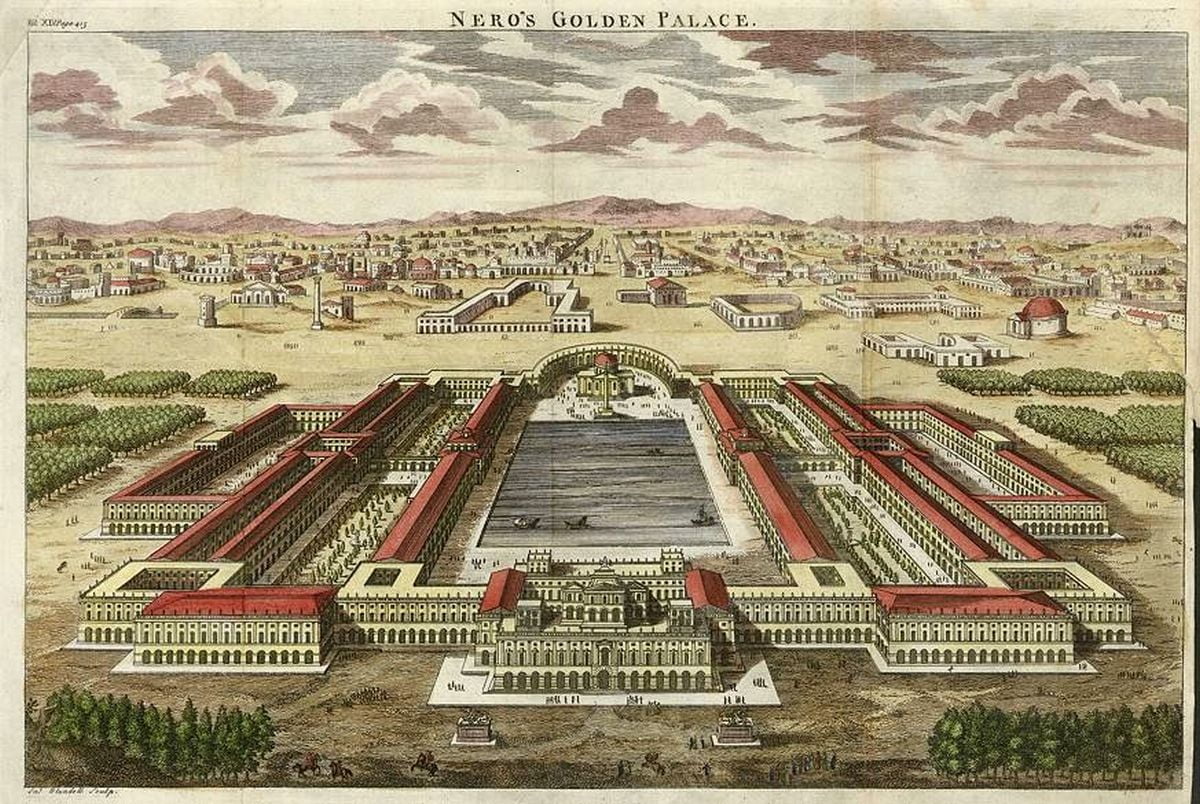
V. The Domus Aurea: Nero's Golden House and the Controversy Over His Rebuilding of Rome
The Domus Aurea, or Golden House, became one of the most controversial consequences of the Great Fire of Rome. Built during the years following the disaster, the enormous imperial complex became closely associated with Nero’s ambition to transform Rome and display the wealth and power of the emperor. For later generations, it also became one of the strongest pieces of evidence used to portray Nero as a ruler who exploited the destruction of the city for his own benefit.
The Domus Aurea was not simply one large palace building. It was an extensive imperial complex that included residential structures, gardens, decorative spaces, courtyards, and other features. Its grounds extended across parts of central Rome, making the project extraordinary in both scale and ambition.
The name “Golden House” comes from the luxurious character of the complex and the descriptions of its decoration. Ancient writers describe elaborate rooms and impressive artistic decoration, while archaeological remains have revealed sophisticated architectural and decorative features. The complex demonstrated the enormous resources available to the Roman emperor.
Its location was particularly important. The palace occupied areas that had been affected by the Great Fire and other imperial properties. This contributed to the perception that Nero was taking advantage of land made available after the disaster.
However, historians need to be careful about turning this into proof that Nero caused the fire. The Domus Aurea was constructed after the fire, but that does not demonstrate that the fire had been deliberately planned to create space for the palace. The surviving evidence does not establish such a connection.
What is clear is that the palace became politically controversial.
Rome’s population had just experienced a devastating disaster. Many residents had lost their homes, while Nero was developing a vast private imperial complex. The contrast between ordinary Romans dealing with the consequences of the fire and the emperor constructing an enormous luxury residence was politically powerful.
Tacitus and other ancient writers contributed to the negative image of Nero’s building program. Their descriptions emphasize the extraordinary scale and extravagance of his projects. Later Roman writers also remembered Nero as an emperor whose personal interests had consumed enormous resources.
The Domus Aurea also reflected Nero’s unusual approach to imperial image-making. Architecture could communicate political power. By creating an enormous palace surrounded by gardens and monumental decoration, Nero could present himself as an emperor capable of reshaping the capital itself.
This was part of a broader pattern in Roman history. Emperors regularly used monuments, temples, roads, forums, and palaces to communicate their authority. Building projects were not merely practical construction; they could serve as political statements.
Nero’s problem was that his architectural ambitions appeared particularly extravagant at a moment when Rome was recovering from catastrophe. A building program that might have been interpreted as impressive under different circumstances could instead be interpreted as wasteful or arrogant.
The Domus Aurea therefore became a symbol of two different versions of Nero.
To one interpretation, Nero was an emperor using the destruction of Rome as an opportunity to create a more impressive capital. The rebuilding regulations and urban improvements could be presented as evidence of constructive leadership.
To another interpretation, Nero was using a catastrophe to expand imperial property and pursue personal luxury. His enormous palace could therefore become evidence supporting the rumors that he had welcomed the destruction.
Neither interpretation proves that Nero caused the fire. The strongest historical conclusion is more limited: Nero’s rebuilding program, including the Domus Aurea, contributed significantly to the later controversy surrounding the Great Fire.
The palace also had a surprisingly short political life. After Nero’s death in AD 68, later emperors sought to distance themselves from his memory. Much of the area associated with the Domus Aurea was eventually redeveloped, and major monuments were constructed over parts of the former imperial complex.
The transformation of Nero’s palace demonstrates how quickly imperial political priorities could change. What had represented Nero’s personal power became something later emperors could replace, reuse, or deliberately overshadow.
The Domus Aurea therefore remains central to the story of the Great Fire—not because it proves that Nero started the disaster, but because it shows how the fire, rebuilding of Rome, imperial architecture, and Nero’s reputation became permanently connected.
5 Main Ideas
I. The Domus Aurea was an enormous imperial complex constructed during the rebuilding of Rome after the Great Fire.
II. Its luxurious scale and extensive grounds made it one of the most controversial building projects of Nero’s reign.
III. The palace’s construction after the fire fueled suspicions that Nero had benefited from the disaster, but it does not prove that he caused the fire.
IV. The Domus Aurea demonstrated how Roman emperors could use architecture to communicate wealth, authority, and political power.
V. After Nero’s death, later emperors redeveloped much of the area, helping erase or transform the physical legacy of his palace.
VI. The Great Fire and Roman Politics: Rumors, Propaganda, and Nero's Reputation
The Great Fire of Rome did not simply destroy buildings; it created a major political crisis for Emperor Nero. In the aftermath, Nero faced the difficult task of rebuilding the capital while also dealing with rumors that he had deliberately caused the disaster. The story became a battle over public trust, imperial reputation, and political power.
Nero’s reign was already controversial before the fire. He had become known for his interest in music, theater, poetry, public performances, and spectacular entertainment, activities that did not always fit the traditional expectations of a Roman emperor. Some members of the Roman aristocracy considered such behavior inappropriate for someone of his position.
The Great Fire gave Nero’s opponents a new opportunity to criticize him. The accusation that he had caused the disaster was particularly powerful because Nero’s rebuilding plans seemed to benefit from the destruction. He was able to reshape parts of Rome, introduce new building regulations, and construct the enormous Domus Aurea.
This created a simple but powerful political narrative: Nero had supposedly destroyed the old Rome so that he could build his own Rome.
The problem is that historical evidence does not establish that story as fact.
The most important source, Tacitus, explicitly discusses the rumors surrounding Nero. Tacitus wrote that people suspected the emperor, but he also describes Nero’s efforts to help the population after the disaster. His account therefore gives us evidence for both the existence of the accusation and the emperor’s response to the crisis.
Other ancient writers, including Suetonius and Cassius Dio, also contributed to the negative image of Nero. Their accounts were written after Nero’s death and were influenced by the political traditions of the Roman elite. This does not mean that everything they wrote was false, but it means their descriptions need to be examined carefully.
This is especially important because Nero’s reputation became increasingly negative after his death. In AD 68, Nero lost political support and eventually died after rebellion against his government. The next emperors had an obvious reason to distance themselves from him. The memory of Nero could therefore become part of the political justification for the new regime.
The Great Fire became particularly useful in this process because it offered a dramatic story about an emperor whose ambition supposedly put his own interests above those of Rome.
The famous story of Nero “playing the fiddle while Rome burned” illustrates how historical memories can change over time. The violin did not exist in ancient Rome, and the simple modern image is not an accurate description of the evidence. Ancient sources do associate Nero with musical performance, but the popular story combines later interpretations with ancient traditions.
The political importance of the fire also involved blame. When a disaster occurs, governments often face pressure to explain what happened. In ancient Rome, where information could spread through rumors, speeches, and personal networks, accusations could become politically significant even without definitive evidence.
Nero’s decision to blame Christians was therefore particularly important. According to Tacitus, the emperor used Christians as an alternative target for accusations, attempting to reduce the suspicion directed toward himself. This demonstrates how the aftermath of the fire became connected with the political management of public opinion.
At the same time, Nero’s government could point to genuine achievements. Rome was rebuilt, regulations were introduced, and assistance was provided to displaced residents. These actions allowed Nero’s supporters to argue that the emperor had responded effectively to the disaster.
The controversy therefore cannot be reduced to a simple question of whether Nero was “good” or “bad.” The surviving evidence shows a much more complicated situation: a devastating disaster, an emperor with an already controversial reputation, competing political narratives, ambitious reconstruction, and later historians who preserved different interpretations of the events.
The Great Fire ultimately became one of the defining episodes of Nero’s reign because it combined all of these factors. The flames eventually disappeared, but the political controversy surrounding them survived for centuries.
5 Main Ideas
I. The Great Fire created a major political crisis because Nero had to rebuild Rome while facing rumors that he had caused the disaster.
II. Nero’s reputation was already controversial because of his public performances, artistic interests, and relationship with the Roman elite.
III. Tacitus, Suetonius, and Cassius Dio all contributed to the historical tradition surrounding Nero, but their accounts were written from particular political and cultural perspectives.
IV. Nero’s decision to blame Christians, according to Tacitus, shows how the disaster became connected with attempts to control public blame and opinion.
V. The famous image of Nero watching Rome burn while playing the fiddle is a later simplification rather than a straightforward historical fact.