
Roman bridges were some of the most impressive examples of ancient Roman architecture and engineering. Across the Roman world, engineers constructed bridges to carry roads over rivers, valleys, streams, and difficult terrain, creating permanent connections between cities and regions. These structures were essential to the movement of soldiers, merchants, officials, travelers, animals, and goods, but they were also architectural achievements in their own right.
The Roman approach to bridge building combined several important technologies. Stone masonry, arches, concrete, foundations, and carefully planned road construction allowed Roman engineers to construct bridges that could withstand enormous loads and, in many cases, survive for centuries. The famous Roman arch was particularly important because it allowed builders to create openings much wider than traditional post-and-lintel construction could easily achieve.
Building a bridge over a river was far more complicated than constructing a wall or road on dry ground. Engineers first had to understand the river’s depth, current, seasonal flooding, riverbed, and surrounding geology. The foundations of the bridge piers had to be strong enough to resist both the weight of the structure and the force of flowing water. If a foundation failed, the entire bridge could become unstable.
Roman engineers developed different solutions depending on local conditions. Some bridges used multiple stone arches supported by substantial piers, while others incorporated concrete cores, timber elements, protective structures around the piers, and carefully shaped stone blocks. Bridge construction could require enormous amounts of labor and materials, making major projects significant undertakings.
The Romans also understood that a bridge was only useful if it formed part of a larger transportation network. A bridge therefore had to connect with a properly constructed Roman road. Roads approached bridges at carefully planned angles and continued across the structure, allowing transportation routes to cross rivers without breaking the wider network.
Some Roman bridges became particularly famous because of their scale or survival. Structures such as Trajan’s Bridge over the Danube, the Pont du Gard in Gaul, and the Alcántara Bridge in Hispania demonstrate different aspects of Roman engineering. Not all Roman bridges looked alike, and their designs reflected the rivers, terrain, materials, and purposes for which they were built.
Roman bridges could also carry an architectural message. Large stone arches and carefully finished masonry demonstrated the wealth, organization, and technical capabilities of the Roman state. Inscriptions sometimes recorded the emperor or official responsible for a construction project, turning infrastructure into a visible statement of Roman authority.
The survival of many Roman bridges makes them especially valuable for understanding ancient construction. Some have been repaired or altered over the centuries, while others retain substantial portions of their original Roman structures. Their remains allow historians and archaeologists to study how Roman engineers designed, constructed, and maintained major infrastructure.
Roman bridges were therefore much more than simple crossings. They were carefully engineered structures that brought together architecture, mathematics, materials science, transportation, and practical problem-solving. Their survival provides some of the clearest physical evidence of the extraordinary engineering tradition that developed within the Roman world.
I. The Roman Arch: The Foundation of Roman Bridge Architecture
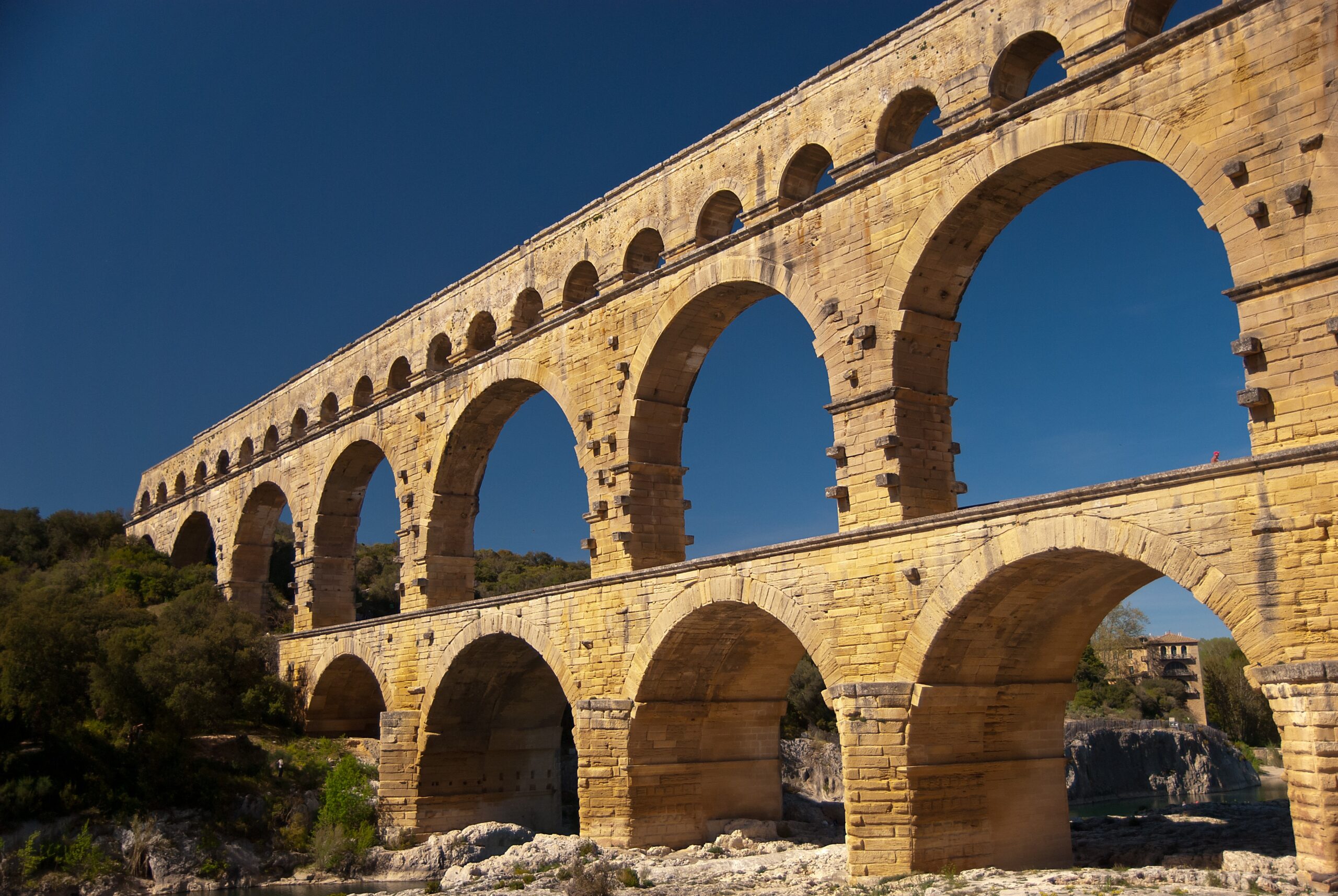
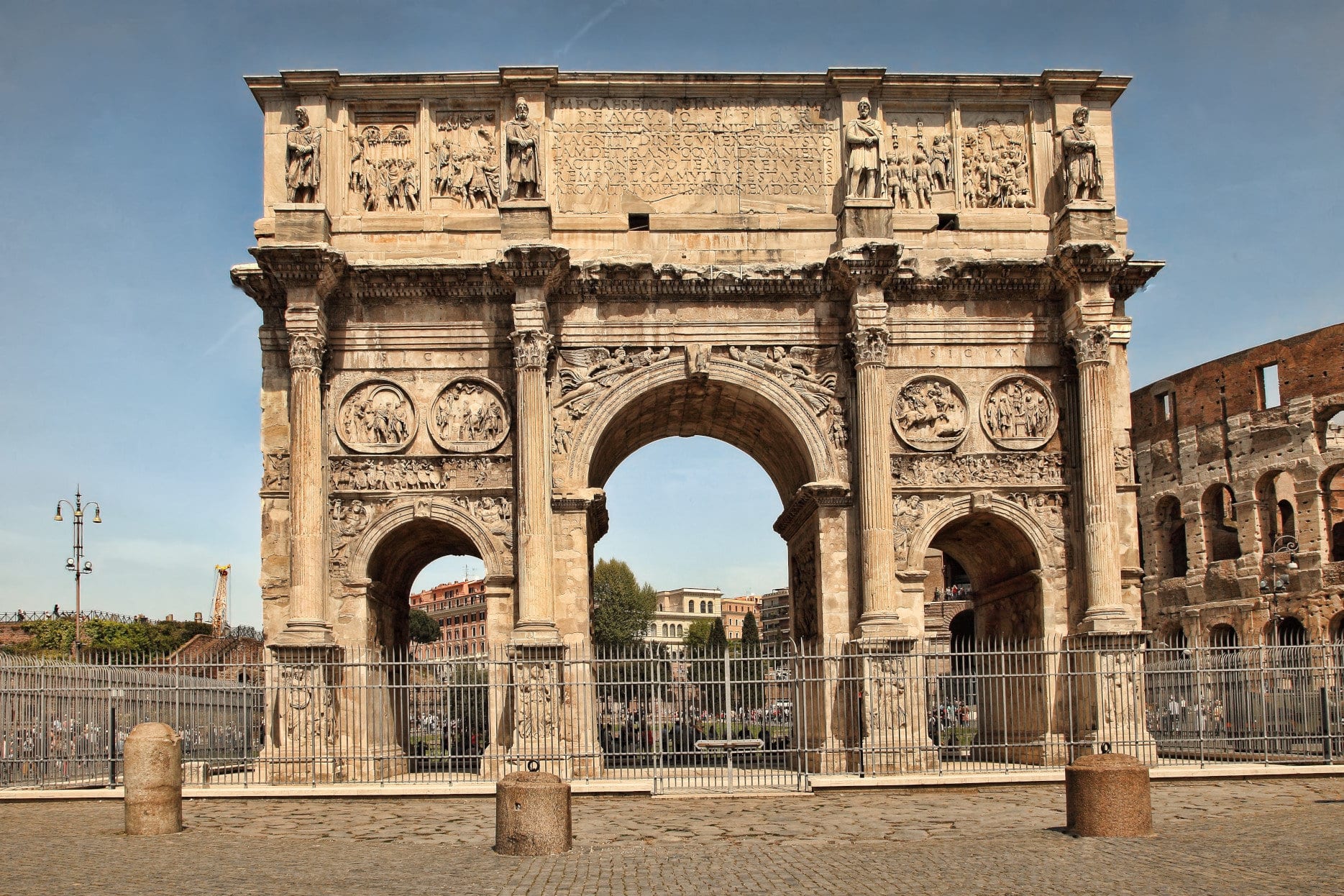
The arch was one of the most important structural features in Roman bridge construction. Although the Romans did not invent the arch, they developed its use on a remarkable scale and incorporated it into bridges, aqueducts, amphitheaters, gateways, and other major structures. For Roman bridge builders, the arch provided a practical way to create strong openings across rivers while supporting a substantial roadway above.
A Roman bridge arch was typically constructed from individual wedge-shaped stones called voussoirs. These stones were arranged around a curved opening so that they pressed against one another. The central stone, known as the keystone, helped lock the arch into position. Once the structure was properly completed, the weight above the arch was transferred through the curved masonry toward the supporting sides and down into the bridge’s foundations.
This was fundamentally different from a simple horizontal beam. A beam placed across a wide opening experiences significant bending forces and can eventually fail if the span becomes too large. An arch instead uses its curved geometry to redirect much of the load into compression, making stone particularly effective as a construction material.
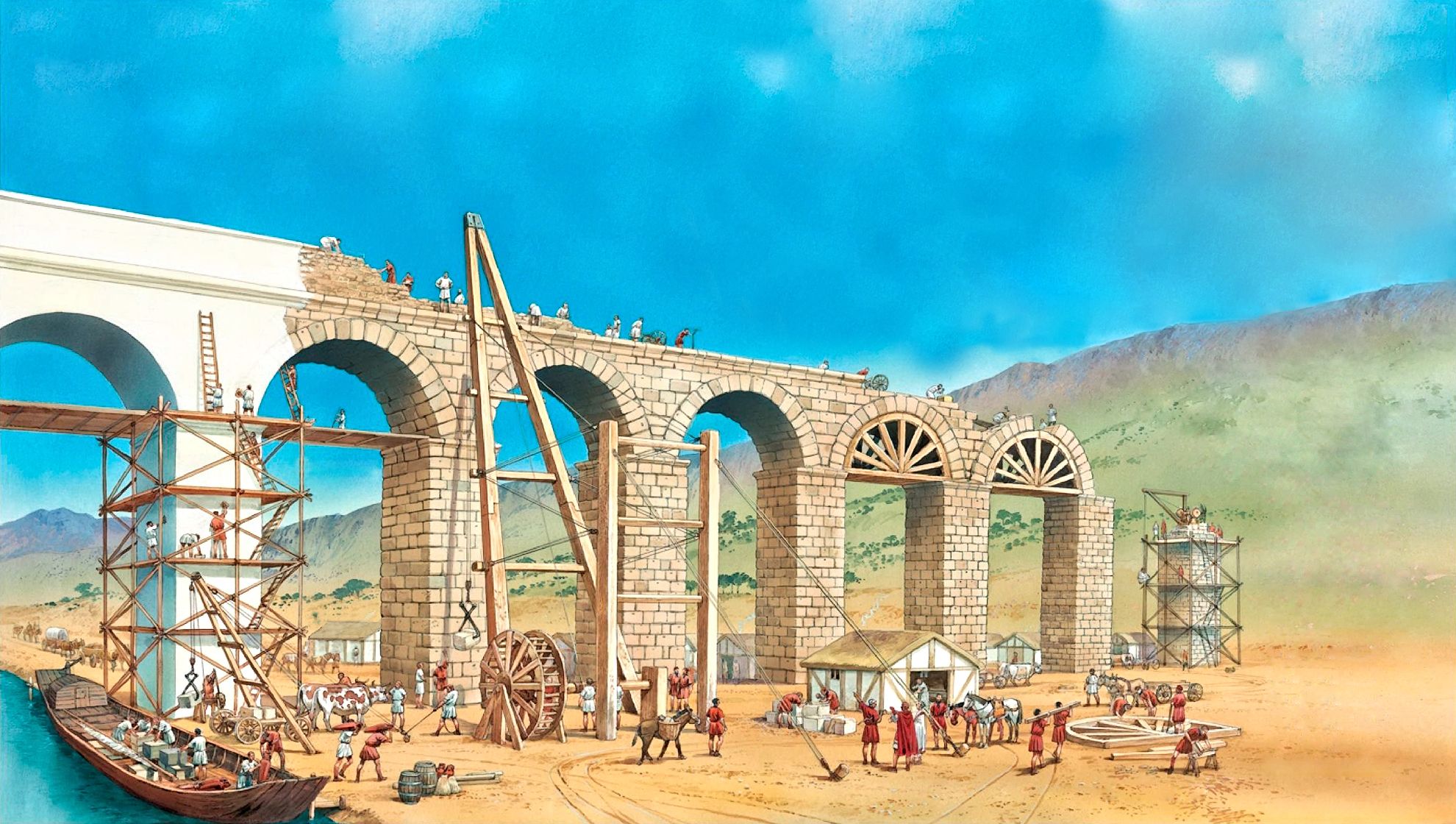
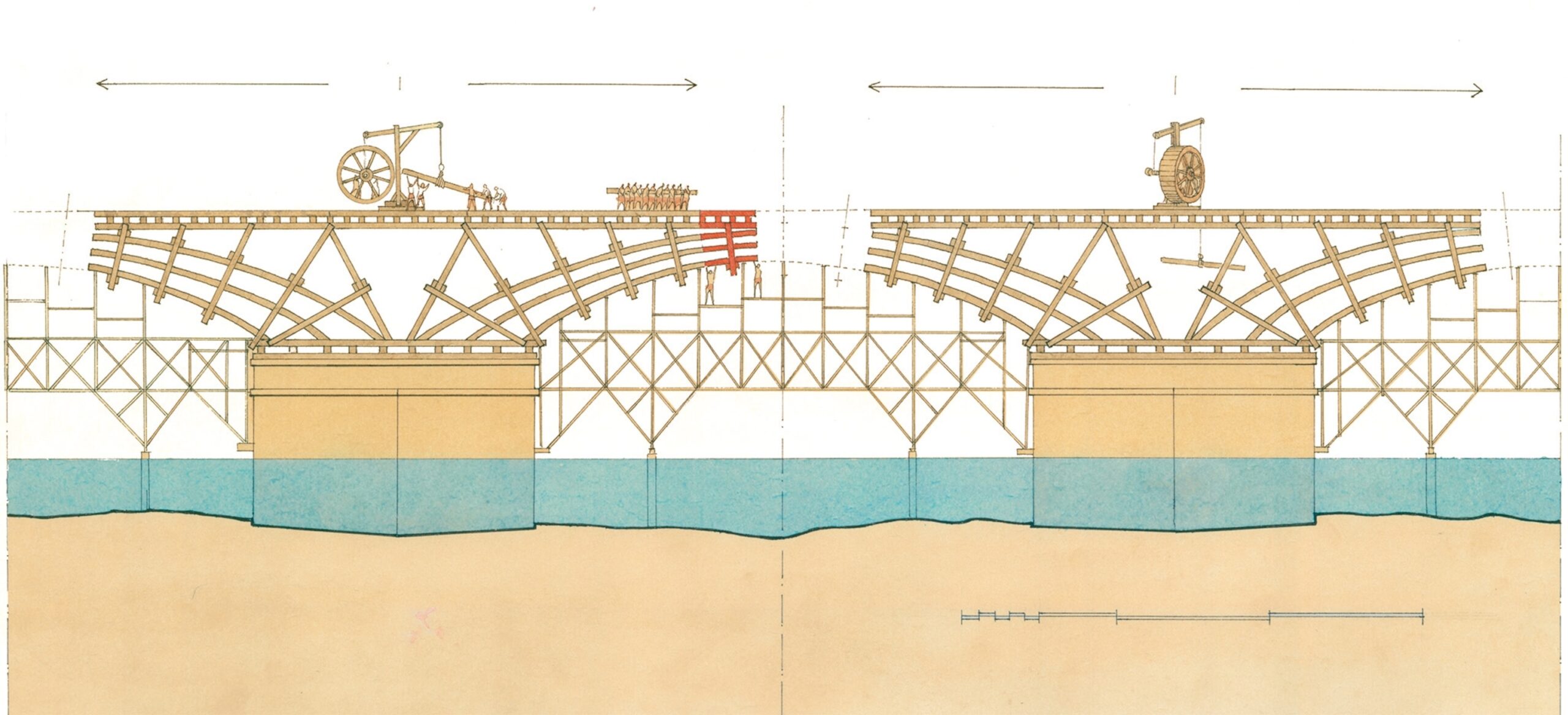
Roman engineers usually constructed arches over temporary wooden frameworks known as centring. The wooden structure supported the stones while the arch was being built. Once the masonry had been completed and the mortar had set sufficiently, the temporary framework could be removed, leaving the finished arch to support itself.
Large bridges often contained multiple arches. Each arch created an opening through which river water could pass, while the masonry between the openings formed substantial piers. The size and arrangement of these arches depended on the width of the river and the expected flow of water.
The bridge piers themselves were extremely important. They had to support the arches and withstand the constant pressure of the river. Roman engineers sometimes gave the upstream faces of piers a pointed or angled shape, helping divide the flow of water and reducing resistance. These projecting structures are commonly known as cutwaters.
The relationship between the arches and piers also affected the overall appearance of a Roman bridge. From a distance, a long bridge could appear as a repeating sequence of massive stone curves. This combination of geometric regularity and structural purpose became one of the defining visual characteristics of Roman engineering.
Not every Roman bridge relied on exactly the same design. Engineers adapted their structures to local conditions, using different materials, arch sizes, foundations, and construction techniques. Some bridges had relatively low arches, while others required much taller structures to cross deep valleys or accommodate waterways.
The arch also made it possible for Roman bridges to become much more than simple functional crossings. Once engineers had mastered the technique, they could construct long sequences of arches carrying roads high above the surrounding landscape. This approach became particularly important in monumental infrastructure such as aqueduct bridges.
The success of Roman bridge architecture ultimately came from combining the arch with other technologies. Strong foundations, high-quality masonry, concrete, careful surveying, and organized construction were all necessary to turn the basic principle of the arch into a durable bridge.
The Roman arch was therefore not simply a decorative feature. It was a fundamental engineering solution that allowed Roman builders to create strong, durable, and sometimes enormous structures across the landscape.
5 Main Ideas
I. The arch allowed Roman engineers to create strong openings while supporting heavy roadways.
II. Wedge-shaped voussoirs and the keystone locked the masonry arch into a stable structure.
III. Temporary wooden centring was commonly used to support arches during construction.
IV. Roman bridge piers had to carry the weight of the structure while resisting powerful river currents.
V. The combination of arches, strong foundations, masonry, and engineering planning allowed Roman bridges to reach impressive sizes.
II. How Roman Engineers Built Bridge Foundations in Rivers
One of the greatest challenges of Roman bridge construction was not building the arches themselves, but creating foundations strong enough to support them. A bridge could contain enormous quantities of stone and masonry, and all of that weight ultimately had to be transferred into the ground beneath the river. Roman engineers therefore had to find ways to construct stable foundations in places that were often wet, unstable, and constantly exposed to moving water.
The first step was choosing a suitable location. Roman surveyors examined the river and surrounding landscape to determine where the bridge should cross. A good location could reduce the width of the crossing, provide more stable ground, and make the construction of the approaches easier. Choosing the right site was itself an important engineering decision.
For bridges crossing rivers, engineers needed to create solid bases for the piers. One method involved constructing cofferdams, temporary enclosures designed to keep water away from a construction area. Timber piles could be driven into the riverbed and connected with wooden structures, creating an enclosed space around the intended foundation. Water could then be removed or controlled sufficiently for workers to prepare the foundation.
Inside these temporary enclosures, Roman builders could construct masonry foundations or lay layers of material that distributed the weight across the riverbed. In some circumstances, concrete was also used as part of the foundation system. Roman concrete was particularly valuable because it could be used in difficult construction environments and could harden in damp conditions, depending on its composition.
Timber played an important role in some foundation systems. Wooden piles could be driven deep into soft ground to provide additional support. In certain environments, timber can survive remarkably well when it remains permanently waterlogged because the conditions can limit the biological processes that normally cause wood to decay. Archaeological discoveries of ancient bridge timbers have therefore provided valuable information about Roman construction.
The bridge piers also had to withstand the force of flowing water. Engineers sometimes built cutwaters on the upstream side of piers. These pointed or angled structures divided the current as water approached the pier, reducing the direct pressure against the masonry. Some bridges also incorporated protective features around their foundations to reduce damage from debris and erosion.
Flooding presented another major challenge. Rivers could rise dramatically during storms or seasonal changes, placing additional pressure on the bridge. Engineers therefore had to consider not only ordinary water levels but also the possibility of exceptional floods. The height and arrangement of the bridge arches could influence how easily floodwater passed beneath the structure.
The foundations were especially important because damage at the bottom of a bridge could eventually affect everything above it. Erosion around a pier, sometimes called scour, could remove material from the riverbed and weaken the foundation. Roman engineers could not eliminate this problem entirely, but their bridge designs often attempted to reduce its effects through substantial masonry and protective structures.
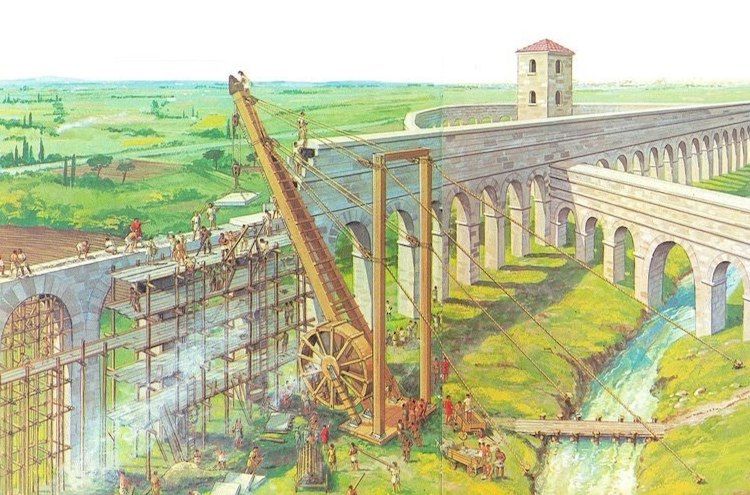
The construction process could require enormous amounts of labor. Stone had to be quarried, transported, shaped, and positioned, while timber was required for temporary structures and construction equipment. Workers also needed to coordinate the construction of piers, arches, roadway surfaces, and approaches.
The result was a remarkable combination of hydraulic engineering, structural engineering, surveying, and construction organization. The visible arches of a Roman bridge may attract the most attention today, but the hidden foundations beneath the water were just as important to its survival.
A Roman bridge could only stand if its foundations remained stable. The engineering beneath the river was therefore the true starting point of the bridge above it.
5 Main Ideas
I. Roman engineers had to create extremely strong foundations to support the enormous weight of bridge masonry.
II. Cofferdams and timber structures could help workers construct foundations in or beside flowing water.
III. Wooden piles and concrete could be incorporated into foundation systems depending on local conditions.
IV. Cutwaters and other protective features helped bridge piers resist flowing water, debris, and erosion.
V. The success of a Roman bridge depended as much on its hidden foundations as on its visible arches.
III. Roman Bridge Construction: Stone, Concrete, Timber, and Building Techniques
Once Roman engineers had selected a suitable location and established stable foundations, the next challenge was constructing the bridge itself. Roman bridge building required enormous quantities of raw materials, skilled labor, careful planning, and specialized techniques. The finished structure might look simple from a distance, but every block, arch, pier, and roadway had to work together as part of a carefully engineered system.
Stone was the most important visible material in many major Roman bridges. Builders could use locally available limestone, sandstone, volcanic stone, or other suitable materials depending on the region. Large blocks were quarried, transported to the construction site, and shaped before being positioned within the bridge.
Roman builders were highly skilled at cutting stone into precise shapes. For an arch, individual voussoirs had to fit together accurately so that the completed curve could distribute weight correctly. Poorly fitted stones could weaken the structure, so precision was essential.
Different parts of a bridge could also use different masonry techniques. Large, carefully cut blocks might form the exterior surfaces, while the interior could contain smaller stones and Roman concrete. This approach allowed engineers to construct massive structures without requiring every part of the bridge to consist of enormous blocks of precisely shaped stone.
Roman concrete, known as opus caementicium, was particularly important to Roman construction. It was made using a mixture of mortar and aggregate, and volcanic materials such as pozzolana could give certain Roman concrete mixtures remarkable properties. Concrete could be poured into prepared spaces, allowing engineers to create strong structural cores behind stone facings.
Timber was also essential even when the finished bridge appeared entirely made of stone. Temporary wooden frameworks supported arches while they were being constructed. These centring structures held the voussoirs in position until the masonry could support itself. Once an arch was complete, workers could carefully remove the temporary framework and reuse the timber elsewhere.
Construction equipment was another important part of the process. Roman builders used cranes, hoists, ropes, pulleys, scaffolding, and lifting devices to move heavy materials. Archaeological and written evidence demonstrates that Roman engineers possessed sophisticated mechanical knowledge and could move extremely heavy stones with relatively simple machines when combined with organized labor.
The bridge roadway was constructed above the arches and piers. It needed to be strong enough to carry carts, animals, soldiers, and pedestrians while also providing a reasonably practical route across the river. Depending on the bridge, the roadway could be relatively flat or rise and fall according to the surrounding landscape and structural requirements.
Construction was therefore carefully coordinated. Engineers had to ensure that the foundations, piers, arches, and roadway remained correctly aligned throughout the project. Surveying instruments and established Roman measurement techniques helped builders maintain accurate lines and levels.
The scale of major bridge projects could be enormous. Stone had to be extracted from quarries, transported over considerable distances, and prepared at or near the construction site. Food, tools, timber, and other supplies also had to be organized for the workers.
Roman bridges were consequently products of both engineering knowledge and large-scale organization. Their durability was not the result of one revolutionary invention. Instead, it came from the successful combination of materials, structural principles, machinery, surveying, skilled craftsmanship, and disciplined construction.
The finished bridge concealed much of this complexity. What appeared to be a simple line of stone arches was actually the result of a carefully coordinated construction process that could take years to complete.
5 Main Ideas
I. Stone was the principal visible material used in many major Roman bridges.
II. Roman concrete could provide strong structural cores behind stone-faced masonry.
III. Timber centring temporarily supported arches while their stones were being positioned.
IV. Cranes, pulleys, ropes, scaffolding, and other machinery helped Roman workers move heavy construction materials.
V. Roman bridge construction depended on precise surveying, skilled craftsmanship, materials, and large-scale organization.
IV. Roman Bridge Design: Piers, Arches, Roadways, and the Shape of a Bridge
Roman bridge design was based on much more than simply placing a series of arches across a river. Every part of the structure had a specific purpose, and the relationship between the piers, arches, roadway, and foundations determined whether the bridge could carry its intended loads safely. Roman engineers developed different designs according to the width of the river, the strength of the ground, the available materials, and the needs of the road network.
The piers were among the most important components. They stood between the arches and transferred the weight of the upper structure down into the foundations. Because they were positioned directly in or beside the river, they also had to withstand flowing water, floating debris, and flooding.
Many Roman bridge piers were built with substantial thickness. This provided stability and gave the arches strong points of support. On the upstream side, engineers could construct cutwaters, which projected outward from the pier and divided the approaching current. This reduced the amount of water striking the flat face of the pier and helped protect the structure.
The arches themselves could vary considerably in size. A bridge might contain several relatively small arches or fewer large arches spanning wider sections of the river. Larger arches could allow more water to pass beneath the bridge and could reduce the number of piers required in the river.
The arrangement of the arches also affected the appearance of the bridge. Some Roman bridges were long and relatively low, while others rose dramatically above the surrounding landscape. The design depended heavily on the geography. A bridge crossing a broad, relatively shallow river required a different solution from one crossing a narrow but deep gorge.
Above the arches was the roadway, which had to be sufficiently strong and wide for its intended traffic. Roman roads were carefully engineered, and the bridge roadway normally formed part of the same transportation system. The transition from road to bridge therefore had to be carefully planned.
The roadway could sometimes have a noticeable upward curve toward the center of the bridge. This type of design, often called a camber, could help with drainage and structural requirements. Other bridges were comparatively flat. There was no single standard Roman bridge profile.
Drainage was also important. Rainwater could damage masonry if it remained on the roadway, so Roman builders needed ways to move water away from the surface of the bridge. The exact drainage arrangements varied between structures.
The bridge’s proportions were equally important. Engineers had to balance the width of the roadway with the structural requirements of the arches and piers. A wider roadway meant additional weight, while larger openings required careful calculation and strong supporting structures.
Roman bridges could also be designed with architectural decoration. Some were relatively plain, emphasizing engineering and practicality, while others included inscriptions, decorative masonry, statues, or monumental features. In important locations, a bridge could become a major architectural landmark.
The design of a Roman bridge therefore represented a constant balance between strength, efficiency, geography, and appearance. Engineers could not simply copy the same structure everywhere. They had to adapt their designs to individual rivers and landscapes.
This adaptability was one of the strengths of Roman engineering. The same basic principles—the arch, pier, foundation, and roadway—could produce bridges of dramatically different sizes and shapes. From modest crossings to enormous monumental structures, Roman engineers used a common architectural language while adapting it to the environment.
5 Main Ideas
I. Roman bridge design depended on the relationship between piers, arches, foundations, and the roadway.
II. Bridge piers supported the arches while also resisting the force of flowing water and floods.
III. Cutwaters helped protect piers by dividing the current before it struck the masonry.
IV. The size and arrangement of arches varied according to the river, terrain, materials, and structural requirements.
V. Roman engineers adapted their bridge designs to individual landscapes rather than using one standard design everywhere.
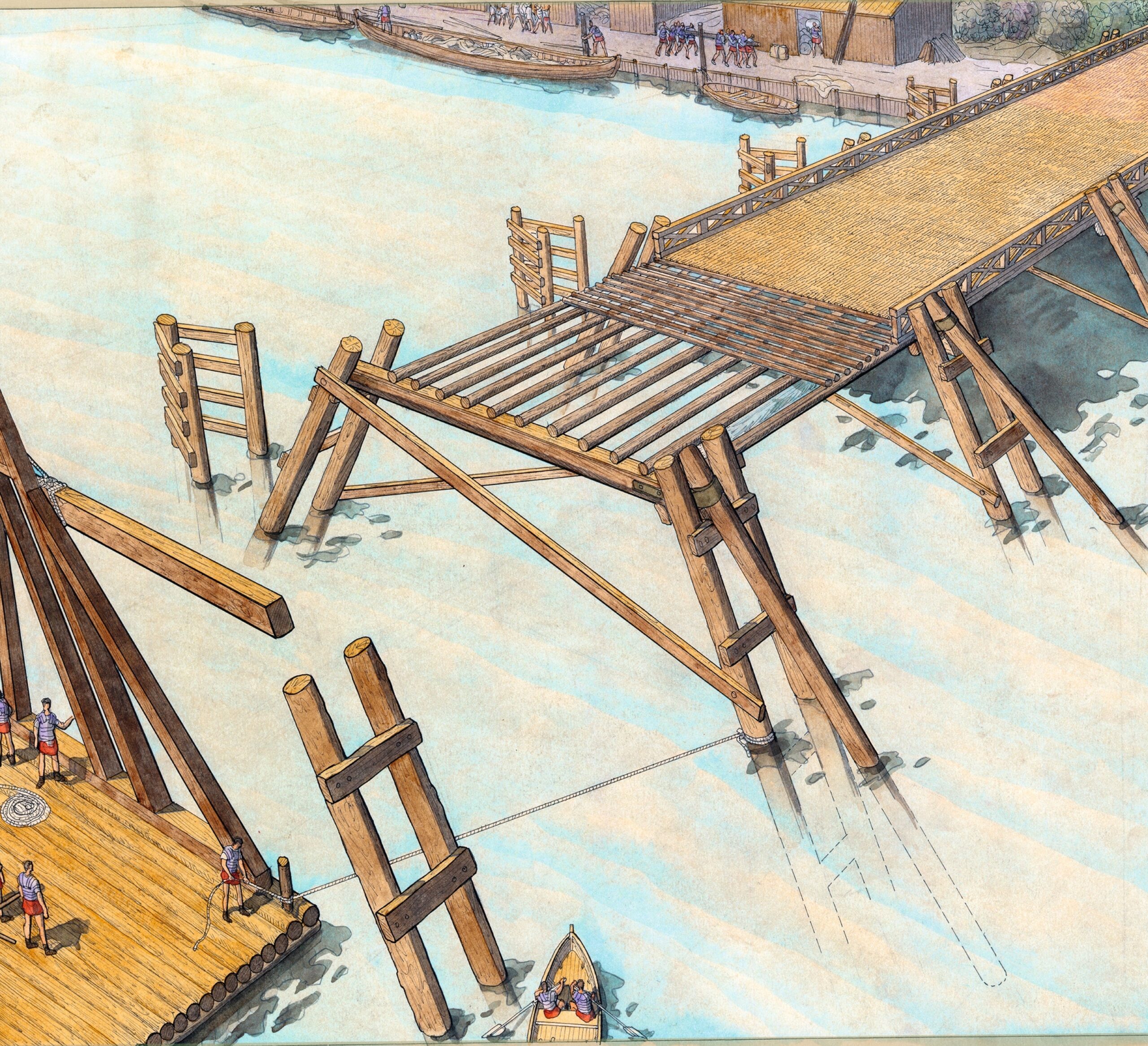
V. Famous Roman Bridges: The Greatest Surviving Examples of Roman Engineering
Across the former Roman world, the remains of ancient bridges provide some of the clearest evidence of Roman engineering ability. Although many bridges have disappeared because of floods, warfare, reconstruction, or the reuse of their stone, a remarkable number of Roman structures still survive. These bridges vary greatly in size and design, demonstrating how Roman engineers adapted their methods to different rivers and landscapes.
One of the most famous examples is the Alcántara Bridge in Hispania, built across the Tagus River during the reign of Emperor Trajan in the early 2nd century AD. The bridge is composed of a series of large stone arches and rises dramatically above the river. Its substantial scale demonstrates the ability of Roman engineers to construct major transportation infrastructure across challenging landscapes.
Another important example is the Ponte Sant’Angelo in Rome, originally constructed under Emperor Hadrian as a bridge connecting the city with his mausoleum, now known as Castel Sant’Angelo. The original Roman structure was later modified and decorated, so the bridge visible today combines ancient foundations and elements with later additions. It demonstrates how Roman infrastructure could continue to be used and transformed for centuries.
The Ponte Fabricio, also in Rome, is particularly significant because much of its ancient structure has survived. Built in the 1st century BC, it crosses the Tiber and remains one of the oldest bridges in Rome still serving a practical purpose. Its survival demonstrates how durable Roman masonry could be when a bridge was properly maintained.
The Ponte Cestio, also crossing the Tiber, has ancient origins but has undergone substantial reconstruction. Like many Roman structures, its history illustrates an important point: a bridge can remain in continuous use while being repeatedly repaired and altered. Not every surviving Roman bridge is completely original, and archaeologists must distinguish ancient material from later additions.
Perhaps the most ambitious Roman bridge project was Trajan’s Bridge over the Danube, constructed under Emperor Trajan around AD 105–106. Designed by the architect Apollodorus of Damascus, the bridge crossed one of the empire’s major rivers near Drobeta. Its original structure was enormous, extending for more than a kilometer when its approaches are considered. Much of the bridge no longer survives, but its remains and ancient descriptions demonstrate the extraordinary scale of the project.
The Pont-Saint-Martin in northern Italy is another surviving Roman bridge known for its large central arch. Its construction is generally dated to the late Republican or early Imperial period, although the exact chronology has been debated. Its impressive masonry demonstrates how Roman engineers could adapt arch construction to difficult terrain.
Roman bridges were also built throughout Gaul, North Africa, the Balkans, Asia Minor, and other provinces. Their distribution reflects the importance of transportation infrastructure throughout the empire. Bridges allowed Roman roads to cross rivers and helped connect military bases, settlements, ports, agricultural regions, and administrative centers.
These structures should not be judged only by whether they remain completely intact today. Archaeologists can learn from surviving piers, foundations, inscriptions, stonework, construction techniques, and fragments of collapsed arches. Even incomplete remains can reveal how the original bridge was designed.
The famous surviving examples also demonstrate that Roman bridge engineering was not a single architectural style. Engineers used common principles but adapted them to local conditions. Some bridges were monumental, while others were comparatively modest. Some crossed enormous rivers, while others connected roads across smaller waterways.
Together, these structures demonstrate the extraordinary geographical reach of Roman engineering. Wherever Roman roads needed to cross difficult terrain, bridge builders developed solutions suited to the landscape. The surviving bridges are therefore not isolated monuments but parts of the enormous transportation network that helped connect the Roman world.
5 Main Ideas
I. Roman bridges survive across Europe and the Mediterranean, demonstrating the geographical reach of Roman engineering.
II. The Alcántara Bridge is one of the most impressive surviving examples of monumental Roman bridge construction.
III. Trajan’s Bridge over the Danube demonstrated the extraordinary scale that Roman bridge engineering could achieve.
IV. Many surviving Roman bridges contain later repairs and alterations, so archaeologists must distinguish ancient and later construction.
V. Roman bridges varied greatly in size and design while sharing common engineering principles based on arches, piers, foundations, and masonry.
VI. Roman Bridges and the Roman Road Network: Connecting the Empire
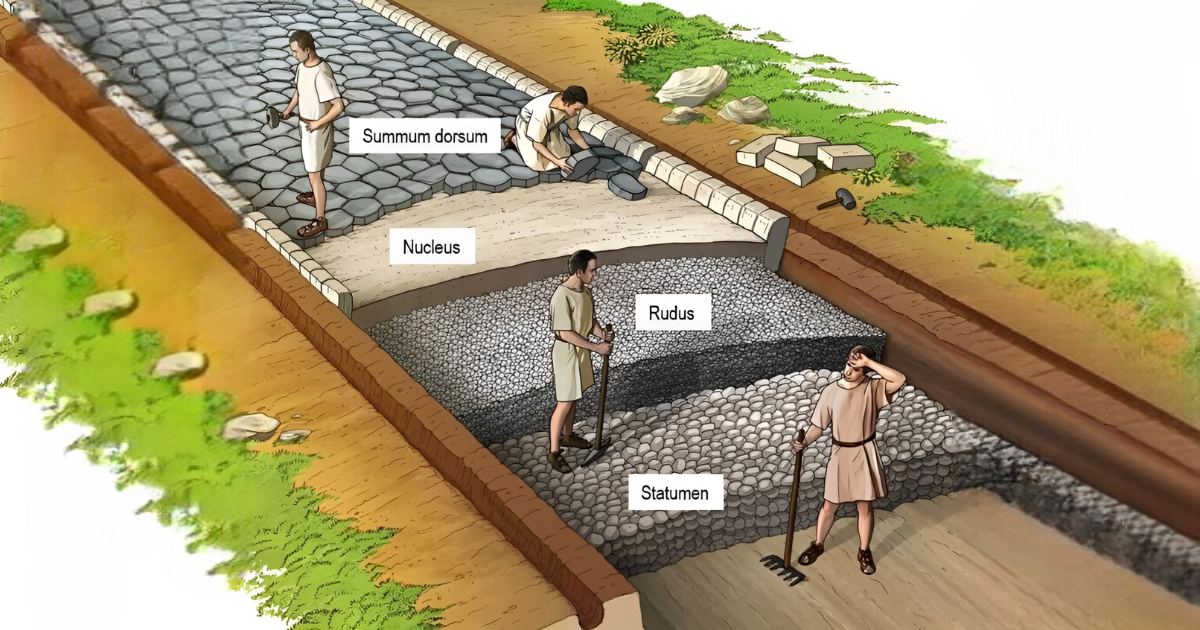
Roman bridges were most effective when they were connected to the vast network of roads that crossed the Roman Empire. A bridge was rarely an isolated structure. Instead, it formed one part of a much larger transportation system that connected cities, military bases, ports, agricultural areas, and administrative centers. The combination of roads and bridges allowed people and goods to move across landscapes that would otherwise have been difficult to cross.
Roman road builders carefully planned routes across the landscape. Where a road encountered a river, engineers had to determine whether the waterway could be crossed using a simple ford, a temporary wooden structure, or a permanent masonry bridge. Major rivers and important routes often justified the enormous effort required to construct permanent bridges.
The position of a bridge could therefore have a major influence on the surrounding road network. Once a permanent crossing had been constructed, roads could be directed toward it from both sides of the river. The bridge became a fixed point within the transportation system, helping establish reliable routes between settlements.
This was particularly important for the Roman military. Armies needed dependable transportation routes for soldiers, weapons, food, animals, and other supplies. A river that could not be crossed easily could delay an entire military movement. Permanent bridges reduced this problem and allowed Roman forces to move through provinces more efficiently.
Trade benefited from the same infrastructure. Merchants transporting agricultural products, pottery, metals, wine, olive oil, and other goods could use established roads and bridges to travel between regions. Reliable crossings reduced the uncertainty of long-distance transportation, particularly during periods of high water when fords might become unusable.
Roman bridges also supported the movement of government officials. The empire depended on communication between cities and provincial administrations, and roads provided important routes for messengers and officials. Bridges helped maintain these connections even where rivers would otherwise divide communities.
The construction of a major bridge could also influence settlement patterns. Roads often encouraged the development of towns, markets, inns, workshops, and other services along important routes. A bridge crossing could become a strategic location where travelers and merchants naturally concentrated.
Roman engineers also had to connect bridge approaches smoothly with the surrounding terrain. A bridge could not simply end at the riverbank. Roads leading toward it needed appropriate gradients, drainage, paving, and retaining structures. In mountainous or uneven areas, engineers might need to construct additional infrastructure before the road could reach the bridge.
Maintenance was equally important. Bridges were exposed to floods, erosion, earthquakes, weather, and constant traffic. A damaged bridge could interrupt an entire transportation route. Roman authorities therefore had to repair infrastructure when necessary. Some bridges remained in use for centuries and were repeatedly repaired by later Roman officials or, eventually, medieval communities.
The road-and-bridge system also helped reinforce the physical integration of the empire. Roman territory stretched across enormous distances, and different provinces possessed very different landscapes. Roads and bridges allowed these regions to remain connected despite mountains, rivers, valleys, and other natural obstacles.
This is why Roman bridges should be understood as part of Roman infrastructure rather than as isolated architectural monuments. Their importance came from what they allowed people to do. A bridge transformed a difficult geographical barrier into a controlled crossing and made the wider road network more reliable.
The Roman achievement was therefore not simply the construction of individual bridges. It was the creation of an interconnected transportation system in which roads, bridges, settlements, ports, and administrative centers worked together. The bridge was one of the essential pieces that made that system possible.
5 Main Ideas
I. Roman bridges formed essential connections within the wider Roman road network.
II. Permanent bridges made important river crossings more reliable for armies, merchants, officials, and travelers.
III. Bridge locations could influence the development of settlements, markets, and transportation routes.
IV. Roads approaching bridges required careful planning, drainage, paving, and adaptation to the surrounding landscape.
V. Roman bridges helped connect distant provinces by overcoming rivers and other major geographical barriers.
VII. The Survival and Legacy of Roman Bridges
One of the most remarkable aspects of Roman bridge architecture is that many Roman bridges have survived for nearly two thousand years. Some remain standing almost entirely intact, while others survive only as foundations, piers, or sections of arches. Their survival provides valuable evidence of Roman engineering and allows modern historians, archaeologists, and engineers to study construction techniques that were developed in antiquity.
The durability of Roman bridges began with their original construction. A well-designed bridge depended on strong foundations, carefully fitted masonry, stable arches, and protection against water and erosion. When these elements worked together, the resulting structure could withstand enormous forces for generations.
However, survival does not mean that a bridge remained completely untouched. Many Roman bridges were repaired repeatedly throughout their history. Floods could damage arches, earthquakes could weaken masonry, and sections of a bridge could collapse or become unstable. Later rulers and communities often repaired these structures rather than abandoning them.
This creates an important archaeological problem. A bridge that is described as “Roman” may contain medieval or modern additions. Researchers therefore examine the masonry, construction techniques, inscriptions, foundations, and individual building phases to determine which parts belong to the Roman period and which were added later.
Some bridges survived because they remained useful. A bridge that continued to provide an important river crossing had a practical reason to be maintained. Communities could repair damaged sections and adapt the roadway to changing transportation needs. In this way, Roman engineering sometimes became part of the infrastructure of later civilizations.
Other bridges survived because their locations remained important even after the Roman Empire disappeared in the West. Roads changed, political boundaries changed, and transportation technology developed, but certain geographical crossings remained valuable. A bridge positioned at a particularly useful point on a river could continue attracting traffic for centuries.
The survival of Roman bridges has also made them important subjects of modern archaeological research. Researchers can study the size of individual stones, the arrangement of masonry, the shape of arches, construction joints, foundation techniques, and traces of repairs. These details can reveal how Roman builders organized their work and how the bridge changed over time.
Roman bridges have also influenced later architecture. The Roman use of arches and masonry construction became an important part of the architectural traditions that developed across Europe and the Mediterranean. Medieval builders frequently constructed bridges using similar principles, although their techniques and designs were not identical to those of Roman engineers.
Modern engineers can also learn from ancient bridges. Their survival demonstrates the effectiveness of certain structural principles, particularly the use of compression-based masonry arches and substantial foundations. Ancient structures are not automatically perfect or indestructible, but their longevity provides useful evidence about how materials and structures behave over very long periods.
Some surviving bridges have become architectural monuments in their own right. Their importance is no longer simply practical. They represent physical connections between the modern world and the Roman past, allowing people to see ancient engineering rather than only reading about it.
Perhaps the greatest legacy of Roman bridges is therefore their combination of function and endurance. They were built to solve practical transportation problems, but many became monuments because their engineering allowed them to survive long after the society that constructed them had changed.
The surviving bridges demonstrate that Roman architecture was not simply about creating impressive buildings. It was also about creating infrastructure capable of shaping the landscape for centuries. A Roman bridge could begin as a practical road crossing and eventually become an archaeological monument, preserving evidence of Roman engineering long after the original builders had disappeared.
5 Main Ideas
I. Many Roman bridges survived because of strong foundations, durable masonry, and effective structural design.
II. Surviving bridges often contain medieval or modern repairs, making archaeological analysis important.
III. Bridges that remained useful transportation routes were often repeatedly maintained and adapted.
IV. Roman bridge construction influenced later architectural and engineering traditions across Europe and the Mediterranean.
V. Surviving Roman bridges provide physical evidence of the durability and sophistication of ancient Roman engineering.