
The effectiveness of the Roman legionary did not depend solely on discipline and training but also on a standardized set of weapons, armor, tools, and personal equipment designed for versatility in combat and endurance on campaign. Roman soldiers were expected to fight, march long distances, construct camps, and survive in hostile environments while carrying much of their own gear. This made their equipment an essential part of Rome’s military success.
Standardization allowed legions to operate efficiently across vast territories. Each legionary carried equipment that served multiple purposes: protection in battle, capability in siege and construction work, and survival during long marches. The combination of defensive armor, offensive weapons, engineering tools, and personal supplies turned each soldier into a self-sufficient unit within the larger military machine.
Understanding the equipment of the average Roman legionary reveals how Rome’s armies maintained mobility, durability, and tactical superiority over enemies throughout the Republic and the Empire.
Gladius: The Primary Weapon of the Legionary
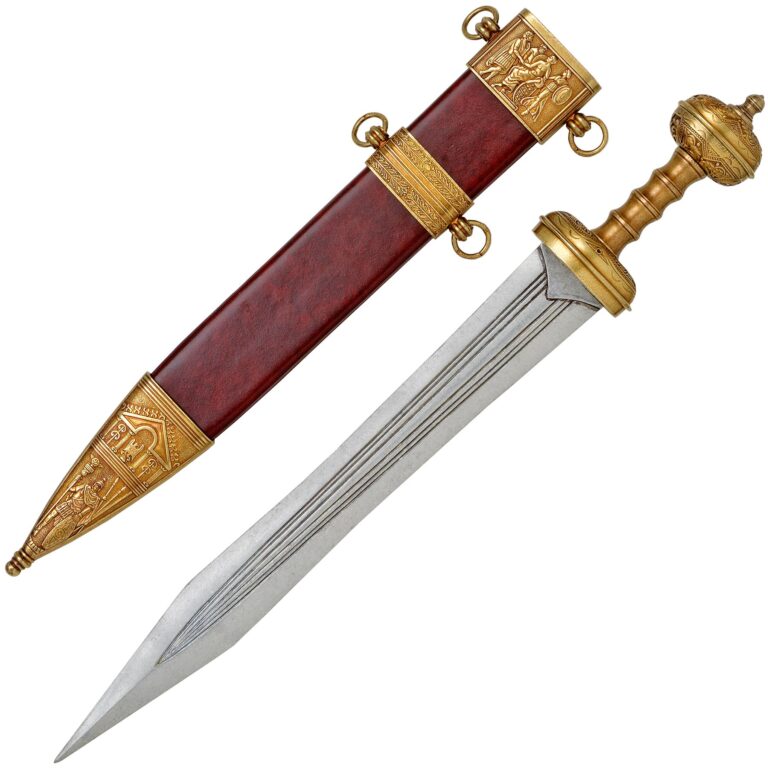
The gladius was the short sword that became the symbol of Roman infantry power. Designed primarily for thrusting, it allowed legionaries to stab effectively from behind the protection of their shields. The blade was typically around 50–55 cm long, double-edged, and made of iron or steel. Its compact size made it ideal for close-quarters combat within tight formations.
Roman training emphasized stabbing rather than slashing because thrusts were more lethal and required less space. The gladius worked perfectly with Roman tactics, where soldiers fought shoulder to shoulder in disciplined ranks. It was worn on the right side to avoid interference with the shield.
Over time, variations such as the Mainz, Fulham, and Pompeii types appeared, but the purpose remained the same: a reliable, deadly weapon for disciplined infantry combat.
Key Ideas
Short sword designed for thrusting
Ideal for fighting behind the scutum
Variations: Mainz, Fulham, Pompeii
Worn on the right side
Central to Roman close-combat tactics
Scutum: The Defensive Backbone
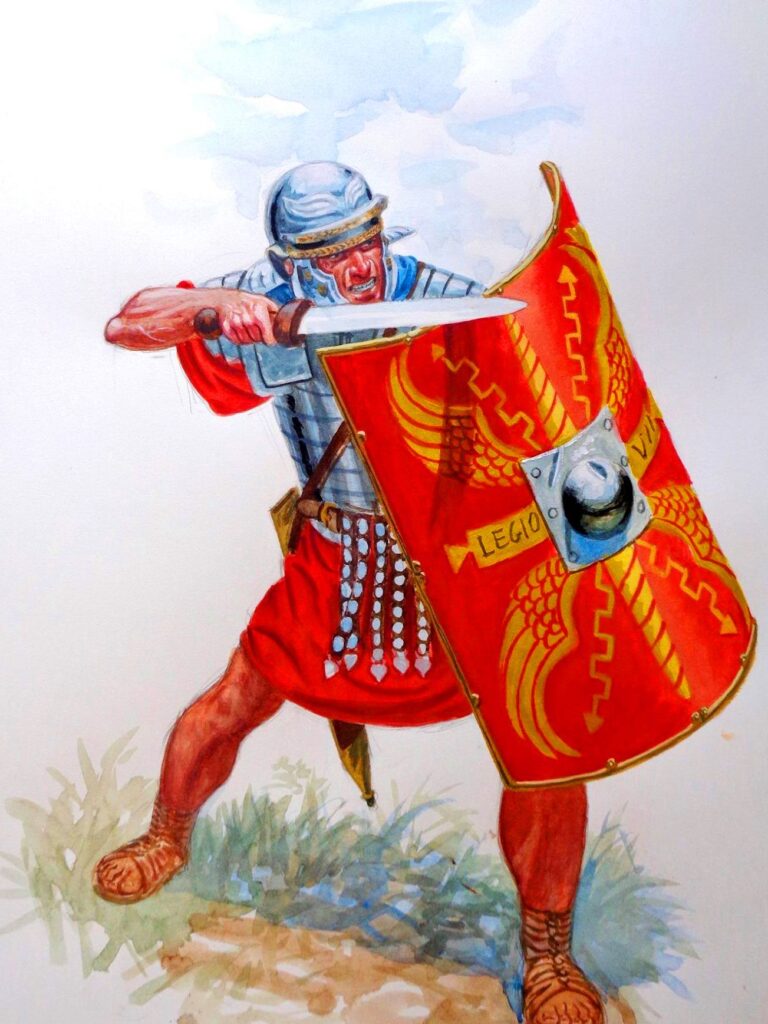
The scutum was the large rectangular shield that defined Roman military strategy and battlefield effectiveness. Constructed from layers of wood glued together, often covered with leather or canvas, and reinforced with a central metal boss called an umbo, the scutum offered both defensive and offensive advantages. Its slightly curved shape allowed the shield to wrap around a soldier’s body, protecting the chest, shoulders, and legs while providing stability in formation fighting. Legionaries used it to deflect projectiles, push against enemies, and maintain cohesion in the ranks.
The scutum was essential for Roman tactical formations, particularly the testudo or “tortoise” formation, where soldiers locked shields overhead and on the sides to protect against missiles. This tactic proved invaluable during sieges or when facing archers. Its large surface area also allowed soldiers to physically push opposing lines while remaining largely protected from counterattacks. Each shield was often decorated with the symbols of the legion or unit, strengthening esprit de corps and enabling commanders to identify units on the battlefield.
The scutum was heavy, generally weighing 10–12 kg, and required training to use effectively. Legionaries practiced maneuvering with it while advancing or retreating, integrating it seamlessly with their gladius for offensive strikes. The combination of shield and sword gave Roman infantry unmatched effectiveness in close combat throughout the Republic and Empire.
Key Ideas
Large, rectangular curved shield for body protection
Reinforced with a central metal umbo
Vital for formations like the testudo
Painted with legion symbols for unit identity
Enabled both defensive stability and offensive pushing

Pilum: The Specialized Throwing Spear
The pilum was a heavy javelin carried by every Roman legionary and represented a uniquely Roman innovation in battlefield weaponry. Designed for throwing, the pilum allowed soldiers to strike enemy lines before close combat with the gladius. Its construction typically consisted of a long wooden shaft, about 1.2 meters in length, topped with a slender iron shank ending in a pyramidal point. The iron portion was deliberately soft or designed to bend upon impact, preventing enemies from throwing the weapon back and often rendering their shields ineffective.
Each legionary carried one or two pila, which were thrown at the enemy just before engaging in hand-to-hand combat. The pilum’s weight and aerodynamic design ensured that it could penetrate shields and armor while disrupting formations. The bending of the iron shank on impact was an ingenious feature: it would embed into enemy shields and armor, making it cumbersome to remove and reducing the effectiveness of opposing defenses. This gave Roman soldiers a tactical advantage before the close-quarters engagement with their gladii.
The pilum also demonstrates the Roman military’s emphasis on combined arms tactics and preparation. It was not only a weapon but a tool for softening enemy resistance and controlling the battlefield. Its standardization across the legions ensured that every soldier could participate effectively in this pre-emptive strike phase of battle, reflecting Rome’s discipline, planning, and innovation.
Key Ideas
Heavy javelin carried by all legionaries
Designed to disrupt enemy formations before close combat
Iron shank bent on impact, disabling enemy shields
Typically carried one or two per soldier
Showed Roman emphasis on discipline, strategy, and battlefield innovation

Helmet (Galea): Head Protection and Identity
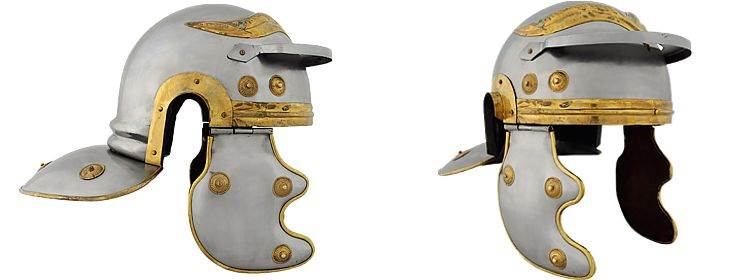
The galea was an essential part of a legionary’s armor, providing protection for the head, face, and neck while maintaining mobility and sensory awareness. Constructed primarily from iron or bronze, the helmet consisted of a rounded dome to protect against downward strikes, reinforced cheek guards to shield the sides of the face, and a flared neck guard to prevent injuries from behind. Some versions included a crest holder for decorative plumes, which were often used to signify rank, unit, or command position, particularly among centurions or officers.
Helmets evolved over time to balance protection and comfort. Early Republican designs prioritized basic defense, while Imperial versions improved weight distribution, padding, and fit, allowing soldiers to wear them for extended periods during long marches, sieges, or battles. Padded liners reduced fatigue and prevented chafing, ensuring that soldiers could maintain combat readiness.
Beyond physical protection, the galea contributed to battlefield discipline and cohesion. Uniform helmets helped commanders identify units amidst the chaos of combat, and the standardized design symbolized the organizational efficiency of the Roman army. Soldiers were responsible for the maintenance of their helmets, including polishing metal surfaces, repairing dents, and ensuring straps remained secure. A damaged or ill-fitting galea could compromise survival during a fight, highlighting the importance of upkeep.
Key Ideas
Constructed from iron or bronze with cheek and neck guards
Protected vital areas while maintaining visibility and hearing
Crests indicated rank or unit identity
Padded for comfort during extended use
Critical for both survival and maintaining battlefield discipline
Body Armor: Lorica Segmentata, Hamata, and Squamata
Roman legionaries wore a variety of body armor depending on availability, period, and tactical needs. The most iconic was the lorica segmentata, composed of overlapping iron strips fastened to leather straps. This armor offered exceptional protection against slashing and stabbing attacks while allowing flexibility for swordplay. Earlier armor types included the lorica hamata, a chainmail shirt providing even coverage, and the lorica squamata, or scale armor, made of small iron or bronze scales sewn onto a cloth or leather backing.
Armor balanced protection, mobility, and weight. The segmentata, though heavier, provided robust defense for the torso and shoulders without significantly restricting movement. Chainmail allowed fluid arm movement and full coverage, while scale armor offered moderate protection and was often used by auxiliary troops or early legionaries. Legionaries were trained to fight effectively while wearing their armor, integrating it seamlessly with shields and weapons during combat maneuvers.
Maintenance was essential. Soldiers polished metal surfaces, oiled leather straps, and repaired damaged components regularly to prevent rust or structural failure. Properly maintained armor not only protected soldiers but reinforced discipline, unity, and intimidation. A fully armored legionary advancing in formation presented an organized, imposing presence that contributed to Roman battlefield dominance.
Key Ideas
Lorica segmentata: iron strips, strong and flexible
Lorica hamata: chainmail, consistent protection
Lorica squamata: scale armor sewn to cloth or leather
Balanced protection and mobility for combat
Required regular maintenance
Enhanced discipline, cohesion, and intimidation

Military Belt (Cingulum) and Dagger (Pugio)
The cingulum, or military belt, was both a functional and symbolic piece of equipment for Roman legionaries. Worn around the waist, it held the gladius securely and symbolized a soldier’s status within the army. The belt often featured decorative metal fittings or plates, indicating rank or unit affiliation, and played a psychological role, reminding soldiers of their martial duty and identity as Roman infantrymen.
Alongside the belt, the pugio, a small dagger, was carried as a secondary weapon. Though less prominent than the gladius, the pugio served multiple purposes: close combat defense, utility tool, or emergency weapon if the primary sword was lost. Its design was compact, sharp, and easily accessible, making it a reliable backup during chaotic battle conditions.
Both the cingulum and pugio were standard-issue and carefully maintained. Soldiers were responsible for keeping the metal fittings polished, leather straps intact, and the dagger sharp. Beyond combat utility, the belt and dagger reinforced the image of the legionary as disciplined, self-sufficient, and prepared. They symbolized the combination of practicality and military tradition that characterized Roman infantry.
Key Ideas
Cingulum held the gladius and signified military status
Often decorated with metal fittings indicating rank
Pugio served as a backup weapon and tool
Both reinforced discipline and self-sufficiency
Standard issue for all legionaries


Marching Pack (Sarcina): The Soldier’s Burden
Roman legionaries carried their equipment and personal supplies in a sarcina, a pack suspended on a wooden pole called a furca. This pack contained essential items for survival, including cooking utensils, rations, spare clothing, blankets, and personal tools. The sarcina allowed the soldier to be self-sufficient during long marches and campaigns far from supply lines.
Packing efficiently was crucial. Each legionary was trained to balance weight, distribute it evenly, and carry the load over long distances. Standardization ensured that every soldier carried similar gear, enabling uniform marching speeds and reducing logistical confusion. The sarcina also contained tools for constructing temporary camps, reflecting the dual role of soldiers as both fighters and engineers.
The ability to carry one’s own supplies and equipment made the Roman army exceptionally mobile and adaptable. Legionaries could march dozens of kilometers per day, fight upon arrival, and construct fortifications without relying entirely on external resources. This mobility and self-sufficiency were key to Rome’s military success and expansion.
Key Ideas
Pack carried on a furca over the shoulder
Contained rations, clothing, personal items, and tools
Standardized to ensure uniform weight distribution
Enabled self-sufficiency during campaigns
Supported mobility, endurance, and fortification building

Tools: Engineering and Camp Construction
Roman legionaries were trained not only as soldiers but also as engineers, carrying essential tools for construction and siege operations. Standard tools included a pala (shovel), dolabra (pickaxe or mattock), and other implements for digging trenches, building ramparts, and fortifying camps. Each soldier carried these tools in addition to weapons, demonstrating the multifunctional demands placed on the average legionary.
Daily training ensured that soldiers could rapidly construct fortified camps (castra) after every day of marching. These camps included defensive walls, ditches, watchtowers, and gates, providing security and operational readiness. The tools also enabled siege operations, road building, and other engineering projects critical to military campaigns.
The emphasis on engineering reflected Rome’s belief that a disciplined soldier should be capable of sustaining the army in hostile environments. Proper use and maintenance of tools were mandatory, as a soldier’s survival and the unit’s operational effectiveness depended on their skill. Legionaries were both warriors and builders, illustrating the Roman army’s versatility and tactical superiority.
Key Ideas
Standard tools: pala (shovel), dolabra (pickaxe), etc.
Used for camp construction, fortifications, and siege works
Carried in addition to weapons and personal gear
Training ensured rapid, effective construction
Demonstrated versatility and operational self-sufficiency

Caligae: Military Footwear for Endurance
The caligae were the standard military sandals of Roman legionaries, designed for durability, comfort, and long marches. Constructed from thick leather with hobnailed soles, they provided traction on rough terrain while protecting the feet from injury. The open design allowed ventilation, reducing blisters and infections during long campaigns.
Caligae were standardized to maintain uniformity within the legion. Soldiers often performed extensive marching drills to condition their feet and test the durability of the footwear. The hobnailed soles were not only practical for marching but also added weight that strengthened the soldier’s legs and endurance over time.
The footwear also reflected Roman attention to mobility. Legionaries were expected to march 20–30 kilometers per day carrying heavy equipment, and caligae allowed them to do so with minimal injury. Proper maintenance, such as cleaning, replacing worn straps, and hammering nails, was part of daily routine, ensuring the soldier’s continued effectiveness.
Key Ideas
Heavy leather sandals with hobnailed soles for traction
Open design for ventilation and comfort
Standardized for uniformity and mobility
Trained to endure long marches
Essential for operational readiness and stamina

Cloak (Sagum) and Personal Items
The sagum was a simple woolen cloak worn by legionaries for protection against rain, cold, and wind. Lightweight and practical, it could be worn over armor or used as a blanket. Alongside the sagum, soldiers carried personal items such as cooking utensils, water containers, and small tools in their sarcina. These items allowed for self-sufficiency during campaigns and ensured that legionaries could endure harsh weather, food shortages, and long marches.
The sagum also had symbolic importance, representing the soldier’s role in the army and his preparedness for campaign life. Standard issue for all legionaries, it was simple yet functional, reflecting Roman practicality. Maintenance involved cleaning, repairing tears, and occasionally weaving new cloaks from available wool. The combination of the sagum and personal items ensured that soldiers were equipped for both combat and survival, emphasizing Rome’s commitment to disciplined, versatile, and resilient forces.
Key Ideas
Woolen cloak for warmth and weather protection
Carried personal survival items in sarcina
Standard issue, practical, and durable
Enabled endurance on long campaigns
Reflected Roman emphasis on self-sufficiency and discipline