From Phalanx to Flexibility: How Rome Evolved from the Greek Phalanx to the Maniple Checkerboard Formation
The rise of Rome as the dominant military power of the ancient world was not based on brute force alone. It was the result of adaptation, learning, and constant reform. One of the most important transformations in Roman military history was the shift from the rigid phalanx formation to the far more flexible manipular “checkerboard” system. This change fundamentally altered how Roman armies fought, allowing them to defeat enemies across diverse terrains and against vastly different styles of warfare.
This evolution was not sudden. It unfolded over centuries of warfare, defeats, experimentation, and hard-earned experience on Italian battlefields.
This image illustrates the Roman manipular system, highlighting the flexible, organized battle formation that allowed Roman soldiers to fight effectively against diverse enemies.
Early Rome and the Phalanx System
In its earliest military phase, Rome closely followed the Greek model of warfare. Influenced heavily by Greek colonies in southern Italy and Etruscan neighbors, early Roman armies fought in a hoplite-style phalanx.
The phalanx was a dense formation of heavily armed infantry:
Soldiers carried large round shields.
They wielded long spears.
They stood shoulder to shoulder in tightly packed ranks.
This formation was extremely effective on flat, open terrain. When two phalanxes met head-on, victory often went to the side with greater discipline, cohesion, and physical strength. Early Rome, a small city-state surrounded by rivals, found the phalanx suitable for limited wars fought near home.
However, the phalanx had major weaknesses:
It required perfectly even ground.
It lacked flexibility once engaged.
It struggled against flanking attacks.
Individual initiative was discouraged.
As long as Rome fought enemies who used similar tactics, these weaknesses were manageable. That would soon change.
Here’s the SEO and concise description for that image:
SEO Alt Text
Drawing of a Greek phalanx formation with 256 men, illustrating the dense, shielded infantry arrangement used in ancient warfare
Reader-Facing Image Description
This drawing shows a Greek phalanx of 256 soldiers, highlighting the tightly packed infantry formation that provided defense and coordinated striking power in battle.
The Italian Battleground Problem
Rome’s expansion brought it into conflict with a wide variety of Italic peoples, particularly the Samnites. Unlike the Greeks, the Samnites fought in rugged, mountainous terrain using looser formations and highly mobile tactics.
The Samnite Wars (4th–3rd centuries BCE) exposed the fatal flaws of the phalanx:
Phalanxes broke apart on uneven hills.
Long spears were impractical in forests and valleys.
Tight formations became liabilities in ambushes.
Commanders had little control once formations collapsed.
Roman armies suffered humiliating defeats, most famously at the Caudine Forks, where an entire Roman force was trapped without a proper battle. These experiences forced Rome to confront an uncomfortable truth: the phalanx was no longer suitable for Italy.
The Birth of the Manipular System
In response, Rome developed a new formation based on flexibility rather than rigidity. This was the manipular system, which organized soldiers into smaller tactical units called maniples.
Instead of one massive block, the army was divided into three main lines:
Hastati (front line, younger soldiers)
Principes (second line, experienced soldiers)
Triarii (third line, veterans)
Each maniple consisted of around 120 men (60 for triarii) and was capable of independent movement. These maniples were arranged in a staggered pattern known today as the checkerboard (quincunx) formation.
This design created deliberate gaps between units, allowing:
Easy movement forward and backward
Rotation of tired troops
Retreat without collapse
Reinforcement where needed
The Roman army became a living system rather than a single rigid mass.
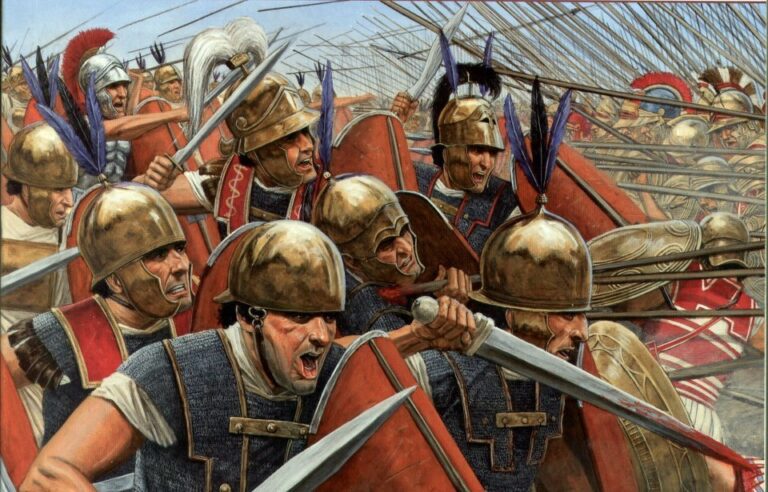
This close-up shows Roman soldiers using the manipular system clashing with Greek phalanx troops, highlighting the tactics and intensity of ancient warfare.
Tactical Advantages of the Checkerboard Formation
The checkerboard formation gave Rome several decisive advantages:
Terrain Adaptability Unlike the phalanx, maniples could fight effectively on hills, forests, and broken ground. Each unit could adjust independently to its surroundings.
Command and Control Officers could issue orders to individual maniples, not just the entire army. This allowed real-time tactical adjustments during battle.
Depth and Endurance If the hastati failed, they could withdraw through the gaps while the principes advanced. If even that failed, the triarii provided a final defensive line. This layered system absorbed shocks without collapsing.
Psychological Warfare Enemies often believed they had broken the Roman front, only to face fresh troops advancing immediately afterward. This had a devastating effect on morale.
Integration with New Weapons The shift away from long spears allowed Romans to adopt the pilum (throwing spear) and gladius (short sword), weapons perfectly suited to close, aggressive combat.
The battle of Pydna between Romans and Macedonians
The Decline of the Phalanx in Roman Warfare
The checkerboard formation laid the foundation for the later Marian reforms and the professional legion system. While maniples would eventually be replaced by cohorts, the core principles remained:
Flexible units
Tactical depth
Soldier versatility
Command responsiveness
The Roman legion became the most effective military system of the ancient world not because it was stronger, but because it was smarter.
Conclusion: Adaptation as Rome’s Greatest Weapon
The Roman transition from the phalanx to the checkerboard formation was more than a tactical adjustment—it was a philosophical shift. Rome learned that survival and dominance depended on adaptation rather than tradition.
By abandoning rigidity in favor of flexibility, Rome transformed defeat into innovation. This evolution allowed a small city-state to conquer Italy, dominate the Mediterranean, and build an empire that endured for centuries.
In the end, Rome did not simply fight better than its enemies. It learned faster.