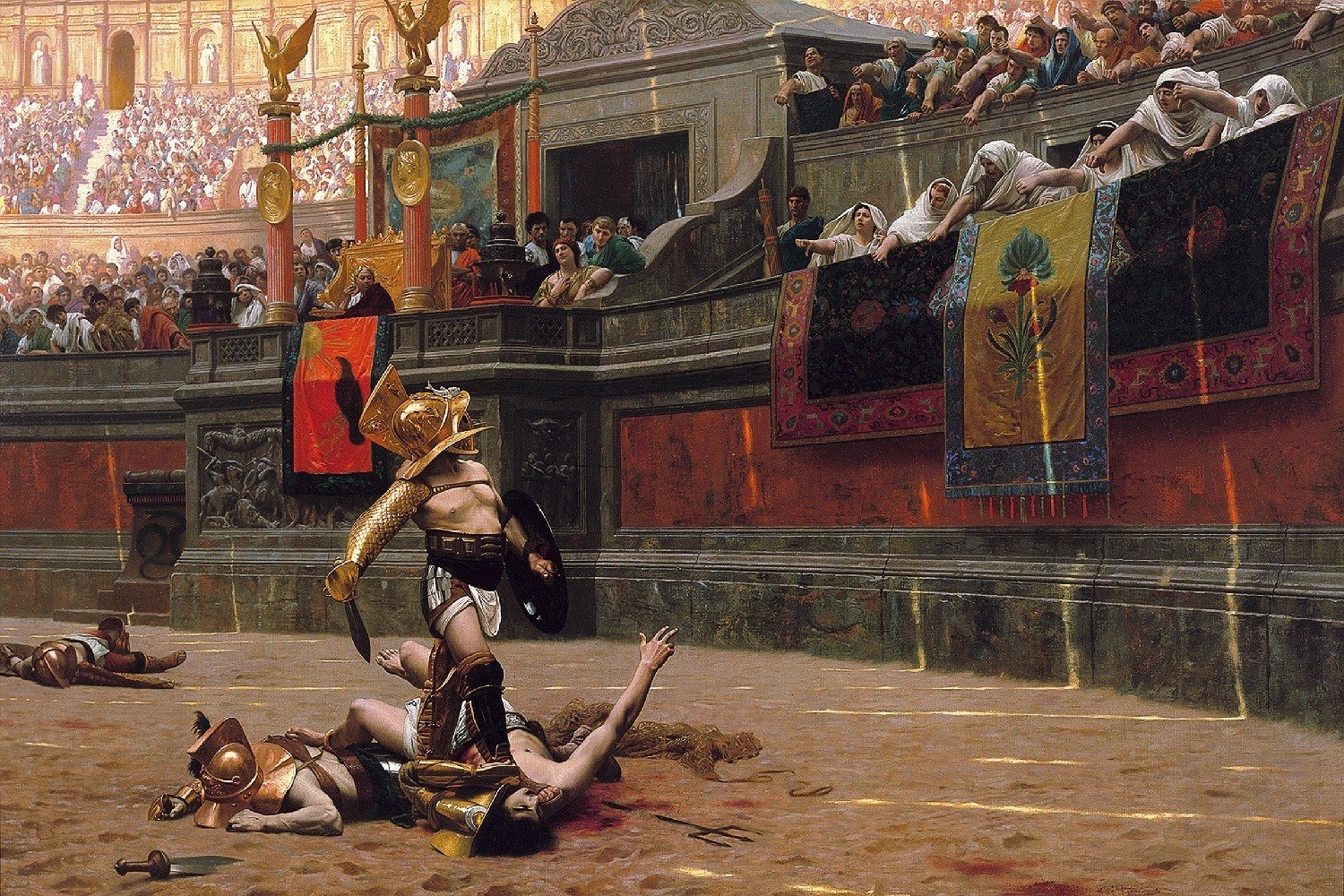
Gladiatorial combat was one of the most famous forms of entertainment in Ancient Rome. Gladiators were trained fighters who entered the arena to fight in front of large crowds, often using specialized weapons, armor, and fighting techniques. Although modern movies often portray gladiatorial combat as random battles between heavily armed warriors, Roman games could involve carefully selected matchups between different types of gladiators.
Different gladiator classes were designed with distinctive equipment and fighting styles. A Murmillo carried a large shield and sword, while a Thraex used a smaller shield and curved sword. A Retiarius fought with a net and trident and generally wore much lighter protection, while a Secutor was heavily equipped and specifically suited to fighting a Retiarius.
These differences made gladiator matchups more interesting because each fighter had different strengths and weaknesses. A heavily armored gladiator might have better protection but could be less mobile. A lightly equipped fighter could move more quickly but had fewer defenses against an opponent’s weapons. The outcome therefore depended not simply on strength, but also on speed, reach, equipment, technique, and strategy.
Roman organizers did not necessarily pair completely random fighters together. Certain combinations became traditional, particularly matchups designed to create a contrast between different fighting styles. This helped make the contests more entertaining for spectators because the audience could watch two very different approaches to combat compete against one another.
The idea of a “best” matchup is therefore less about identifying which gladiator was personally the strongest and more about examining which pairings created the most interesting contrast. A matchup between two heavily armored fighters could emphasize strength and defense, while a contest between a net fighter and an armored opponent could emphasize speed, distance, and movement.
It is also important to remember that gladiatorial combat changed throughout Roman history. Gladiator types, equipment, rules, and fighting practices were not completely identical in every century or every arena. Some famous gladiator classes became more common during particular periods, while others disappeared or evolved.
This article looks at seven notable gladiator matchups and explains what made each pairing distinctive. Rather than focusing on graphic violence, we will examine the fighters’ equipment, fighting styles, advantages, disadvantages, and why Roman audiences may have found these combinations exciting.
From the famous Murmillo vs. Thraex to the classic Secutor vs. Retiarius, these matchups show how Roman entertainment combined specialized equipment and carefully contrasting fighting styles to create dramatic contests inside the arena.
I. Murmillo vs. Thraex
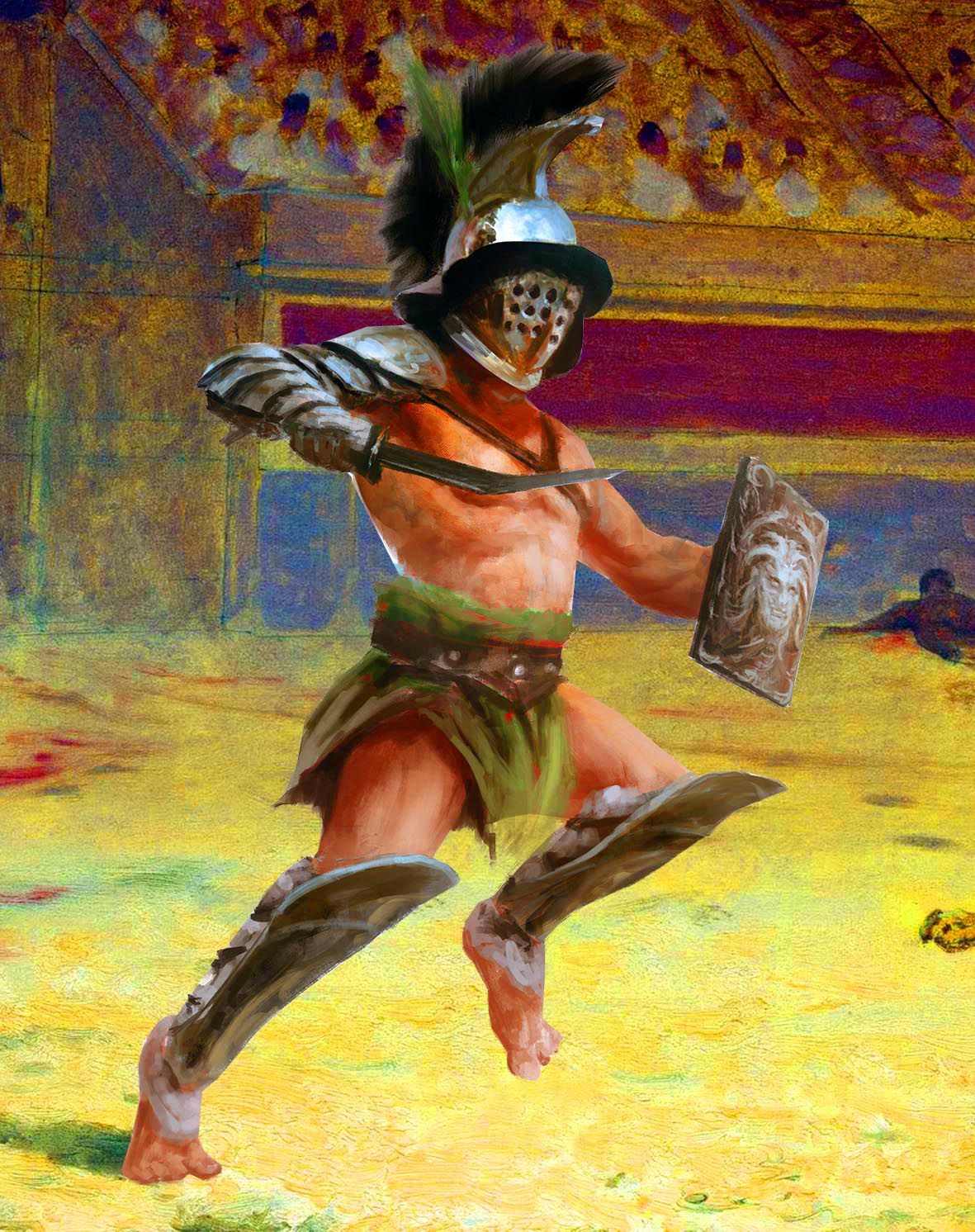
The Murmillo vs. Thraex matchup was one of the most distinctive combinations in Roman gladiatorial combat because the two fighters had noticeably different weapons, shields, armor, and fighting styles. Rather than simply placing two identical warriors against each other, Roman gladiatorial traditions often created matchups in which each fighter had particular advantages and disadvantages. The Murmillo and Thraex provided a good example of this contrast.
The Murmillo was a heavily equipped gladiator who carried a large rectangular shield called a scutum. The shield was similar in general shape to the shields used by Roman soldiers and covered a substantial portion of the fighter’s body. This gave the Murmillo strong defensive protection while allowing him to advance toward his opponent.
The Murmillo normally carried a short sword called a gladius. This was primarily a close-range weapon, meaning that the fighter needed to get relatively close to his opponent to use it effectively. His equipment also included a distinctive helmet with a broad crest and protective features covering much of the face. He could therefore present a heavily protected appearance in the arena.
The Thraex, or Thracian, used a noticeably different set of equipment. Instead of the Murmillo’s large scutum, he carried a smaller shield known as a parmula. Because the shield was smaller, it provided less overall body coverage, but it could allow the fighter to move more freely.
The Thraex also carried a distinctive curved sword called a sica. This weapon was one of the most recognizable features of the gladiator type. Its curved shape allowed the fighter to attack from different angles and potentially strike around an opponent’s shield. The Thraex also commonly wore substantial protection on the legs because his smaller shield left more of the lower body exposed.
This created a fascinating contrast between the two fighters. The Murmillo relied heavily on protection and shield coverage, while the Thraex had a smaller shield and a weapon that encouraged different attacking angles. The Murmillo could use his large shield to protect himself while advancing, whereas the Thraex had to make careful use of positioning and movement.
The difference in shields was particularly important. A large scutum could provide excellent protection, but it was also a larger piece of equipment to carry. The Thraex’s parmula offered less coverage but gave him a different balance between defense and mobility.
Their weapons created another contrast. The Murmillo’s gladius was effective in close combat, encouraging him to get inside his opponent’s defensive range. The Thraex’s curved sica provided a different method of attacking, particularly around the edges of a shield.
This meant that the matchup could be understood as a contest between defensive coverage and mobility. The Murmillo’s equipment gave him significant protection, while the Thraex’s lighter shield and distinctive sword gave him different opportunities to maneuver and attack.
The matchup was not necessarily perfectly identical in every arena or period. Gladiatorial equipment changed over time, and Roman artwork does not always provide enough evidence to reconstruct every detail of how individual fights were organized. The exact rules of a particular contest may therefore have varied.
Nevertheless, the Murmillo and Thraex became associated with contrasting styles of gladiatorial combat. Their equipment made each fighter immediately recognizable to spectators and created a visual difference that could make the contest more interesting.
For the Roman audience, the appeal was not simply seeing two men with swords. It was watching different types of trained fighters use specialized equipment against one another. The Murmillo’s large shield and straight sword contrasted strongly with the Thraex’s smaller shield and curved blade, making their matchup one of the clearest examples of how gladiatorial combat could be structured around opposing strengths.
Main Ideas
- Murmillo: Large scutum, gladius, and substantial armor
- Thraex: Smaller parmula, curved sica, and strong leg protection
- The Murmillo emphasized shield protection and close combat
- The Thraex emphasized mobility and different attack angles
- Their contrasting equipment created a distinctive gladiator matchup
II. Secutor vs. Retiarius
The Secutor vs. Retiarius matchup was one of the most famous and visually distinctive combinations in Roman gladiatorial combat. Unlike the Murmillo and Thraex, who both carried shields and swords, the Secutor and Retiarius represented almost opposite approaches to fighting. One relied on heavy protection and close combat, while the other depended on mobility, distance, and specialized equipment.
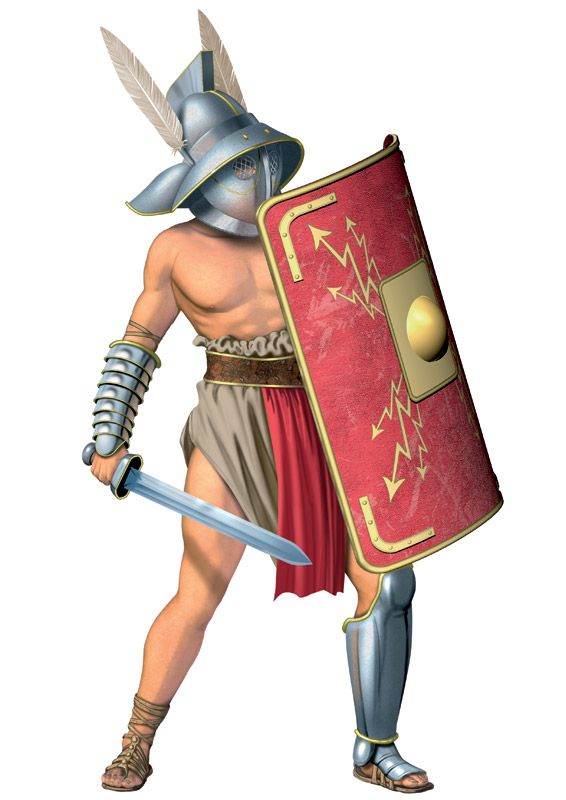
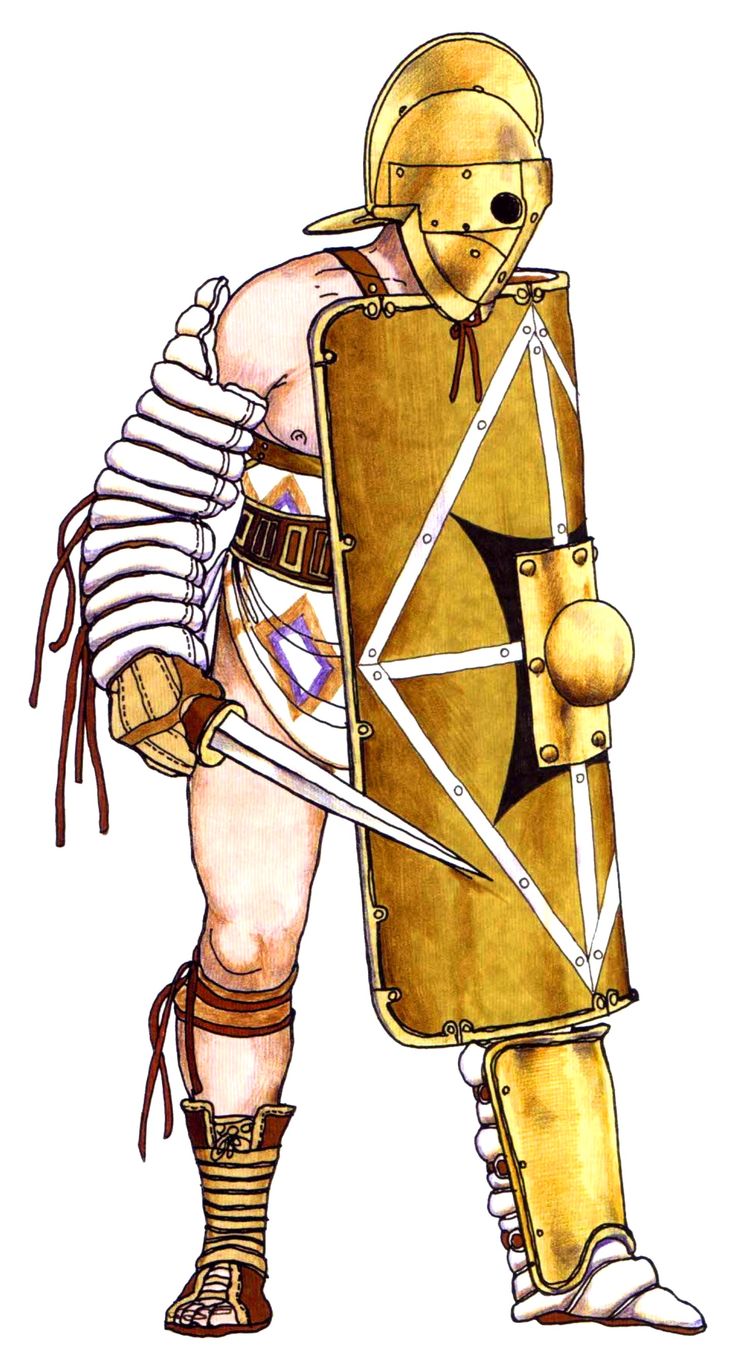
The Secutor was a heavily armed gladiator whose equipment was closely related to that of the Murmillo. He normally carried a large shield called a scutum and a short sword, allowing him to fight effectively at close range. His most distinctive feature was his helmet. The Secutor’s helmet was designed with a smooth, rounded shape and relatively small openings, reducing places where a net could catch.
This equipment was particularly useful against the Retiarius. The Secutor was not simply a heavily armored fighter chosen at random. His equipment was specifically associated with the challenge of facing a gladiator who relied on a net. His relatively smooth helmet reduced the chances of the net becoming caught on a large crest or other projections.
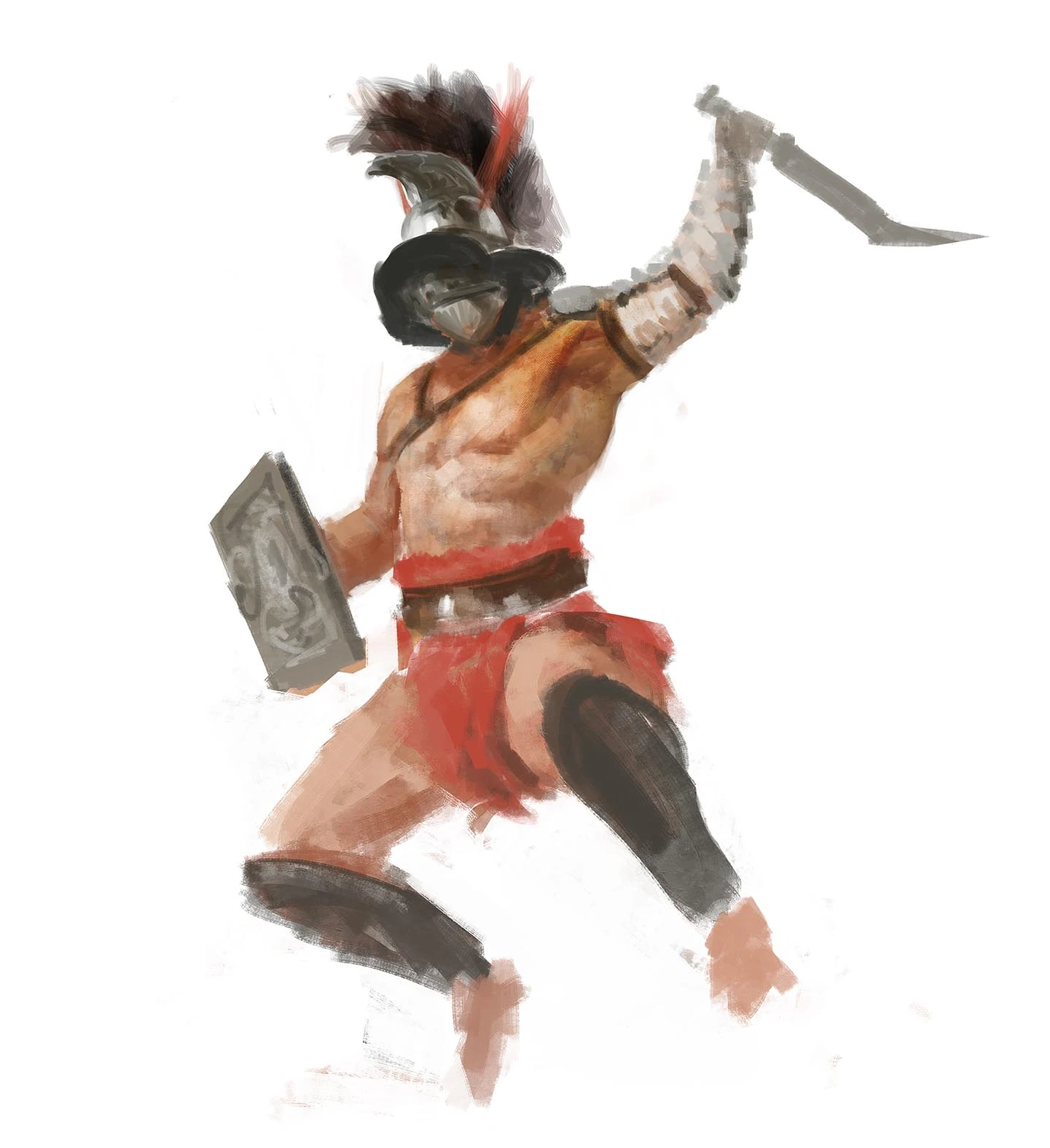
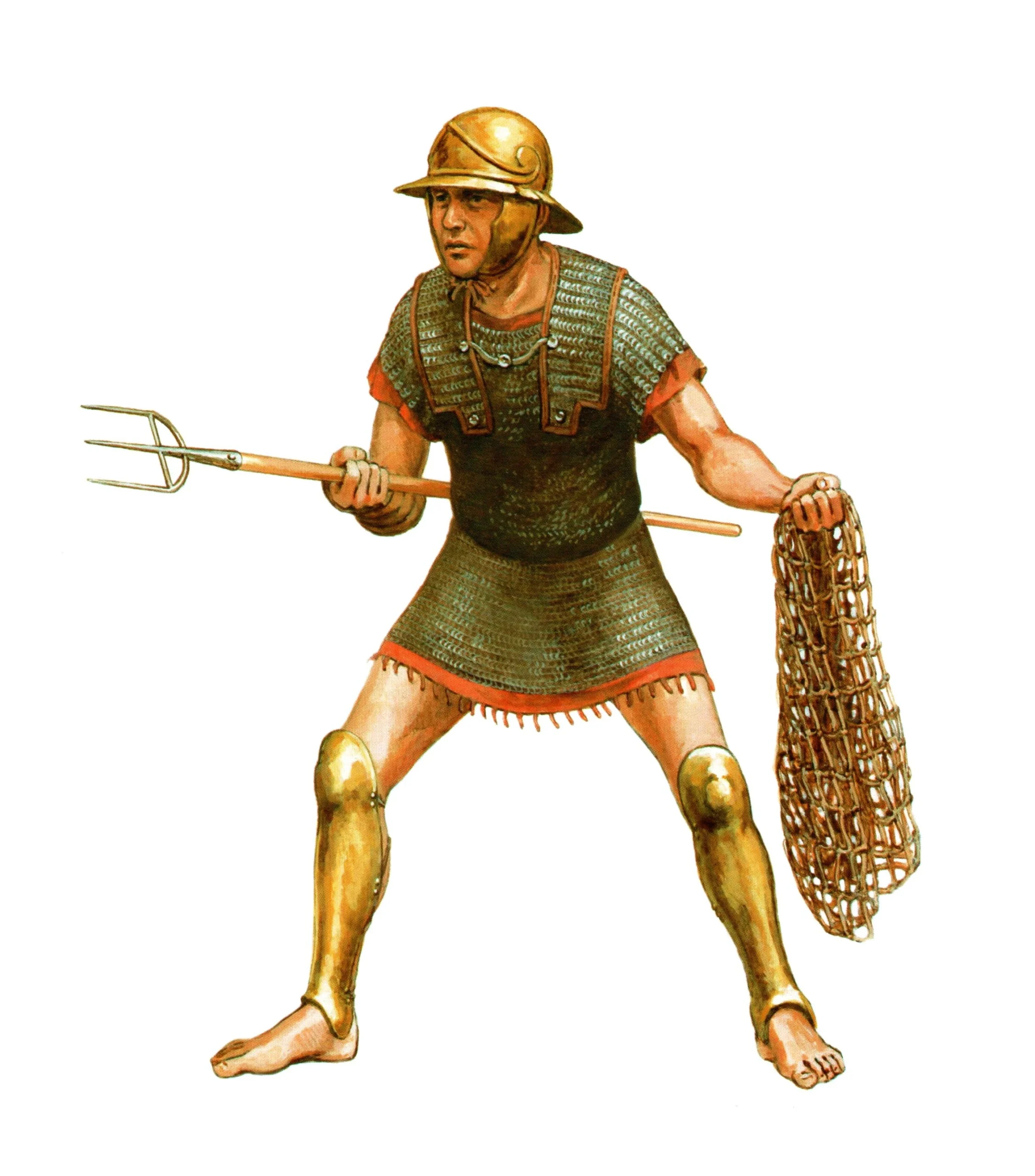
The Retiarius had a completely different style. His name is connected with rete, the Latin word for net, which was his most recognizable weapon. He also carried a trident and a small dagger. Unlike heavily armored gladiators, the Retiarius wore relatively little protective equipment.
The Retiarius therefore depended heavily on movement and controlling distance. Instead of approaching the Secutor directly, he could attempt to use his net to interfere with the opponent’s movement and then use the trident from a safer distance. His lighter equipment also allowed him to move around the arena more freely.
This created a fascinating tactical contrast. The Secutor wanted to close the distance, where his shield, armor, and sword gave him important advantages. The Retiarius wanted to maintain distance, where his net and trident were more useful.
The matchup therefore depended heavily on positioning. If the Retiarius could control the space between the two fighters, his mobility and longer weapons could become important advantages. If the Secutor successfully moved close enough, his heavier equipment and sword could become much more effective.
The Secutor’s helmet is particularly interesting because it demonstrates how Roman gladiatorial equipment could be adapted to specific opponents. The smooth design was not merely decorative. It helped address one of the Retiarius’s most recognizable weapons: the net.
The Retiarius’s lack of heavy armor also made his fighting style fundamentally different. He had less physical protection than many other gladiators, so avoiding attacks and maintaining distance were especially important. His equipment encouraged a fighting style based on speed, positioning, timing, and precision rather than simply absorbing attacks.
Roman writers and artists frequently associated the Retiarius with a distinctive appearance, and the matchup with the Secutor became one of the best-known gladiatorial combinations. It demonstrated how Roman arena combat could be deliberately structured around opposing strengths.
The matchup was not necessarily identical in every period of Roman history. Gladiatorial equipment evolved, and individual contests could vary. Nevertheless, the Secutor and Retiarius became strongly associated with this classic contrast between heavy armor and mobility.
For spectators, this could create a dramatic contest because the two fighters had very different objectives. The Secutor needed to get close, while the Retiarius needed to control the distance. The outcome depended heavily on which fighter could impose his preferred style of combat.
Main Ideas
- Secutor: Heavy armor, large scutum, sword, and specialized helmet
- Retiarius: Net, trident, dagger, and lightweight equipment
- The Secutor focused on closing the distance
- The Retiarius relied on mobility, range, and positioning
- Their matchup created a classic contrast between heavy protection and speed
III. Samnite vs. Murmillo
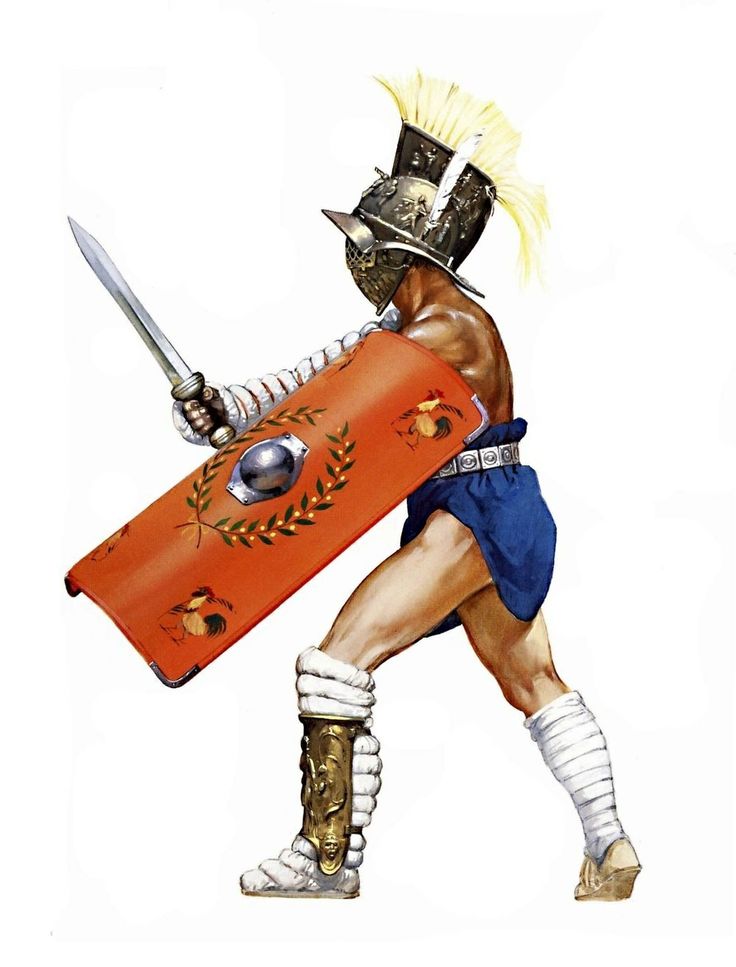
The Samnite vs. Murmillo matchup is an interesting comparison because it connects two different stages of gladiatorial history. The Samnite was one of the earlier gladiator types associated with Roman games, while the Murmillo became a highly recognizable gladiator during the later Roman Empire. Both fighters were associated with heavy equipment, shields, and close-range combat, but their historical backgrounds and equipment were not identical.
The Samnite gladiator was originally connected to the Samnites, an Italian people who fought several wars against Rome during the Republic’s expansion across Italy. Early Roman gladiatorial games sometimes featured fighters equipped to resemble Rome’s enemies. This meant that the arena could turn military history into entertainment.
The early Samnite was generally equipped for close combat, using a large shield and sword along with protective equipment. However, the exact equipment of Samnite gladiators changed over time. The category eventually became less common as Roman gladiatorial types became more standardized.
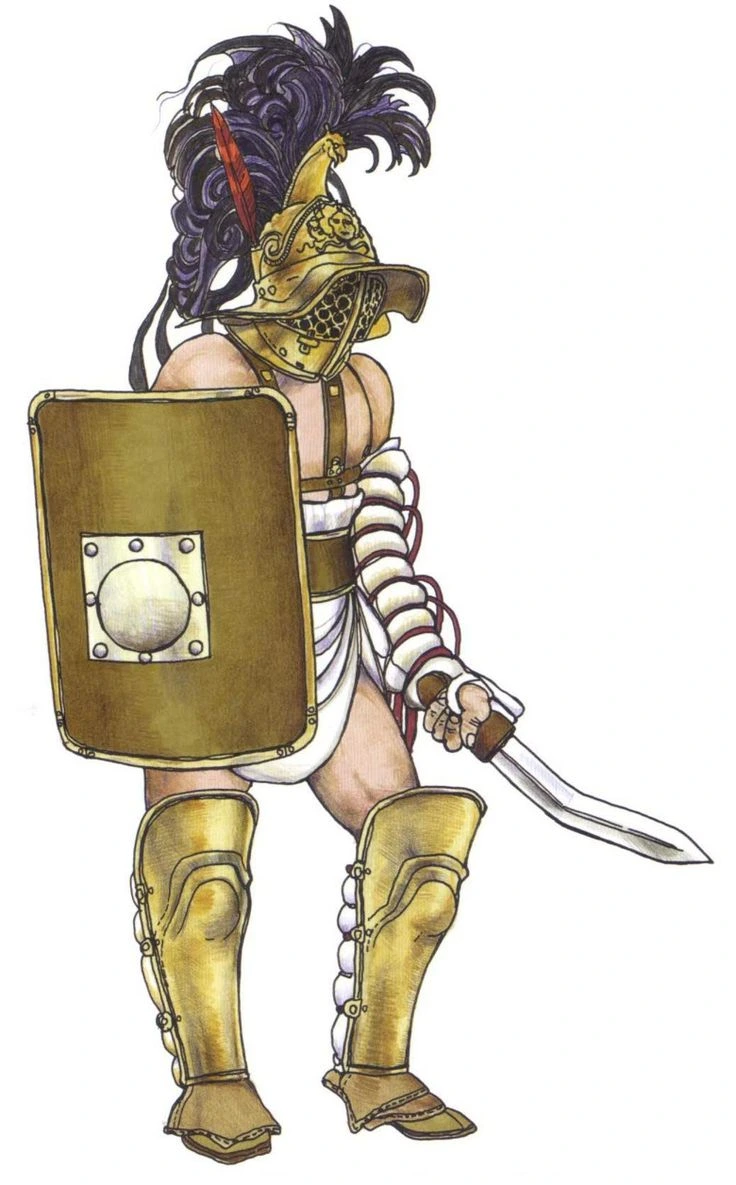
The Murmillo belonged to this later standardized system. He carried a large rectangular scutum, a short sword called a gladius, and a distinctive helmet. He also had substantial protection for his body and legs. His equipment made him one of the more heavily protected gladiators in the arena.
Because both fighters relied on shields and close-range weapons, a contest between them would have been less about extreme differences in equipment and more about technique, positioning, endurance, and shield control. A fighter who could use his shield effectively could protect himself while looking for an opening to attack.
The Murmillo’s large scutum was especially important. The shield could cover much of his body, allowing him to advance while maintaining a strong defensive position. His gladius was designed for close combat, making the distance between the fighters an important part of the contest.
The Samnite’s equipment also emphasized protection and close fighting, although the exact combination depended on the period being discussed. This makes the Samnite different from gladiators such as the Retiarius, whose equipment encouraged a much lighter and more mobile style.
One of the most interesting aspects of this matchup is that Samnite vs. Murmillo should not be treated as a standard pairing that occurred throughout Roman history. The Samnite category belonged largely to an earlier period, while the Murmillo became prominent later. In other words, imagining them as two standardized gladiators fighting each other in a typical arena match can be historically misleading.
Instead, the matchup is useful for understanding how Roman gladiatorial traditions developed. Early gladiators were often connected to Rome’s military enemies, while later gladiators became specialized arena categories with recognizable equipment and traditional pairings.
The transformation from the Samnite to later types such as the Murmillo also reflects changes in Roman society. As gladiatorial games became more organized and widespread, the fighters became increasingly specialized. Their equipment was designed not only for protection but also to create recognizable contrasts that audiences could understand.
The Murmillo therefore represents a later stage of this development. His equipment was standardized enough that spectators could immediately recognize his fighting style. The Samnite represents an older tradition in which the identity of the gladiator was more directly connected to Rome’s military history.
Main Ideas
- Samnite: Early gladiator associated with Rome’s Samnite enemies
- Murmillo: Later standardized gladiator with scutum and gladius
- Both emphasized shields and close-range combat
- Their equipment and traditions changed over time
- The matchup is best understood as a comparison of different stages of gladiatorial history
IV. Hoplomachus vs. Thraex
The Hoplomachus vs. Thraex matchup was one of the more interesting combinations in the Roman gladiatorial system because both fighters were relatively mobile and used smaller shields than heavily protected gladiators such as the Murmillo. Their equipment created a contest based on movement, timing, weapon range, and positioning rather than simply relying on heavy armor.
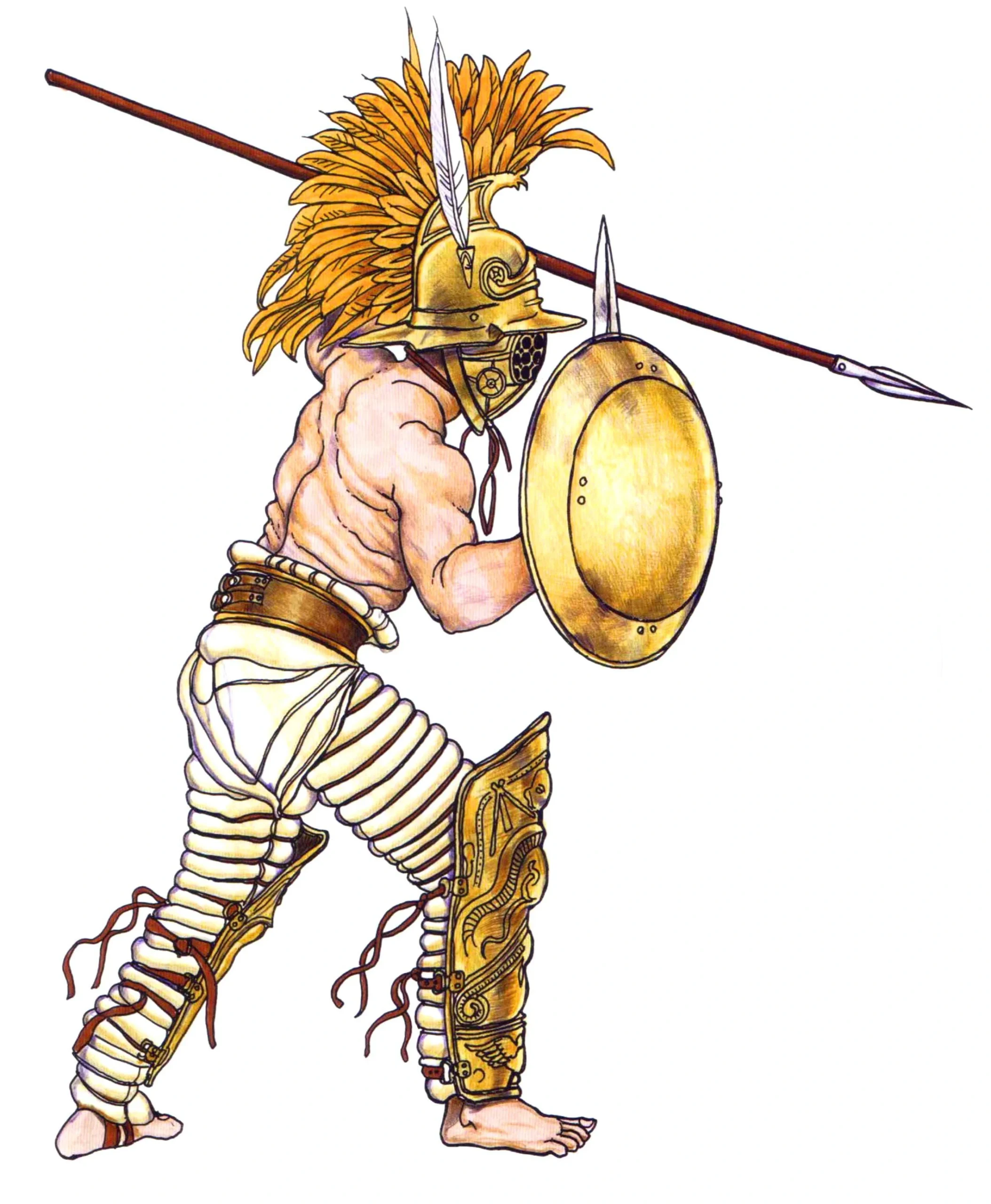
The Hoplomachus was a gladiator whose equipment was inspired partly by Greek-style warriors. His name is connected with the Greek word hoplomachos, meaning someone who fights with weapons or armor. He typically carried a small round shield called a parmula or parma, along with a spear (hasta) and a short sword or dagger for closer fighting. He also wore protective greaves and a distinctive helmet.
The spear gave the Hoplomachus an important advantage in terms of reach. He could threaten an opponent from farther away than a gladiator relying only on a short sword. However, using a spear also required good positioning. If the opponent managed to move inside the spear’s effective range, the Hoplomachus could switch to his secondary weapon.
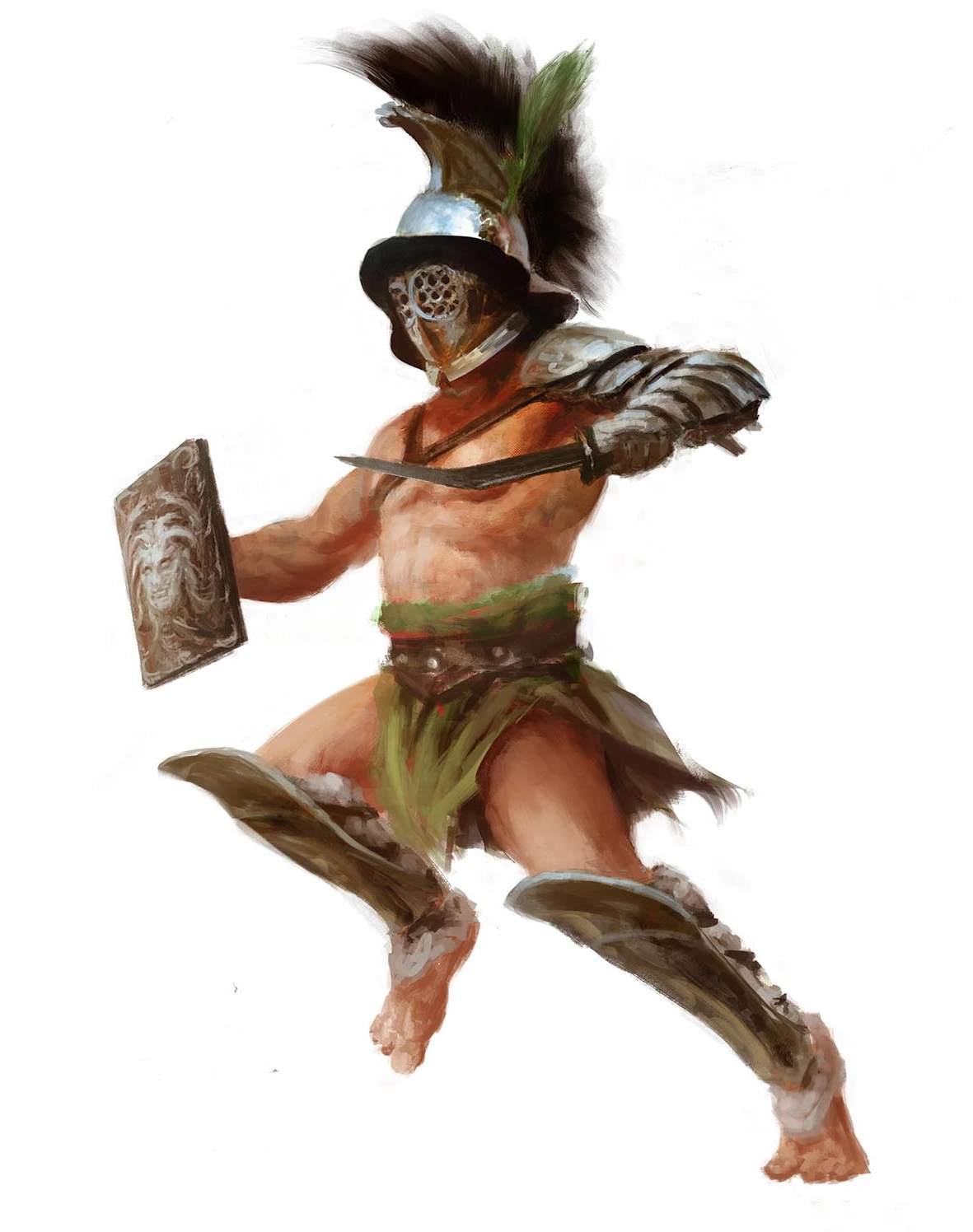
The Thraex, meanwhile, was based on the traditional image of a Thracian warrior. He carried a smaller curved shield known as a parmula and a curved sword called a sica. The sica was particularly distinctive because its curved blade allowed the fighter to attack from unusual angles. The Thraex also had substantial protection for his legs, which was important because his smaller shield left more of his body exposed than the large scutum carried by a Murmillo.
This created an interesting contrast. The Hoplomachus had a spear, giving him greater reach, while the Thraex had a curved sword, making close-range attacks and maneuvering especially important. Both fighters had relatively small shields, meaning that neither had the same broad defensive coverage as a Murmillo.
The battle would therefore depend heavily on distance. The Hoplomachus would benefit from maintaining enough space to make effective use of his spear. The Thraex would benefit from moving into closer range where his curved sword could become more useful.
Their helmets and protective equipment also contributed to their distinctive appearances. Roman audiences could recognize different gladiator types by their weapons, shields, helmets, and armor, making each matchup visually different.
It is important, however, not to imagine every gladiator matchup as following exactly the same rules across the entire Roman period. Gladiatorial equipment changed over centuries, and individual fighters could have variations in their equipment. The Hoplomachus itself also developed over time.
The Hoplomachus vs. Thraex pairing is especially useful for understanding how Roman entertainment turned military equipment into specialized fighting styles. Instead of simply placing two identical fighters against each other, Roman games could create contests where each fighter had different strengths and weaknesses.
The matchup also shows how gladiatorial combat was connected to the wider Mediterranean world. The Hoplomachus drew inspiration from Greek military traditions, while the Thraex represented the image of a warrior from Thrace. Roman audiences could therefore see different cultural and military traditions represented inside the arena.
Ultimately, the matchup was a contest between reach and maneuverability. The Hoplomachus had the spear and could control distance, while the Thraex relied on his curved sword, smaller shield, and mobility. That combination made their fighting styles visually and tactically distinct.
Main Ideas
- Hoplomachus: Small shield, spear, short sword, and protective greaves
- Thraex: Curved sica, small parmula, and strong leg protection
- Hoplomachus had an advantage in weapon reach
- Thraex relied more on mobility and close-range attacks
- The matchup showed the Roman fascination with different warrior traditions
V. Retiarius vs. Murmillo
The Retiarius vs. Murmillo matchup created one of the most recognizable contrasts in Roman gladiatorial combat. The two fighters had almost completely different approaches to fighting. The Retiarius was lightly equipped and depended on speed, distance, and a net, while the Murmillo was heavily equipped and relied on a large shield, armor, and a sword. Their differences made the matchup particularly distinctive for Roman audiences.
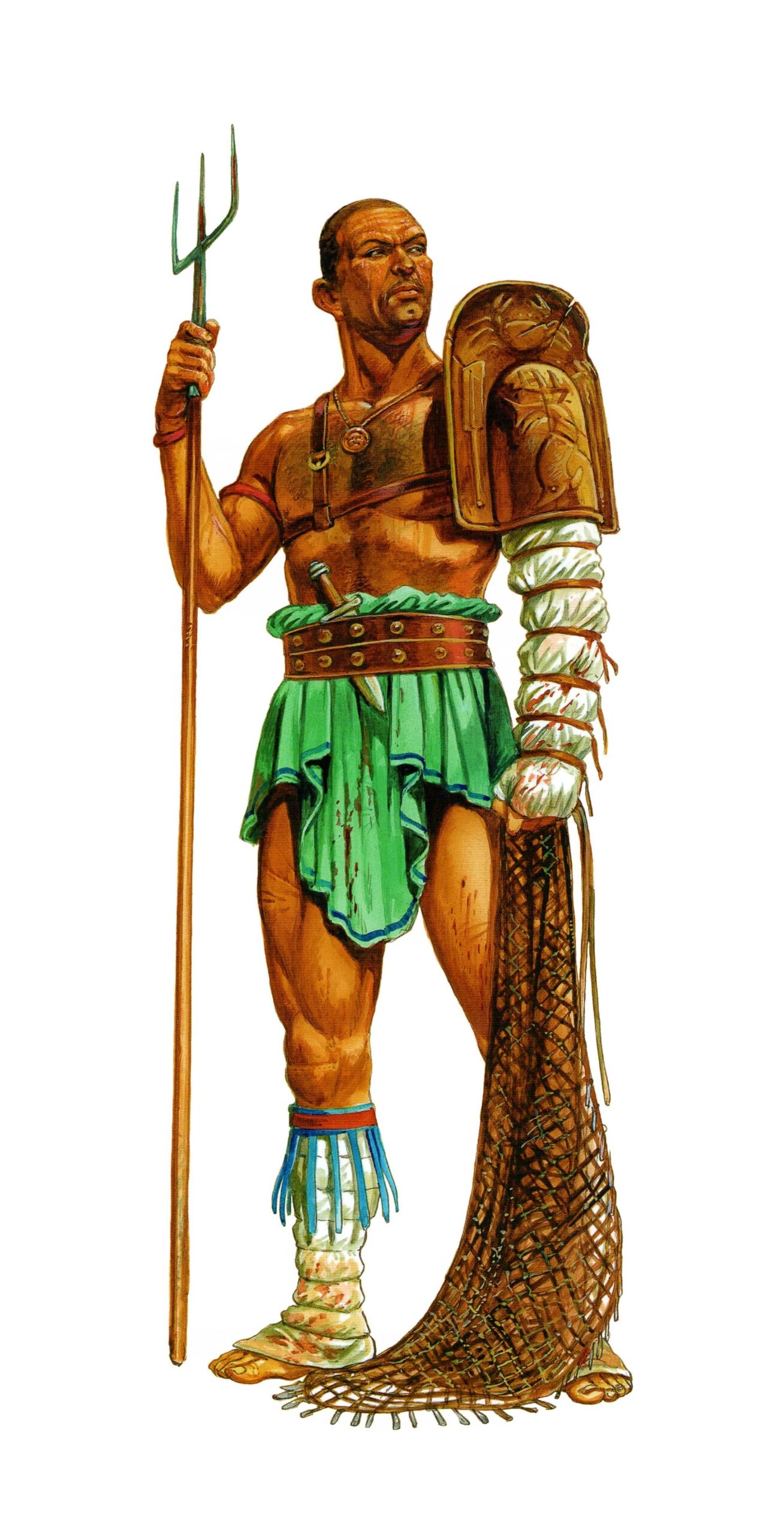
The Retiarius was one of the most unusual gladiator types in the Roman arena. His main weapons were a weighted net (rete), a trident (fuscina), and a dagger. Unlike heavily armored gladiators, he usually wore relatively little protective equipment. This allowed him to move quickly around the arena.
The Retiarius’s main advantage was mobility. Rather than immediately trying to fight at close range, he could use his movement to maintain distance from his opponent. His net was especially important because it could interfere with an opponent’s movement and create an opportunity for the Retiarius to use his trident.
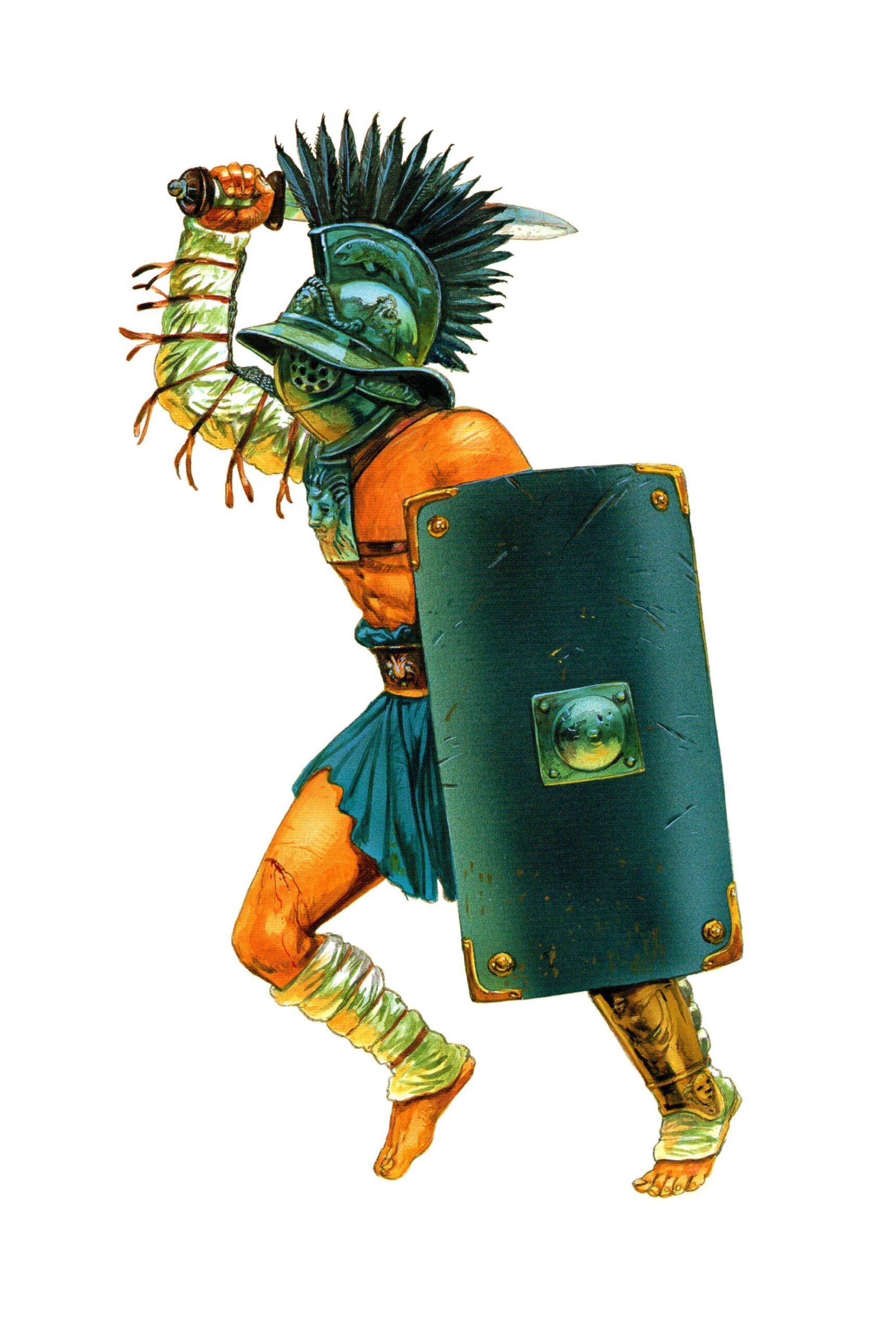
The Murmillo represented almost the opposite style. He carried a large rectangular scutum and a gladius, along with substantial protective equipment. His large shield could cover much of his body and was an important part of his fighting technique.
Because the Murmillo was more heavily protected, he could approach his opponent while using his shield defensively. His goal was essentially to reduce the distance between himself and the Retiarius. At close range, his sword and shield could become much more useful.
This created a battle based heavily on distance and positioning. The Retiarius wanted to keep moving and prevent the Murmillo from getting close. The Murmillo wanted to steadily advance and force the fight into close quarters.
The contrast was also obvious visually. One fighter carried a large shield and sword, while the other carried a net and trident. Roman spectators could easily recognize the different roles and understand that the two fighters had very different strengths.
The Retiarius’s lack of heavy armor made movement particularly important. His equipment allowed him to move around the arena more freely, but it also meant that he did not have the same level of protection as the Murmillo. His strategy therefore depended heavily on using his equipment effectively rather than simply relying on armor.
The Murmillo’s equipment presented the opposite trade-off. His heavy protection and large shield gave him strong defensive capabilities, but his equipment was less suited to rapid movement. He therefore needed to use positioning and controlled advances rather than simply chasing his opponent around the arena.
The matchup also demonstrates that gladiatorial combat was not simply about determining which fighter had the strongest weapons. Different gladiator types were designed around different combinations of strengths and weaknesses. A lightly equipped fighter could have advantages in mobility, while a heavily equipped fighter could have advantages in protection and close combat.
The Retiarius and Murmillo pairing became particularly famous because of this dramatic contrast. It represented a basic tactical struggle between speed and protection, distance and close combat, and mobility and defensive strength.
However, the exact equipment and rules of gladiatorial combat could vary across different periods. The Retiarius and Murmillo were not identical throughout Roman history, and individual fights could have different circumstances.
Overall, Retiarius vs. Murmillo is one of the clearest examples of how Roman gladiatorial games created contrasting fighting styles. The Retiarius depended on movement, the net, and the trident, while the Murmillo relied on his shield, sword, and protective equipment. Their completely different approaches made the matchup especially distinctive.
Main Ideas
- Retiarius: Net, trident, dagger, and lightweight equipment
- Murmillo: Large scutum, gladius, and substantial protection
- Retiarius relied on speed, distance, and mobility
- Murmillo relied on shield protection and close combat
- The matchup contrasted mobility against heavy protection
VI. Provocator vs. Provocator
The Provocator vs. Provocator matchup was different from many other gladiatorial contests because both fighters used broadly similar equipment and fighting styles. Instead of creating a dramatic contrast between a heavily armored gladiator and a lightly equipped one, the Provocator matchup placed two similarly equipped opponents against each other. This made skill, timing, defense, and technique especially important.
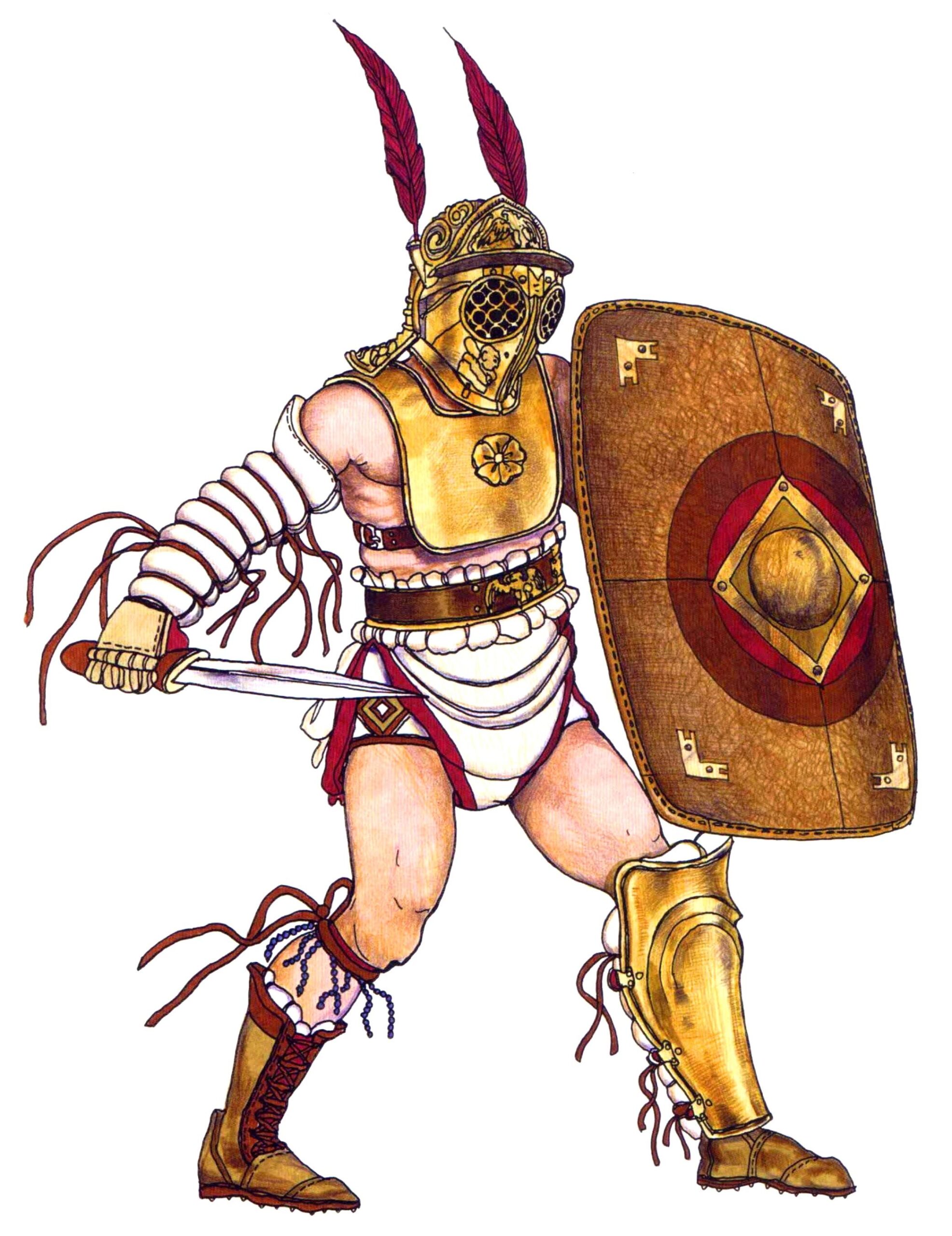
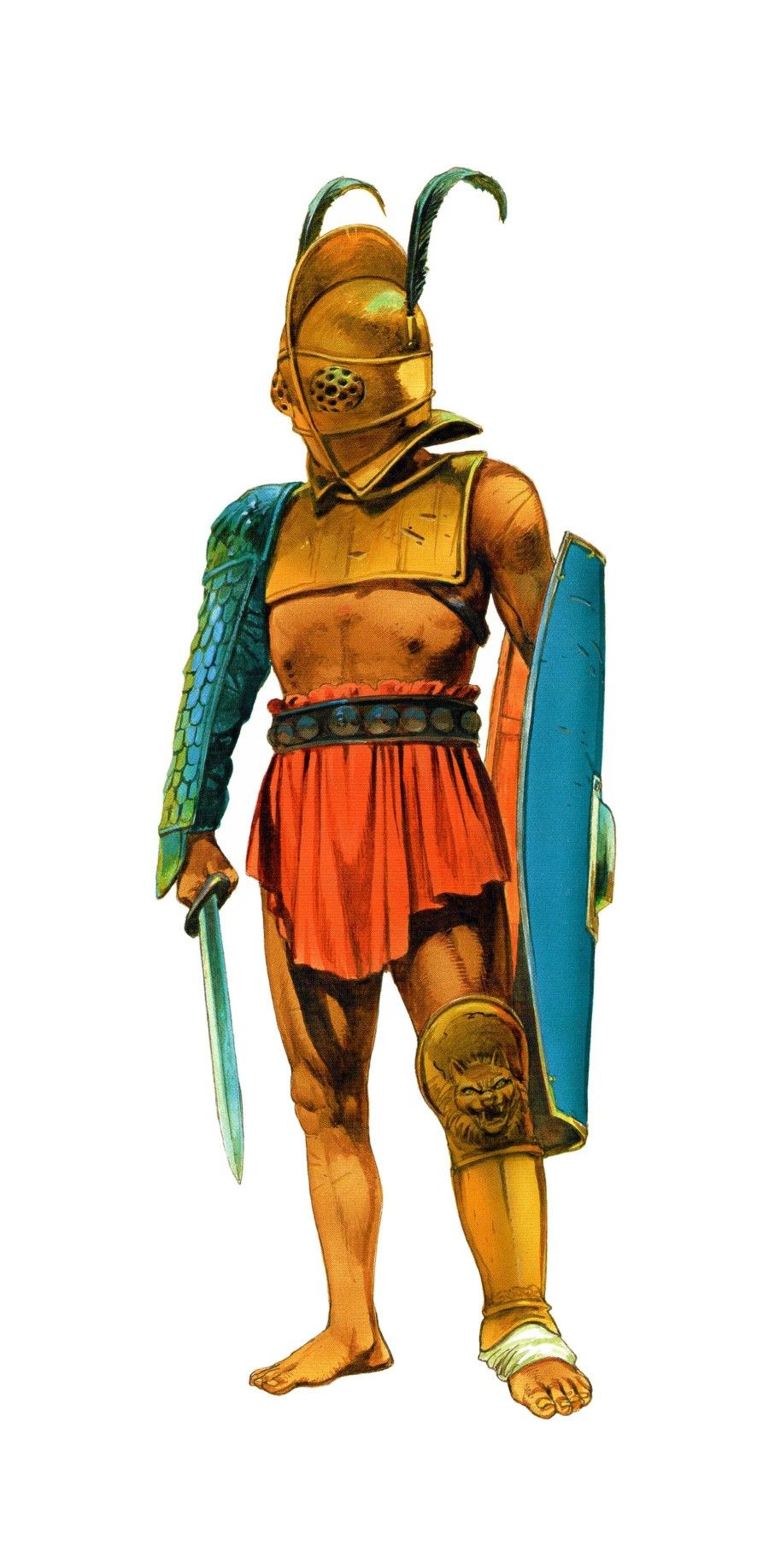
The Provocator was a gladiator designed primarily for fighting another Provocator. His equipment included a large shield, a sword, and substantial body protection. One of his most recognizable features was his breastplate, which protected the chest and distinguished him from several other gladiator types.
The Provocator also wore protective equipment on his legs and arms, while his helmet provided additional protection. His overall equipment made him a relatively well-protected gladiator, although his exact equipment could change over time.
Unlike the Retiarius, who depended heavily on movement and distance, the Provocator was designed for close-range combat. His large shield was an important part of his fighting style. It could protect his body while allowing him to advance toward his opponent.
Because both fighters had similar equipment, neither had an obvious equipment-based advantage. This made technique and timing particularly important. A Provocator needed to manage his shield effectively while looking for opportunities to attack with his sword.
The large shields also made positioning important. Each fighter had to consider how much of his body was protected and how to move around the opponent’s shield. Fighting was therefore not simply a matter of attacking continuously. Defensive movements could be just as important as offensive ones.
The matchup also shows that Roman gladiatorial games were not always based on completely different fighting styles. Some pairings deliberately placed similar fighters against one another, creating a contest in which the equipment was relatively balanced.
The Provocator was particularly associated with the earlier Roman gladiatorial tradition and appears in evidence from different periods of Roman history. His name itself comes from the Latin provocator, meaning roughly challenger or one who challenges.
Archaeological evidence, inscriptions, and artistic representations help historians understand the equipment used by Provocatores. However, the exact appearance of a gladiator could vary depending on the period. Gladiatorial equipment was not completely fixed for hundreds of years.
One interesting feature of the Provocator was his chest protection. His breastplate provided additional protection to the torso and helped distinguish his equipment from that of gladiators who relied on different forms of armor.
The Provocator matchup was therefore less about dramatic differences in equipment and more about individual ability. Both fighters had shields, swords, and protective armor, so success depended heavily on how effectively each gladiator used those tools.
This also makes the matchup useful for understanding why gladiatorial games were more complicated than simply putting two warriors into an arena. Different gladiator categories were developed with particular combinations of weapons, armor, and tactics. Some pairings emphasized contrast, while others emphasized relative similarity.
The Provocator vs. Provocator contest represents the second type. Both fighters entered the arena with broadly comparable equipment, making their abilities easier to compare directly.
For Roman spectators, this could create a contest where experience, discipline, reflexes, and tactical decisions mattered greatly. The gladiators could not simply depend on having a completely different style from their opponent.
Overall, the Provocator matchup demonstrates another side of Roman gladiatorial combat. Instead of speed versus armor or net versus shield, it was a contest between two similarly equipped fighters. Their large shields, swords, and protective equipment made defense, positioning, and technique central to the fight.
Main Ideas
- Provocator: Shield, sword, helmet, armor, and distinctive breastplate
- Both fighters used similar equipment and fighting styles
- The matchup emphasized close-range combat
- Timing, defense, and positioning were especially important
- It represented a relatively balanced gladiatorial contest
VII. Gladiator vs. Gladiator: How Rome Created Balanced Matchups
Roman gladiatorial games were not simply random fights between two people. The Romans developed a system of specialized gladiator types, each with particular weapons, armor, and fighting methods. By combining different types of fighters, the games could create contests with clear contrasts in speed, protection, weapon range, and fighting technique.
One of the most important features of gladiatorial combat was the use of specialized equipment. A Murmillo carried a large scutum and gladius, while a Retiarius used a net, trident, and dagger. A Thraex had a curved sica and smaller shield, while a Hoplomachus could use a spear and small shield. These differences meant that each gladiator had particular strengths and weaknesses.
This helped create what can be described as balanced matchups. Balance did not necessarily mean that both fighters had identical equipment. Instead, one fighter’s advantages could be countered by another fighter’s different abilities.
The classic Secutor vs. Retiarius matchup is a good example. The Secutor had heavy protection and a large shield, while the Retiarius was much more lightly equipped and relied on mobility and distance. The Retiarius could move quickly, but the Secutor had stronger protection. Their equipment therefore created a tactical contrast.
The Murmillo vs. Thraex matchup worked differently. Both fighters were equipped for close combat, but their weapons and shields differed. The Murmillo’s large shield provided extensive protection, while the Thraex had a smaller shield and curved sword. This created differences in defensive coverage and attack style.
The Hoplomachus vs. Thraex pairing created another type of contrast. The Hoplomachus could use a spear to maintain greater distance, while the Thraex’s curved sword was more suited to closer fighting. The contest therefore depended heavily on controlling distance.
Not every gladiatorial matchup was based on dramatic differences. The Provocator vs. Provocator contest is an important example. Both fighters had similar equipment and fought primarily at close range. In such a contest, individual skill, timing, defense, and experience became especially important.
The Roman system also changed over time. Gladiatorial types were not completely fixed throughout the history of Rome. Some earlier types, such as the Samnite, became less common as later standardized categories developed. Other gladiators became more recognizable through their distinctive equipment and traditional opponents.
This evolution reflects the growing organization of the Roman games. Gladiatorial combat developed from relatively simple contests into a sophisticated form of public entertainment with different fighter categories and specialized equipment.
It is also important not to assume that every famous pairing happened in exactly the same way throughout Roman history. The equipment of gladiators changed, and historians cannot reconstruct every individual contest. Some pairings are much better documented than others.
The real significance of these matchups is that they show how Roman entertainment combined combat, strategy, spectacle, and specialized roles. Audiences could recognize different gladiators by their equipment and understand that each fighter had particular strengths.
The result was a highly organized form of entertainment in which the matchup itself was part of the spectacle. Whether it involved the speed of the Retiarius, the protection of the Murmillo, the spear of the Hoplomachus, or the shield of the Provocator, each gladiator type brought something different to the arena.
Ultimately, Roman gladiatorial combat was built around different fighting styles rather than one universal style. The most interesting matchups were those in which the strengths and weaknesses of the two fighters interacted, creating contests based on movement, defense, distance, and technique.
Main Ideas
- Rome created specialized gladiator types with different equipment
- Matchups could emphasize contrasting strengths and weaknesses
- Weapons, shields, and armor affected each fighter’s strategy
- Gladiatorial categories changed over time
- The arena combined combat, strategy, and public entertainment