The Gladiator Types of Ancient Rome: A Complete Guide to Classes, Weapons and Combat Roles
Gladiators occupy one of the most iconic—and misunderstood—places in Roman history. These fighters were not a single uniform group, but a highly diverse collection of specialized combatants, each with distinct weapons, armor, ethnic origins, and tactical styles. The Roman arena was not merely chaotic violence: it was a carefully choreographed martial spectacle, drawing from conquered peoples, mythologies, and Rome’s own military traditions.
What follows is a comprehensive, detailed overview of all major and minor gladiator types recorded in literary sources, inscriptions, artwork, mosaics, and archaeological evidence.
The End of Gladiator Fight in the Arena of Ancient Rome
1. The Heavy Infantry Types
These gladiators relied on heavy armor, large shields, and stamina. Their role often mimicked Roman soldiers or foreign enemies of the state.
1.1 Murmillo
The Murmillo, a heavily armored gladiator class known for its large shield and fish-crested helmet
Origins: Named after the Greek word mormýros—a type of fish—because of the fish-shaped crest on their helmets. Equipment:
Large rectangular scutum (like legionaries)
Straight sword (gladius)
Heavy bronze or iron helmet with grill visor
Greave on the left leg
Thick manica (arm guard) on sword arm
Fighting Style: Slow, powerful, and defensive. The scutum allowed strong shield bashes, pushing enemies or absorbing blows.
Opponents:
Thraex
Hoplomachus
Symbolism: Represented Roman soldiers and discipline.
The Murmillo often served as the “standard” heavy gladiator, making their duels central attractions in major games. Their equipment closely mimicked legionary gear, making them visually familiar to Roman audiences who celebrated military identity. Because of their weight and armor, training emphasized endurance and close-range control to prevent exhaustion during long bouts. Murmillos were among the most respected heavy fighters, often winning large fan followings and prestige within their familia gladiatoria.
1.2 Secutor
The Secutor, a Roman gladiator class built for speed, featuring a rounded helmet to avoid the Retiarius’ net
Origins: Developed specifically to counter the agile retiarius. Equipment:
Smooth, featureless helmet with tiny eyeholes (to prevent net entrapment)
Large scutum
Gladius
Short greave on one leg
Manica on sword arm
Fighting Style: Aggressive pursuit. They charged forward like battering rams, staying close to prevent the retiarius from using distance weapons.
Opponents:
Retiarius (their only standard matchup)
Symbolism: “The Chaser.” A dramatic predator-prey dynamic played out in the arena.
The Secutor’s helmet, while protective, severely limited vision and airflow, making endurance a major challenge in extended fights. Because of these limitations, Secutores trained extensively in short-range bursts of power and rapid closing techniques. Their duels with retiarii were among the most popular in the arena, carefully staged to highlight contrasting fighting philosophies. A skilled Secutor could anticipate the retiarius’ movements by subtle shifts in stance or net position, turning the apparent matchup disadvantage into a tactical advantage.
1.3 Provocator
Provocator gladiator equipped with gladius, helmet, and chest armor designed for frontal combat
Origins: One of the oldest gladiator types; often used in training. Equipment:
Breastplate (cardiophylax)
Scutum
Gladius
Helmet with broad brim
Greaves and manica
Fighting Style: Balanced and brute-force oriented. Provocatores usually fought each other, creating a symmetrical, skill-based contest.
Opponents:
Other Provocatores
Symbolism: Represented civic conflict—Roman against Roman.
Provocatores were often used in early parts of the games because their evenly matched equipment made their duels longer, more technical, and easier for crowds to follow. Their chest armor distinguished them from most gladiators, who typically fought bare-chested—symbolizing discipline and formality rather than exotic flair. Archaeological inscriptions show that Provocatores often had high survival rates compared to riskier classes like the Retiarius or Hoplomachus. Because their duels emphasized endurance and pure technique, they were sometimes used to train new gladiators in fundamental combat principles.
1.4 Samnite
The Samnite, an early gladiator type inspired by Rome’s Samnite warriors, carrying a tall shield and crested helmet
Origins: Modeled after the Samnites—Rome’s early Italian enemies. Equipment:
Large oblong shield
Heavy helmet with plumes
Short sword or spear
Notes: Disappeared as Samnites were assimilated into Rome; evolved into later types like the Murmillo.
The Samnite gladiator was one of the earliest types in the Roman arenas, representing a fully armored combatant similar to the enemies Rome faced in its early wars. Their style emphasized strength, endurance, and the ability to maintain formation under pressure. Samnites often participated in highly structured bouts that highlighted both their martial prowess and the exotic nature of their equipment. They helped set the precedent for later heavy infantry gladiator types, influencing both tactics and audience expectations for spectacle and skill.
2. The Light and Agile Infantry Types
These fighters were fast, mobile, and relied on dodging and precision rather than armor.
2.1 Thraex (Thracian)
The Thraex, a swift gladiator class armed with the curved sica and a small, square shield
Origins: Modeled after Thracian warriors. Equipment:
Small rectangular shield (parmula)
Curved blade (sica) designed to reach around shields
The Thraex gladiator relied on agility and speed rather than brute force, making them a counterbalance to heavily armored opponents. Their curved sword allowed them to exploit gaps in armor, demonstrating precision and skill. Training focused on footwork, timing, and tactical positioning, reflecting the Thracian style of light, mobile warfare. They were a popular spectacle for audiences who enjoyed seeing the clash of speed versus strength, and their distinct armor and weaponry made them easily recognizable in the arena..
2.2 Hoplomachus
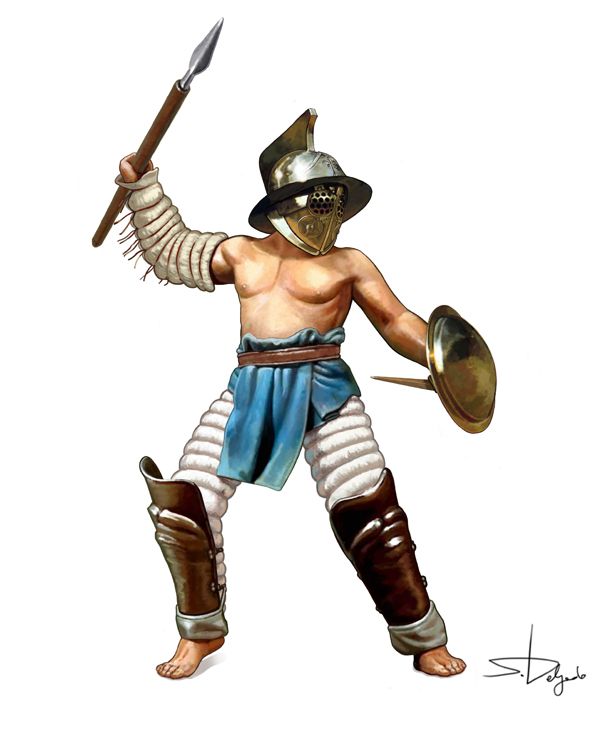
The Hoplomachus, a gladiator modeled on Greek hoplites, armed with a spear, dagger, and small round shield
Origins: Inspired by Greek hoplites. Equipment:
Round hoplite-style shield (small)
Long spear
Dagger for close combat
Helmet with tall crest
Two greaves
Fighting Style: Mixed-range combat. Began at spear distance, closed in with dagger when needed.
Opponents:
Murmillo
Thraex
Symbolism: Represented Rome’s victory over Greek traditions.
The Hoplomachus gladiator combined versatility and endurance, able to switch seamlessly between ranged spear attacks and close-quarter dagger fighting. Their style demanded careful timing and defensive awareness to exploit openings while avoiding heavy blows. Hoplomachi trained extensively in formations and individual combat techniques, reflecting their origin in Greek military traditions. Their presence in the arena emphasized discipline and tactical skill, offering spectators a dynamic and visually striking performance that contrasted with the power-oriented Murmillo and Thraex.
3. The Net and Trident Class
3.1 Retiarius
Ancient Roman Retiarius gladiator using net and trident to outmaneuver heavier fighters
Origins: Modeled on fishermen. Equipment:
Trident (fuscina or tridens)
Weighted throwing net
Dagger
Minimal armor (shoulder guard galerus only)
Fighting Style: Speed, distance, and trickery. Focused on mobility, entanglement, and thrusting.
Opponents:
Secutor (primarily)
Occasionally Murmillo
Symbolism: A dramatic underdog—lightly armored versus heavily armored.
The Retiarius relied on agility, cunning, and timing rather than brute strength, making them one of the most unique gladiator types. Mastery of the net was essential for controlling the battlefield and creating openings for thrusts with the trident. They required excellent spatial awareness, quick reflexes, and stamina to evade heavily armored opponents. Their minimal armor made fights dangerous but thrilling for spectators, showcasing the contrast between speed and strength and adding theatrical tension to the arena.
3.2 Laquearius
Laquearius gladiator displaying rope weapon and agile fighting style in the Roman arena
Origins: A variant of the retiarius. Equipment:
Lasso (laqueus)
Dagger or short sword
Minimal armor
Fighting Style: Attempted to snare the opponent’s legs or weapon arm. Rare and considered exotic.
The Laquearius was a highly specialized gladiator, relying on precision, timing, and dexterity to entangle opponents effectively. Their lasso technique required extensive training to avoid self-injury while trapping an adversary. Minimal armor allowed for maximum mobility but left them vulnerable, creating dramatic tension in the arena. This type added variety and spectacle to Roman games, demonstrating the technical and strategic possibilities within gladiatorial combat. Laquearii often served as rare, exotic displays rather than main-event fighters, thrilling audiences with their skillful maneuvers.
4. Mounted Gladiators
4.1 Equites
Equites gladiator type: fast, agile horse-mounted combatant of the Roman arena
Origins: Modeled after Roman cavalry. Equipment:
Horse
Round shield
Spear and sword
Light armor
Helmet with feathers
Fighting Style: Fought first on horseback with spears, then dismounted for close combat.
Opponents:
Other equites
Symbolism: Noble class duels; often fought in opening acts.
Equites gladiators demonstrated the combination of horsemanship, weapon mastery, and tactical awareness, making them a spectacle of speed and coordination. Their training emphasized mounted combat techniques, balance, and rapid dismounting for melee engagement. They often appeared in the early stages of games, showcasing skill and precision before heavier gladiators entered the arena. Fighting on horseback required courage and adaptability, as falls or missteps could be fatal. Equites illustrated Rome’s martial traditions and the integration of cavalry tactics into entertainment, blending practicality with theatricality for the audience.
4.2 Cataphractarii
The Cataphractarius, a heavily armored cavalry gladiator designed for powerful charges in the arena
Extremely rare. Fully armored cavalry inspired by eastern armies.
Equipment:
Chain or scale armor for both rider and horse
Long lance
Sword
Notes: More of an exhibition than a standard gladiator combat type.
Cataphractarii were among the most visually striking gladiators, appearing heavily encased and almost invulnerable on horseback. Their presence in the arena demonstrated Roman fascination with foreign military styles and exotic warfare. These gladiators required exceptional strength, endurance, and training to control armored horses under combat conditions. Due to the cost and rarity, their appearances were usually reserved for grand shows or special imperial games. Their spectacle emphasized power, intimidation, and the theatrical contrast between different fighting styles, leaving a lasting impression on the audience.
5. Exotic and Ethnic Gladiator Types
These types served as cultural theatre—demonstrating Rome’s victories over conquered peoples.
5.1 Gallus
The Gallus, a gladiator type modeled after Gallic warriors, equipped with helmet, shield, and sword
Origins: Celtic warriors. Equipment: Long shield, short sword, tall helmet. Notes: Eventually replaced by the Murmillo.
The Gallus gladiator emphasized strength, endurance, and the ability to withstand prolonged combat, reflecting the martial reputation of Celtic warriors. Their armor and weapons required skill to wield effectively while providing a visually impressive display for spectators. They often participated in early arena spectacles, setting the tone for subsequent bouts by demonstrating the contrast between heavy, disciplined fighters and lighter, faster opponents. Gallus gladiators also served as a cultural symbol, reinforcing Roman superiority and the empire’s narrative of conquest. Their presence influenced the design and tactics of later heavy infantry types like the Murmillo.
5.2 Veles
Veles gladiator, a lightly armored arena fighter inspired by the Roman army’s Velites skirmishers
Origins: Light skirmishers from early Roman armies. Equipment: Small shield, javelins, light gear. Role: Mock reenactments of early Roman warfare.
Veles gladiators excelled in mobility and strategic positioning, striking quickly and retreating before opponents could counterattack. Their role in the arena emphasized the tactical diversity of Roman warfare, highlighting skill, timing, and coordination over raw strength. Training focused on javelin accuracy, dodging, and stamina, preparing them for prolonged engagements or hit-and-run maneuvers. They added variety to the spectacle, providing contrast to slower, heavily armored combatants. Veles were often used in staged historical recreations, helping educate and entertain audiences by demonstrating Rome’s martial heritage.
5.3 Amazon and Achillia (Female Gladiators)
Female gladiators of Ancient Rome: Amazon and Achillia demonstrating courage and skill in the arena
Origins: Rare but documented. Equipment: Varied—often lightly armed. Notes: Used for novelty or propaganda; Nero and Domitian held female matches.
Female gladiators were a rarity and often reserved for special events or imperial extravaganzas, such as under Nero and Domitian. Their matches emphasized agility, daring, and showmanship rather than brute strength, adding variety and theatricality to the games. Training for Amazon and Achillia fighters focused on speed, precision, and controlled combat, with an emphasis on avoiding injury while maintaining excitement for spectators. Their presence challenged social norms, creating a spectacle that blended martial skill with novelty. These female gladiators also underscored the political and cultural messaging of the arena, demonstrating the emperor’s ability to surprise and captivate audiences with unique forms of entertainment.
5.4 Essedarius
The Essedarius, a rare gladiator type who fought from a small chariot, inspired by Celtic and British warriors
Origins: British chariot warriors. Equipment:
Chariot
Spears or javelins
Light armor
Fighting Style: Fought from or leapt off a moving chariot. Rare and expensive to stage.
Essedarii required exceptional skill in horsemanship, balance, and weapon handling, as they maneuvered both chariot and weapons simultaneously. Their fights were highly theatrical, thrilling audiences with daring charges, jumps, and precise attacks. Training emphasized coordination, timing, and rapid adaptation to combat situations, as mistakes could be deadly for both gladiator and horse. They often appeared in grand spectacles, particularly during games celebrating military victories or imperial power. Essedarii illustrated Rome’s ability to incorporate diverse martial traditions into entertainment, blending authenticity with dramatic flair for maximum audience impact.
5.5 Sagittarii
Origins: Archers (Eastern auxiliary types). Equipment: Bow and arrows Notes: Often used in staged hunts or specialty demonstrations, not mainline gladiatorial combat.
Sagittarii required extensive training in archery, accuracy, and timing to engage targets effectively in a chaotic arena environment. Their combat style contrasted sharply with heavily armored gladiators, providing variety and visual excitement for the audience. They often participated in staged hunts or paired demonstrations with other exotic gladiators to highlight different combat techniques. Sagittarii also demonstrated the integration of foreign military skills into Roman entertainment, blending practical skill with theatrical presentation. Their presence reinforced Rome’s image as a cosmopolitan empire capable of mastering and showcasing the martial talents of conquered peoples.
6. Paired and Theatrical Gladiators
Some gladiators existed only for spectacle, theatrical reenactments, or comic relief.
6.1 Andabatae
Origins: Blindfolded fighters. Equipment: Helmet with no eyeholes. Purpose: Comic relief; stumbling combat for entertainment.
Andabatae were trained to fight despite restricted vision, creating suspense and humor for spectators who watched their stumbling, clumsy movements. Their matches emphasized spectacle over skill, and bouts were often short due to the high risk of injury. They highlighted the Roman appetite for novelty and the extremes of gladiatorial entertainment. Training focused on basic combat techniques adapted to limited visibility, relying on instinct, timing, and audience engagement. Andabatae bouts reinforced the idea that gladiatorial games were as much about performance and dramatic tension as about martial prowess.
6.2 Dimachaerus
Origins: “Two-sword fighters.” Equipment: Two short swords, minimal armor. Fighting Style: Fast, dual-wielding, acrobatic.
Dimachaeri required exceptional coordination and stamina, as fighting with two swords demanded simultaneous offense and defense. Their training emphasized agility, reflexes, and timing to execute complex maneuvers while avoiding injury. They added visual flair to the arena, thrilling spectators with rapid attacks, spins, and unpredictable movement. Dimachaeri often faced off against a variety of opponents to showcase versatility and mastery of dual-weapon combat. Their presence reinforced the diversity of gladiatorial styles, highlighting the combination of artistry and martial skill in Roman spectacles.
6.3 Scissor
Ancient Roman Scissor gladiator: rare fighter with specialized bladed arm weapon
Origins: Extremely rare. Equipment: A specialized forearm-mounted cutting weapon shaped like a curved blade or tube with a blade at the end. Fighting Style: Designed to counter net-users.
The Scissor required exceptional strength, precision, and timing, as their weapon allowed unique offensive techniques while maintaining a defensive posture. Training focused on arm strength, wrist control, and rapid reaction to an opponent’s movements. Their unusual weapon made them a rare spectacle, providing audiences with novelty and excitement beyond standard gladiator types. Scissores added tactical depth to matches, showing that the arena could feature specialized counters and strategies. Their presence highlighted the creativity and variety inherent in Roman gladiatorial games, combining danger with entertainment.
6.4 Crupellarius
Origins: Gaulish rebels under Florus and Sacrovir. Equipment: Extremely heavy full-body armor—practically immobile. Notes: A curiosity; impractical but dramatic.
The Crupellarius was designed to impress audiences with extreme armor and near-impervious defense, often serving as a visual centerpiece rather than a dynamic fighter. Their matches highlighted the dramatic contrast between heavy, almost impervious combatants and faster, more agile opponents. Training focused on conditioning to move in heavy armor and maintain balance under weight, as missteps could be fatal. These gladiators added variety and theatricality to the games, emphasizing spectacle and novelty over traditional fighting skill. Crupellarii reinforced the idea that the arena celebrated both endurance and innovation in combat display.
6.5 Bestiarii
The Bestiarius, a gladiator trained to battle wild animals such as lions, leopards, and bears in the Roman arena
Origins: Animal fighters. Equipment: Spears, whips, knives, or no weapons at all. Role:
Fought lions, leopards, boars
Sometimes executed condemned criminals as punishment
Not always counted as gladiators but often included in arena spectacles.
Bestiarii were often trained in specialized schools or forced into the arena as part of their sentence, making their fights unpredictable and thrilling for spectators. They required awareness, agility, and courage to confront dangerous animals, and their success or failure could be fatal. Training focused on animal behavior, defensive techniques, and quick reactions to avoid deadly attacks. Some Bestiarii were volunteers seeking fame or rewards, while others were condemned, adding a layer of drama and suspense to their combat. Their presence emphasized the diversity of spectacles in Roman games, blending danger, entertainment, and moral lessons about bravery and survival.
7. Naval Gladiators
Naumachiarii
Naumachiarii gladiator type: specialized arena fighters trained for mock sea battles in Ancient Rome
These were not traditional gladiators but fighters placed in staged naval battles (naumachiae) on flooded arenas or artificial lakes.
Equipment: Varied—often dressed as sailors or marines.
Notes: Massive, expensive spectacles used only for major imperial celebrations.
Naumachiarii required specialized training in both swimming and combat on unstable, moving platforms, making their role extremely dangerous. The logistics of staging a naumachia were immense, involving the construction of pools or flooding arenas, transporting ships, and coordinating hundreds of combatants. Their battles were highly theatrical, often reenacting famous naval conflicts from Roman history or myth, and demonstrated the empire’s ability to combine entertainment with propaganda. They added variety to the games, contrasting traditional arena combat with large-scale, elaborate displays of skill and spectacle. Naumachiarii highlighted Rome’s creativity in spectacle design, blending military precision with dramatic flair for the enjoyment of the populace.
8. Gladiator Schools and Training Roles
8.1 Doctores
Trainers for specific styles:
Doctor Retiarii
Doctor Thraecum
Doctor Murmilloniarum
Doctores were essential for preparing gladiators for the arena, ensuring that fighters mastered weapons, armor, and tactics appropriate to their type. They provided personalized instruction, correcting mistakes and refining techniques to maximize effectiveness in combat. Training included sparring, stamina conditioning, and strategic drills to prepare gladiators for both performance and survival. Doctores also supervised safe practice, preventing unnecessary injury while instilling discipline and confidence. Their role reinforced the professional and educational structure of gladiatorial schools, emphasizing that behind every spectacle was a system of rigorous training and expertise.
8.2 Lanista
Owner and manager of gladiators—the “boss” of the school.
Lanistae were responsible for acquiring and training gladiators, managing contracts, and negotiating bouts with organizers and sponsors. They ensured fighters received proper training, medical care, and equipment, while also monitoring discipline and morale. Their schools often housed dozens of gladiators, each specialized in different fighting styles, requiring the Lanista to balance resources and schedules effectively. Lanistae played a critical role in maintaining the quality and spectacle of the games, as their management directly affected audience satisfaction and the school’s reputation. They combined entrepreneurship with martial expertise, serving as the backbone of Rome’s gladiatorial system.
8.3 Armatura Specialists
Gladiators were classified by armatura—their style of equipment—defining their role permanently.
Armatura specialists required lifelong training to master their specific equipment and fighting techniques, with emphasis on precision, timing, and endurance. Their classification allowed trainers and organizers to design bouts that highlighted contrasts in strength, speed, and skill, maximizing entertainment value. These specialists often became iconic figures, easily recognizable to spectators by their distinctive armor and weapons. They also reflected Rome’s ability to incorporate martial traditions from conquered peoples into the spectacle, blending authenticity with drama. Their presence ensured that every match had a tactical and visual narrative, reinforcing the structured complexity of the gladiatorial system.