The Roman Empire rose, expanded, stabilized, and eventually declined under the authority of men who ruled with near-absolute power. Their policies, personalities, and ambitions shaped the lives of millions. Some strengthened Rome, others endangered it, but each of the following emperors left a defining mark on Roman history and imperial rule.
Augustus — Architect of the Roman Empire and Restorer of Stability

Reign: 27 BCE – 14 CE
Born: Gaius Octavius (later adopted by Julius Caesar)
Augustus stands as the foundational figure of Roman imperial power. When he emerged victorious from the civil wars that destroyed the Roman Republic, he did not simply seize control. Instead, he built a political structure designed to make his rule appear lawful, traditional, and necessary. Augustus accumulated powers slowly, allowing the Senate to function publicly while ensuring that true authority remained firmly in his hands. This delicate balance between appearance and reality became the defining characteristic of Roman imperial rule.
A major component of Augustus’ success was his transformation of the Roman military. He created a professional standing army with fixed terms of service, standardized pay, and retirement rewards. This prevented unrest and ensured loyalty. He also formed the Praetorian Guard, an elite force responsible for protecting the emperor — though it would later develop into a political power in its own right.
Administrative reform under Augustus reshaped the empire. He reorganized taxation, standardized provincial governance, and established structured oversight to reduce corruption. These measures supported economic stability and centralized authority. Romans experienced not chaos, but order — a powerful change after decades of war.
Culturally, Augustus cultivated legitimacy through symbolism and public works. Monumental architecture transformed Rome into an imperial capital rather than a republican city-state. Literature reinforced imperial ideology, presenting Augustus as the stabilizing force chosen by fate to protect Rome. This period initiated the Pax Romana — a long era of relative peace that encouraged trade, infrastructure growth, and urban development.
Yet Augustus’ state rested upon control. Political rivals were eliminated, and dissent was suppressed. The Republic was not preserved — it was buried beneath ceremony and tradition. Augustus ensured that Rome would never again function without a singular ruling authority, setting a precedent that would define governance for centuries.
His rule combined political skill, administrative reform, cultural strategy, and calculated power. Augustus did not merely become emperor. He defined what an emperor was.
Key Ideas — Summary
Augustus created the political structure of the Roman Empire
He preserved republican appearances while centralizing power
His military and administrative reforms ensured stability
The Pax Romana began under his leadership
His system made imperial rule permanent
Tiberius — An Effective but Isolated Ruler Defined by Suspicion

Reign: 14 – 37 CE
Successor to Augustus
Tiberius inherited a functioning imperial machine — and he maintained it with competence, discipline, and restraint. Before ruling, he distinguished himself as a skilled general who strengthened Rome’s frontiers. As emperor, he governed cautiously, avoided reckless wars, and protected the treasury through fiscal responsibility. Under his administration, law courts and provincial governments continued to function with efficiency, and the empire remained stable.
Where Tiberius failed was in political perception. Reserved by nature, he lacked Augustus’ charisma and public engagement. His relationship with the Senate was tense and distant, encouraging mistrust. Over time, he withdrew further from Rome, preferring isolation to leadership presence. This retreat culminated in his relocation to the island of Capri, marking a decisive shift in imperial authority.
With the emperor physically and politically removed, power gravitated toward the Praetorian Prefect Sejanus. Sejanus manipulated treason laws to eliminate rivals and consolidate influence. Rome entered a period of fear as accusations became weapons. Although Tiberius eventually discovered Sejanus’ ambitions and ordered his execution, the climate of suspicion continued. Executions and trials escalated, deepening the image of a paranoid regime.
Ancient historians often portray Tiberius as immoral, cruel, and corrupt. However, these accounts were written under later emperors and reflect political hostility as much as fact. Modern scholarship views him as a capable, serious administrator who lacked the public legitimacy necessary to sustain authority. Rome functioned effectively — but confidence collapsed.
The irony of Tiberius’ rule lies in contrast. Economically and administratively, the empire remained strong. Yet leadership requires visibility. By withdrawing from government, Tiberius allowed rumors, fear, and internal manipulation to replace imperial presence.
His reign revealed one of the great weaknesses of Augustus’ system: the stability of the empire depended upon the character and participation of its ruler. When the emperor disengaged, the state became vulnerable to intrigue.
Key Ideas — Summary
Tiberius governed effectively but failed to maintain political trust
His isolation allowed the Praetorian Guard to grow in influence
Sejanus’ rise created fear and instability in Rome
Administration remained strong but legitimacy weakened
His reign demonstrated the danger of invisible leadership
Caligula — Absolute Power, Personal Rule, and the Collapse of Restraint
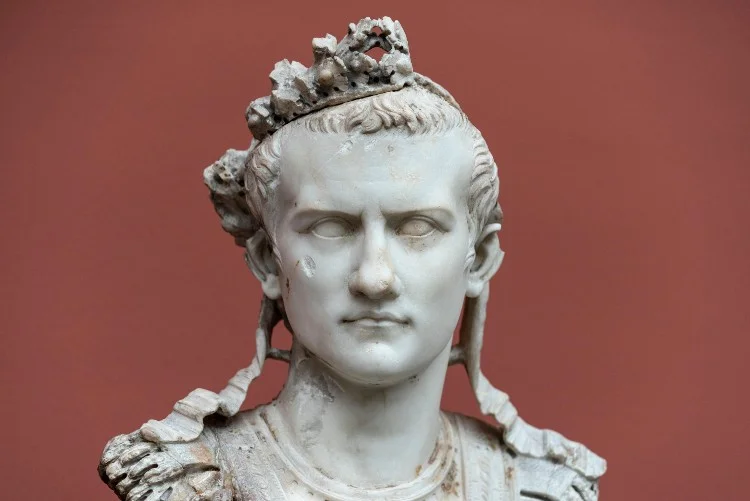
Reign: 37 – 41 CE
Full name: Gaius Julius Caesar Germanicus
Caligula’s reign is one of the most infamous in Roman history. Initially welcomed as a symbol of renewal after the cautious government of Tiberius, he entered power with immense popularity. As the son of the beloved general Germanicus and the great-nephew of Augustus, he represented both dynastic legitimacy and youthful energy. The early months of his rule included public generosity, spectacles, and reduced taxation — all of which strengthened his popularity.
However, soon after suffering a severe illness, Caligula’s rule changed dramatically. Whether this transformation was caused by psychological instability, stress, or political environment remains debated. What is clear is that he began governing as if Roman power existed solely for his personal gratification. He abandoned the restraint that earlier emperors had carefully cultivated and embraced uninhibited autocracy.
Caligula spent lavishly on games, construction, and personal luxury. His expenditures rapidly drained the treasury, forcing him to impose new taxes and confiscate wealth. Senators were humiliated publicly. Judicial processes became unpredictable. Political purges eliminated perceived threats, sometimes without formal accusations. The fear generated under his regime destabilized Rome’s elite class, replacing cooperation with anxiety.
Caligula also confronted traditional boundaries on imperial power. He emphasized his divinity, promoted his cult, and demanded honors previously reserved for gods. Ancient accounts describe incidents such as ordering statues of himself in temples and expecting worship from subjects. While some of these stories were exaggerated by later writers hostile to his reign, they reflect his disregard for Roman norms concerning modesty in power.
Despite his instability, Roman provincial administration continued functioning because imperial bureaucracy had already become structurally resilient. Local governors, legal officials, and military commanders largely maintained order. Yet instability at the center endangered long-term stability. Legitimacy depends not only on systems, but on the ruler embodying them responsibly.
Caligula’s rule ended violently. A conspiracy involving members of the Praetorian Guard assassinated him, confirming the Guard’s emerging role as kingmakers. His death demonstrated that while emperors possessed extraordinary power, they also depended on the loyalty of those around them.
Caligula’s reign matters historically because it tested the limits of imperial power. He exposed the fragility of the political balance Augustus constructed. Rule by one man could provide stability, but it also allowed for catastrophic personal misrule if that man acted without restraint.
Key Ideas — Summary
Caligula abandoned political restraint and emphasized personal power
Financial irresponsibility destabilized imperial finances
Persecution and unpredictability created fear among elites
The Praetorian Guard proved capable of removing emperors
His reign showed how absolute authority could rapidly become tyranny
Claudius — Administrative Reformer and Unexpectedly Effective Emperor

Reign: 41 – 54 CE
Full name: Tiberius Claudius Caesar Augustus Germanicus
Claudius became emperor under extraordinary circumstances. Considered physically weak and intellectually eccentric, he had been marginalized by the imperial family. Yet after the assassination of Caligula, the Praetorian Guard discovered Claudius hiding in the palace and proclaimed him emperor. What many expected to be a puppet ruler instead proved to be one of Rome’s most effective administrators.
Claudius possessed strong scholarly interests and deep knowledge of law and governance. Unlike earlier emperors who gained prestige through military heroism, Claudius achieved authority through organization and reform. He strengthened imperial bureaucracy by involving equestrian administrators, creating a more professional civil service that was loyal to the emperor rather than aristocratic families. This significantly reduced senatorial control and increased administrative efficiency.
Claudius also expanded Roman citizenship, integrating provincial elites into Roman political culture. Extending participation in governance strengthened loyalty and accelerated the Romanization of conquered territories. His policies reflected a view of empire not merely as conquest but as a wider political community.
One of Claudius’ most significant actions was the conquest of Britain in 43 CE. While the campaign had been prepared by earlier commanders, Claudius’ involvement turned it into a major propaganda success. Britain became a province of the empire, bringing resources, prestige, and strategic advantage. This demonstrated that Claudius was not merely scholarly, but capable of decisive imperial expansion.
Public works flourished during his rule. Aqueducts, harbors, and administrative centers were constructed, contributing to urban growth and infrastructure development. His judicial reforms improved legal consistency and increased imperial oversight. Yet his reign was not without difficulties. Claudius’ reliance on freedmen administrators and his marriages — particularly to Messalina and Agrippina the Younger — generated controversy. Intrigues within the palace culminated in his likely poisoning, possibly orchestrated by Agrippina to secure power for her son Nero.
Claudius’ rule revealed the maturing nature of the Roman state. The empire could be governed not only through battlefield charisma but through systematic administration. He transformed governance from aristocratic privilege toward centralized professional management.
Key Ideas — Summary
Claudius strengthened imperial administration and bureaucracy
He integrated provincial elites and expanded citizenship
Roman Britain was successfully conquered during his reign
Public infrastructure and legal reforms advanced significantly
His reign proved that intellectual and administrative skill could sustain empire
Nero — Image, Performance, and the Politics of Popularity and Fear

Reign: 54 – 68 CE
Full name: Nero Claudius Caesar Augustus Germanicus
Nero remains one of the most controversial Roman emperors. Ascending to the throne as a teenager, guided initially by advisers such as Seneca, he soon developed a ruling style centered on image, performance, and personal authority. Nero valued popularity with the masses, emphasizing public entertainment, games, and displays rather than traditional senatorial governance. This shift highlighted growing tension between aristocratic elites and urban public opinion.
Early in his reign, administration functioned competently under his advisers. However, Nero increasingly asserted independence, sidelining traditional elites and cultivating a personal following. His interest in performance — music, theater, and spectacle — scandalized conservative Romans who believed emperors should embody dignity and restraint. Nero, by contrast, wanted admiration, not merely respect.
The Great Fire of Rome in 64 CE transformed his legacy. Large sections of the city burned, and although Nero organized relief efforts and rebuilding projects, rumors spread that he himself had ordered the fire to clear space for grand construction. He constructed the Domus Aurea, a luxurious palace complex, reinforcing suspicion. To counter blame, Nero targeted Christians, initiating one of the earliest state persecutions of the group.
Political opposition increased, leading to conspiracies and reprisals. Notably, the Pisonian conspiracy triggered waves of executions among senators and intellectuals. Meanwhile, unrest spread in provinces such as Judea and Gaul. Rebellions and military dissatisfaction eroded Nero’s authority. When governors declared against him, Nero lacked military loyalty necessary to retain power and eventually committed suicide, ending the Julio-Claudian dynasty.
Nero’s reign demonstrates how imperial power relied on delicate balances: between elite legitimacy and popular approval, between spectacle and governance, and between personal ambition and institutional stability. He invested heavily in image while allowing administrative authority to fragment. His fall showed that emperors who failed to secure military loyalty could not survive.
Key Ideas — Summary
Nero prioritized popularity and spectacle over senatorial tradition
The Great Fire of Rome reshaped his reputation and urban landscape
His rule featured repression, court intrigue, and purges
Military discontent and revolts led to his downfall
His reign highlighted the tension between image and governance
Trajan — Military Expansion and the Height of Roman Territorial Power

Reign: 98 – 117 CE
Full name: Marcus Ulpius Traianus
Under Trajan, Rome reached its greatest territorial extent. A career soldier and popular leader, Trajan combined military ability with administrative competence, earning the Senate’s title of Optimus Princeps — the Best Ruler. His reign marked the apex of Roman imperial expansion and demonstrated the empire’s capacity for coordinated campaigning on a massive scale.
Trajan’s major conquests included Dacia, located in modern-day Romania. The Dacian Wars not only added territory but brought immense wealth from gold mines, strengthening imperial finances. Trajan commemorated this achievement through monumental architecture such as Trajan’s Column, which visually recorded his campaigns. Conquest also extended into Arabia and parts of Mesopotamia, briefly pushing Rome’s borders deep into the Near East.
Yet Trajan was not solely a conqueror. He invested heavily in infrastructure, public buildings, and welfare programs. Roads, harbors, aqueducts, and the expansive Trajan’s Forum transformed urban life. He expanded the alimenta program, providing assistance for poor children in Italy and promoting population growth. Administrative reforms developed provincial governance and improved legal consistency.
Trajan cultivated strong relations with the Senate, publicly respecting its authority while clearly holding supreme power. His leadership style balanced imperial dominance with aristocratic cooperation. This preserved legitimacy and minimized political conflict in Rome.
However, expansion brought limits. Extended borders strained logistical capacity, and holding Mesopotamia proved unsustainable after his death. His successor, Hadrian, would consolidate rather than expand territory. Nevertheless, Trajan’s campaigns symbolized imperial strength and demonstrated Rome’s capacity for large-scale warfare well into the second century.
Trajan’s reign represents the high-water mark of Roman confidence. The empire appeared unstoppable — wealthy, administratively sophisticated, militarily dominant, and culturally unified. This sense of success concealed underlying pressures, yet in his lifetime, imperial power seemed secure and expansive.
Key Ideas — Summary
Trajan led Rome to its greatest territorial size
Dacian conquest brought wealth and strategic advantage
Major public building projects transformed Rome
He balanced Senate relations with imperial authority
His reign represented the zenith of Roman expansion
Hadrian — Consolidation, Defense, and Cultural Integration of Empire

Reign: 117 – 138 CE
Full name: Publius Aelius Hadrianus
Hadrian succeeded Trajan and immediately shifted Roman strategy from expansion to consolidation. Recognizing the overextension of imperial borders, he withdrew from unsustainable eastern territories and focused on fortifying defensible frontiers. His reign emphasized stability over conquest, law over ambition, and integration over expansion.
Hadrian is best known for Hadrian’s Wall in Britain, a massive fortification marking the empire’s northern boundary. It symbolized a strategic transition: the empire would defend its limits rather than endlessly push outward. Fortifications across the Rhine, Danube, and eastern provinces reinforced this defensive policy.
He traveled extensively across the empire, more than any previous emperor. These journeys allowed him to inspect troops, oversee construction, administer justice, and directly interact with provincial communities. His visits demonstrated imperial presence beyond Rome, reinforcing unity in a geographically vast state.
Hadrian promoted Hellenistic culture, philosophy, and architecture. Cities flourished under his patronage, particularly in the Greek East. He reorganized legal administration, promoting uniformity and strengthening central oversight. Artistic and intellectual life thrived, reflecting a cosmopolitan imperial identity that blended Roman authority with Greek culture.
His reign also experienced conflict, notably the Bar Kokhba Revolt in Judea. This rebellion required massive military suppression and resulted in devastating consequences for the region. Judea was renamed Syria Palaestina in an effort to weaken Jewish identity. The revolt illustrated the persistent challenge of managing diverse cultures within empire.
Hadrian’s policies created sustainable governance. By focusing on defense and administration rather than conquest, he stabilized the empire after Trajan’s expansion. He shaped the empire geographically and culturally, leaving lasting architectural and legal legacies.
Key Ideas — Summary
Hadrian shifted Rome from expansion to consolidation
Defensive frontiers, including Hadrian’s Wall, defined borders
Extensive travel reinforced imperial unity and control
Hellenistic cultural patronage shaped Roman identity
The Bar Kokhba Revolt revealed limits of cultural integration
Marcus Aurelius — Philosopher Emperor and the Burden of Crisis Leadership

Reign: 161 – 180 CE
Full name: Marcus Aurelius Antoninus
Marcus Aurelius stands out as Rome’s philosopher emperor. Deeply influenced by Stoic philosophy, he viewed imperial power not as privilege, but as duty. His writings, preserved in the Meditations, reveal a reflective ruler grappling with responsibility, mortality, and ethical leadership. Yet his reign was marked less by peace than by relentless crisis.
Marcus Aurelius faced continuous warfare on multiple fronts. Germanic tribes threatened the Danube frontier, requiring prolonged military campaigns. Simultaneously, the Parthian War in the East demanded significant resources. During these conflicts, the Antonine Plague swept through the empire, causing widespread mortality and economic disruption. Leadership required resilience and adaptability rather than expansionist ambition.
Despite constant warfare, Marcus Aurelius maintained a commitment to legal reform and justice. He issued rulings aimed at improving conditions for slaves, orphans, and the poor, reflecting philosophical principles applied to governance. He valued reasoned decision-making and deliberation, contrasting with emperors who ruled by impulse.
His greatest mistake, however, was dynastic. Marcus Aurelius broke from the precedent of adopting capable heirs and instead elevated his biological son Commodus. Commodus’ disastrous reign contributed to political instability and symbolized the failure of hereditary succession to guarantee competence.
Marcus Aurelius represents the fragility of even wise rule. Philosophy could not remove plague, reduce barbarian pressure, or resolve structural strains on the empire. His reign marks the end of the Pax Romana and the beginning of increasing conflict and economic difficulty.
Key Ideas — Summary
Marcus Aurelius embodied Stoic philosophical leadership
His reign was dominated by wars and plague
Legal and social reforms reflected ethical governance
Adoption system of succession ended with Commodus
His era marks the transition from stability to crisis
Diocletian — Reorganization, Autocracy, and Survival of the Imperial State

Reign: 284 – 305 CE
Full name: Gaius Aurelius Valerius Diocletianus
By the time Diocletian rose to power, the Roman Empire was in severe crisis. Military anarchy, economic collapse, repeated civil wars, and external invasions threatened imperial survival. Diocletian did not merely rule; he rebuilt the state. His reforms created a more bureaucratic, centralized, and overtly autocratic system that allowed the empire to persist for centuries.
Diocletian reorganized imperial administration through the Tetrarchy — the rule of four emperors. Two senior emperors (Augusti) and two junior emperors (Caesares) governed different regions, ensuring rapid response to threats and reducing civil war over succession. This system acknowledged that the empire was too vast for one man to control directly.
He transformed imperial image. Earlier emperors had maintained the pretense of republican tradition. Diocletian abandoned that illusion. Emperors now appeared as distant, sacred rulers requiring elaborate ceremony. The imperial court adopted oriental-style hierarchy, reinforcing absolute authority.
Economically, Diocletian attempted to stabilize inflation through currency reform and issued the Edict on Maximum Prices to control market speculation. While not fully successful, these policies revealed the scale of economic crisis. He restructured provincial administration and separated civil from military authority, increasing efficiency and limiting rebellions by governors.
Diocletian also launched the most severe persecution of Christians in Roman history, seeing them as a threat to unity. Though persecution ultimately failed, it revealed how religion had become politically significant.
Diocletian voluntarily abdicated — a rare act in imperial history — retiring to his palace in Split. His reforms, however, endured, providing foundations for the later Byzantine state.
Key Ideas — Summary
Diocletian saved the empire from collapse through radical reform
The Tetrarchy divided power and increased stability
Autocracy replaced republican illusion permanently
Economic restructuring attempted to address crisis
His rule marks the beginning of the Late Roman Empire
Constantine the Great — Christianization and Transformation of Imperial Identity

Reign: 306 – 337 CE
Full name: Flavius Valerius Constantinus
Constantine transformed Rome not through conquest alone, but through religion and imperial identity. His victory in civil wars made him sole ruler, but his endorsement of Christianity reshaped Roman society permanently. The Edict of Milan legalized Christian worship, ending persecution and allowing the religion to expand openly across the empire.
Under Constantine, Christianity moved from persecuted minority faith to imperial partner. Church leadership became connected to state power. Councils such as Nicaea set doctrinal foundations with imperial support. While paganism persisted, imperial policy clearly favored Christian institutions.
Constantine also restructured imperial geography. He founded Constantinople on the site of Byzantium, establishing a new capital strategically placed between Europe and Asia. This city would become the heart of the Eastern Roman (Byzantine) Empire for over a thousand years, long after the fall of Rome in the West.
Militarily and politically, Constantine continued Diocletian’s centralization of authority. He strengthened bureaucracy, maintained large armies, and preserved autocratic imperial image. However, he rolled back aspects of the Tetrarchy by re-establishing dynastic succession.
Constantine’s conversion remains debated among historians, but its effect is undeniable. Christianity’s integration into imperial identity reshaped laws, culture, and political legitimacy. The Roman Empire no longer defined itself primarily through traditional religion. A Christian empire emerged.
Key Ideas — Summary
Constantine legalized and promoted Christianity
Constantinople became a new imperial capital
He preserved autocracy while altering imperial ideology
His reign bridged classical Rome and medieval Christendom
Religion became central to imperial legitimacy