The Three Phases of Ancient Rome: From Kingdom to Republic and Empire
Ancient Rome did not appear as a fully-formed empire. Instead, it evolved through three distinct political systems across many centuries. Each phase reshaped Roman power, identity, and society, gradually transforming a small settlement on the Tiber River into one of the most formidable civilizations in world history. Understanding these three stages explains not only Rome’s success, but also its conflicts and eventual transformation.
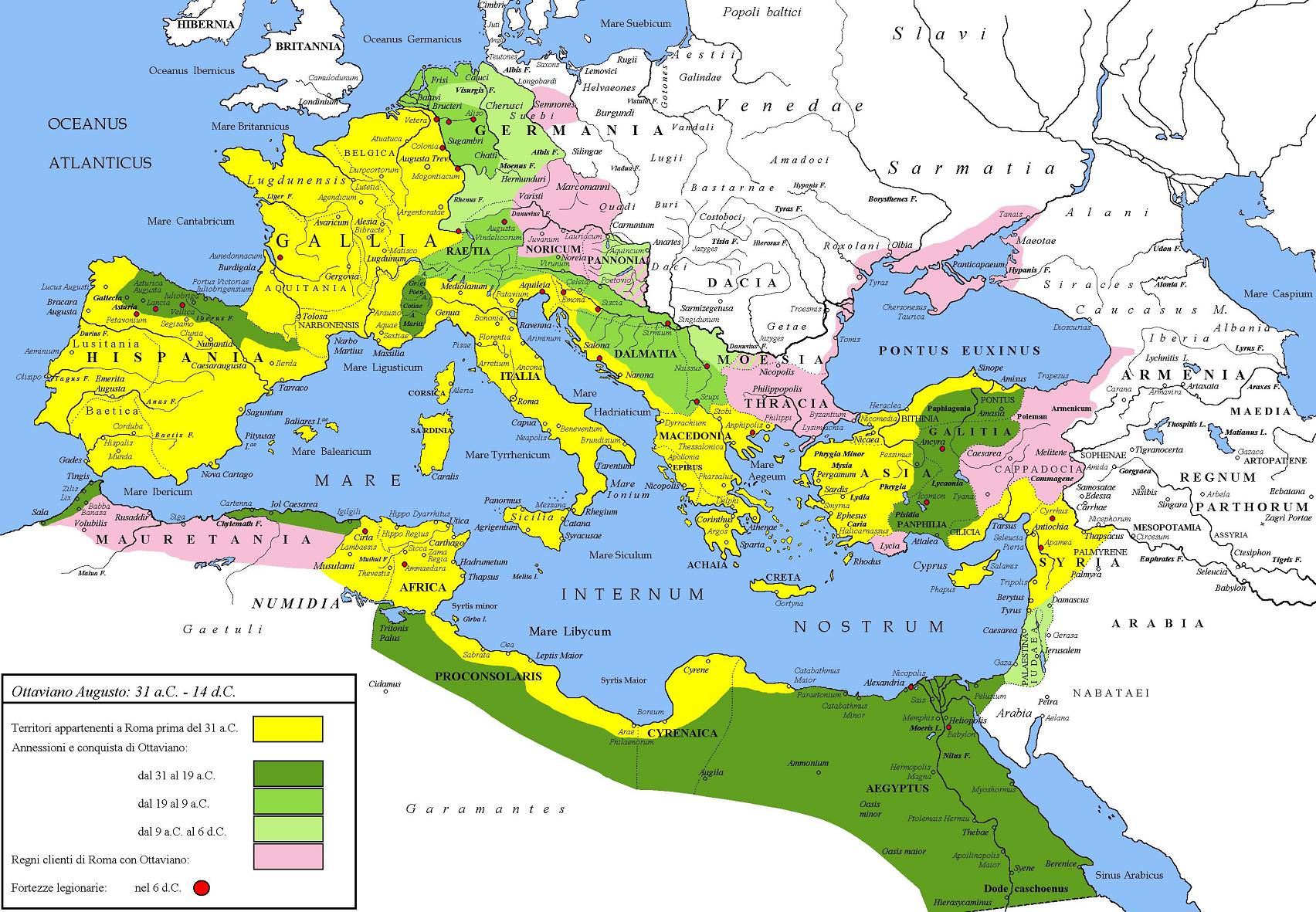
A Map of Roman Expansion from the Year 31 a.C to 14 d.C
The Roman Kingdom — Foundations of Power and Sacred Authority (753–509 BCE)
Origins, Kingship, and Early Society
According to Roman tradition, Rome began in 753 BCE, founded by Romulus, the first of seven kings. Whether legend or history, these stories reveal how early Romans viewed their origins: rooted in strength, divine favor, and order emerging from struggle.
The Roman Kingdom was not a democracy. Power rested with the king, who combined roles of military commander, religious leader, and supreme judge. Yet this was not tyranny in the later sense. Kings were expected to rule with the Senate, a council of aristocratic elders whose influence would outlast monarchy itself. Roman social order began forming early, with citizens divided into patricians (elite families) and plebeians (commoners).
Religion structured daily life. Kings performed rituals, sought divine approval, and preserved traditions that later Romans believed defined their identity. Law also began to develop, establishing the idea that Roman society functioned through rules, not chaos.
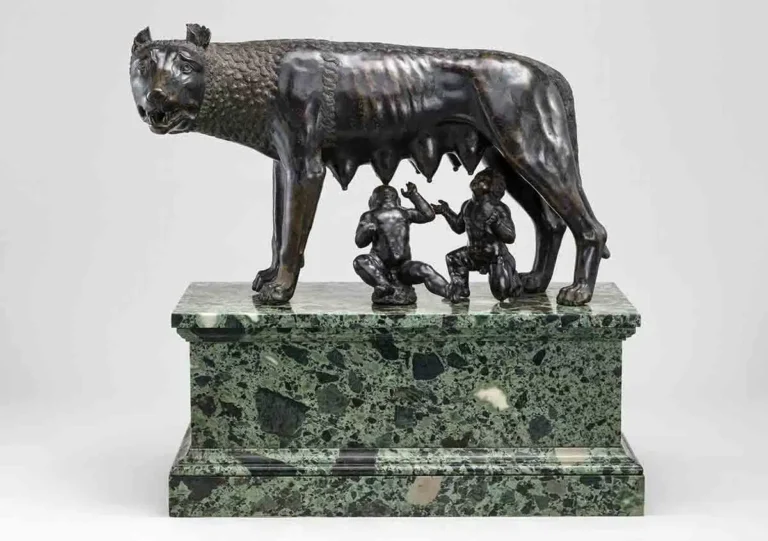
This statue shows the Capitoline Wolf nursing Romulus and Remus, representing the legendary story of Rome’s founding and the city’s origins in Roman mythology.
Expansion, Infrastructure, and Cultural Influence
The early Roman kings consolidated control over surrounding Latin communities. Rome transitioned from a cluster of settlements into a fortified town with growing political relevance.
Key developments included:
Defensive walls and early military organization
Expansion of trade networks
Basic institutions that evolved into later offices
Perhaps most transformative was the influence of the Etruscans, a powerful neighboring civilization. The last kings were Etruscan-linked rulers who introduced architectural, religious, and administrative practices. Rome began to look like a real city rather than a tribal settlement.
Monumental projects such as early drainage systems and public spaces were undertaken. These were not yet imperial works — but they formed the architectural DNA Rome later expanded upon. Roman identity was still forming, yet certain traits — discipline, hierarchy, reverence for law — were already visible.
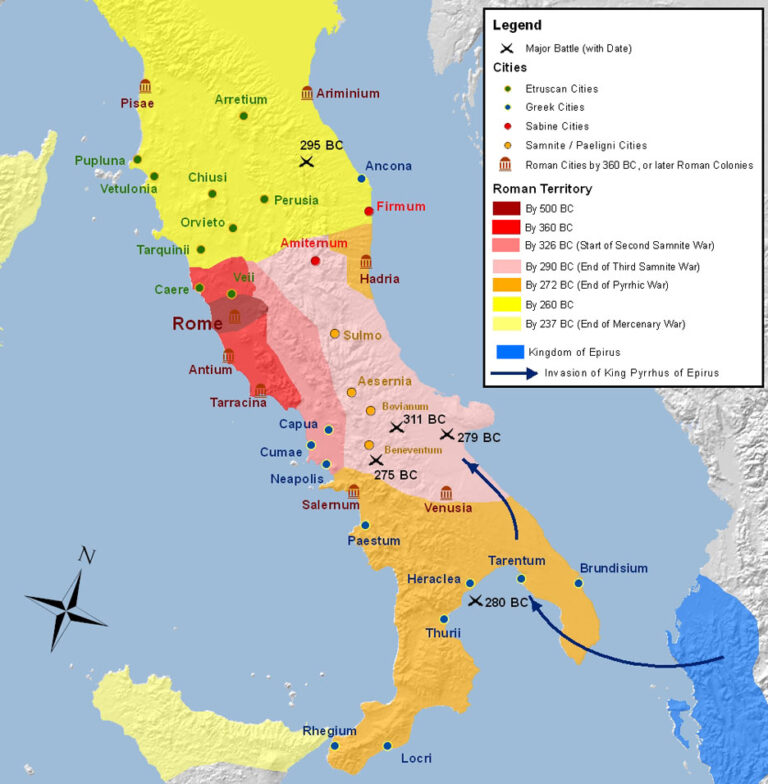
This map depicts the early expansion of Rome throughout Italy, illustrating the growth of Roman settlements, territorial control, and increasing influence during the Kingdom and early Republic periods.
The Fall of the Kings and Birth of a New System
The monarchy ended dramatically in 509 BCE. Traditional accounts describe the expulsion of the final king, Tarquinius Superbus, accused of tyranny and abuse of power. Whether entirely factual or embellished, the political result was crucial:
Rome rejected kingship permanently.
The aristocratic elite replaced monarchy with elected magistrates and a strengthened Senate. Rome now saw itself as a community governed by its citizens — at least those with status. This transition laid the groundwork for one of history’s most influential political experiments: the Roman Republic.
Key Ideas — Roman Kingdom
Rome began as a monarchy rooted in sacred authority and aristocratic influence
Early kings shaped institutions, religion, and urban development
The fall of the monarchy created powerful anti-royal political culture
The Roman Republic — Laws, Citizens, and Expansion Through Conflict (509–27 BCE)
Political Structure and the Balance of Power
The Republic introduced a radical political idea for its time: no single ruler should dominate the state. Power was distributed among elected officials, magistrates, and the Senate. Two consuls shared executive authority, each able to veto the other, ensuring mutual restraint.
However, this was not equality. Only male citizens with sufficient status participated meaningfully. A long struggle known as the Conflict of the Orders reshaped politics as plebeians demanded representation. Over time, offices opened to non-patricians, and new political bodies formed — but the elite still dominated governance.
What made the Republic unique was not pure democracy, but a structured balance of power designed to prevent tyranny while maintaining aristocratic leadership. Roman law gained prominence, establishing rights and codified procedures that later civilizations would study and emulate.
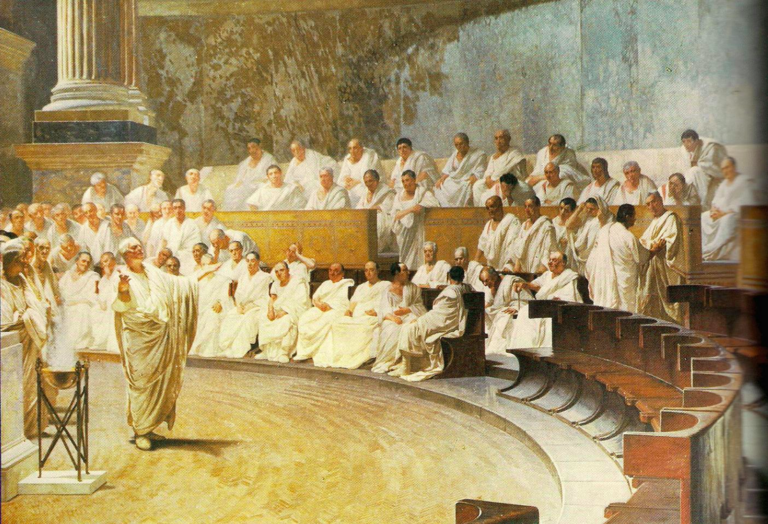
This image shows the Roman Senate in session, highlighting the political assembly where laws were debated and decisions shaping the Republic and Empire were made.
Military Power and Territorial Expansion
The Republic’s most visible achievement was expansion. Through alliances, warfare, and assimilation, Rome gained control of the Italian peninsula before turning outward to confront major powers such as Carthage.
The Punic Wars marked turning points. Rome emerged not only victorious but transformed into a Mediterranean hegemon. Provinces were established, taxes collected, and military service became the path to status and influence.
Success, however, created strain. Wealth concentrated among elites. Veterans demanded land. Enslaved labor expanded. Political rivalries intensified. Rome became powerful — but uneasy.
Roman last stand in the battle of Cannae
Crisis, Civil War, and the End of Republican Order
By the late Republic, traditional systems struggled to manage Rome’s scale. Generals such as Marius, Sulla, Pompey, and Julius Caesar commanded personal armies loyal to them rather than the state. Violence entered politics. Reforms failed. Assassinations became tools of power.
The decisive turning point came with the rise of Julius Caesar, whose dictatorship shattered republican norms. His assassination in 44 BCE did not restore the Republic — instead it unleashed further conflict. Ultimately, Octavian (Augustus) consolidated authority and reorganized Rome under imperial rule.
The Republic ended — but its legal and political legacy endured for millennia.
Key Ideas — Roman Republic
The Republic balanced power among elected officials and the Senate
Military expansion transformed Rome into a Mediterranean superpower
Internal conflict and political violence destroyed republican stability
The Roman Empire — Centralized Authority and Global Legacy (27 BCE–476 CE West / 1453 CE East)
The Rise of Imperial Rule and the Pax Romana
With Augustus, Rome entered a new era. Power became centralized, though disguised beneath republican titles. The result was stability — and the beginning of the Pax Romana, a period of relative peace, prosperity, infrastructure development, and cultural flourishing.
Administratively, the empire professionalized governance. Provinces were organized, taxation standardized, and law extended. Citizenship gradually expanded, eventually covering nearly all free inhabitants. Rome became a vast multicultural world, connected by roads, trade, and shared institutions.
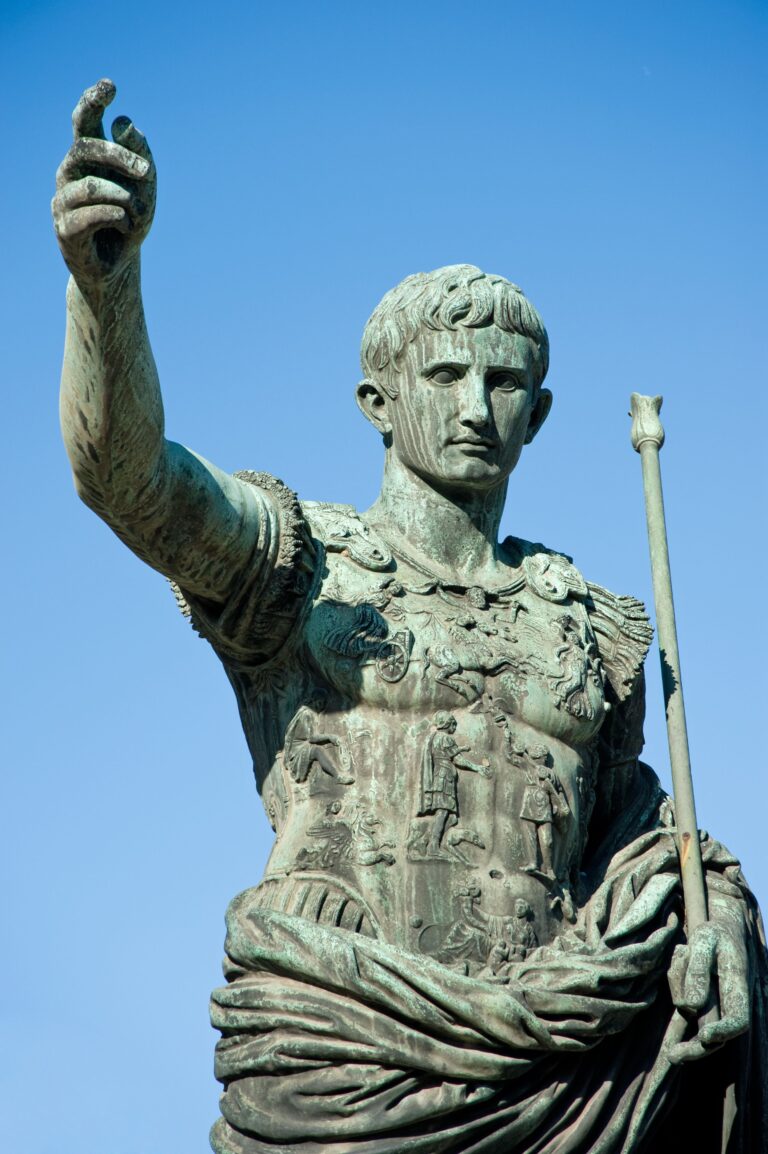
A Bronze Statue of Octavian Later Known as Augustus
Strength, Crisis, and Transformation
The empire’s success depended on strong leadership and economic capacity. When these faltered, crisis followed. The third century witnessed internal conflict, invasions, and financial strain. Yet reforms under rulers such as Diocletian and Constantine preserved imperial structure — though increasingly authoritarian.
Constantine’s legalization of Christianity marked one of history’s defining religious shifts. Rome was no longer merely a pagan imperial power; it became intertwined with a faith that would shape global civilization.
Meanwhile, the empire split administratively into Eastern and Western halves. The East remained economically resilient. The West weakened under pressure from internal decline, economic fragmentation, and external migration and invasion.
This map illustrates the Roman Empire in 292 A.D., divided into Eastern and Western regions under Diocletian’s Tetrarchy to improve administration and defense.
Fall, Survival, and Enduring Influence
The Western Roman Empire formally collapsed in 476 CE, when the last emperor was deposed. Yet Rome did not vanish. The Eastern Roman Empire (Byzantium) survived until 1453 CE, preserving Roman law, administration, and cultural continuity.
Rome’s imperial legacy endured in:
Legal systems
Urban planning
Language
Political thought
Religion
Identity
The empire ended — but Roman civilization never truly disappeared.
This painting illustrates the fall of the Western Roman Empire, capturing the chaos, invasions, and the collapse of political power that marked the end of an era.
Key Ideas — Roman Empire
Centralized imperial power replaced republican governance
The empire sustained vast economic, legal, and cultural systems
Western collapse did not end Rome’s influence, which continued through Byzantium and beyond