The Battle of Cannae, fought on August 2, 216 BCE, during the Second Punic War, remains one of the most studied battles in military history. It was a stunning and brutal defeat for the Roman Republic at the hands of the Carthaginian general Hannibal Barca, and it showcased one of the most brilliant battlefield maneuvers ever executed — the double envelopment.
Despite being vastly outnumbered, Hannibal managed to surround and destroy a Roman army of nearly 80,000 men in a single day. The name “Cannae” would haunt Rome for generations.
Context: The Second Punic War
The Second Punic War (218–201 BCE) was one of Rome’s deadliest conflicts, fought against Carthage, a powerful trading empire based in North Africa.
Its most famous commander, Hannibal, had shocked the Roman world by:
Crossing the Alps with elephants and an army
Defeating the Romans at Trebia (218 BCE) and Lake Trasimene (217 BCE)
After these victories, Hannibal pushed deeper into Italy. The Roman Senate, humiliated and desperate for revenge, raised the largest army in its history to confront him directly.
That army marched to a small town in Apulia called Cannae — and into the jaws of disaster.
Map of the Punic wars
The Armies
Rome:
~80,000 infantry
~6,000 cavalry
Commanders: Consuls Lucius Aemilius Paullus and Gaius Terentius Varro
Massive force but inexperienced in fighting Hannibal’s tactics
Carthage:
~40,000 infantry
~10,000 cavalry
Commander: Hannibal Barca
Multinational army: Iberians, Gauls, Numidians, and Carthaginians
Despite being outnumbered in infantry, Hannibal had superior cavalry and far better leadership and strategy.
Statue of Hannibal Barca
The Battle: Encirclement and Annihilation
As the battle began:
The Roman infantry pushed hard into the center, forcing the Gauls and Iberians to gradually fall back.
But this retreat was controlled — not a collapse, but a deliberate withdrawal that pulled the Roman army deeper into the trap.
At the same time, Hannibal’s cavalry on the flanks crushed the Roman cavalry, then swung behind the Roman infantry.
The strong African infantry, waiting on the wings, then curved inward and attacked the exposed sides of the Roman line.
The Roman army, now trapped on all sides, could not maneuver or escape. The battlefield turned into a killing ground.
By the end of the day:
50,000 to 70,000 Romans were dead
Thousands more were taken prisoner
The Carthaginians lost only about 6,000 men
It was total annihilation — perhaps the bloodiest single-day battle in ancient history.
Roman last stand in the battle of Cannae
The Genius of Hannibal
Cannae is famous not just for its outcome, but for its perfect execution of a double envelopment (or pincer movement):
A weaker center draws the enemy forward
Strong flanks close in on the sides
Cavalry or reserves seal the rear
The enemy is completely surrounded and destroyed
This tactic has been studied for centuries. Even modern generals, including Napoleon, Schlieffen, and Norman Schwarzkopf, considered Cannae the gold standard of battlefield tactics.
Tactics of the battle of Cannae
Aftermath: Rome at the Brink
Cannae was a catastrophe for Rome:
Many Roman noble families lost multiple members
Panic spread throughout Italy
Several Roman allies defected to Hannibal, including the important city of Capua
Hannibal seemed unstoppable
But despite the disaster, Rome did not surrender.
The Senate rejected peace offers and began a new strategy:
Avoid direct battles with Hannibal
Cut off his supplies and allies
Slowly wear him down
This strategy, led by Quintus Fabius Maximus, known as “The Delayer,” would eventually force Hannibal into a defensive position.
Rome Learns From Defeat
Cannae taught Rome many harsh lessons:
Never underestimate your enemy
Brute strength means nothing without tactics
Leadership and discipline are everything
Future Roman generals would remember these lessons. Even Caesar and Scipio Africanus studied Cannae — not to copy Hannibal’s tactics, but to never fall victim to them again.
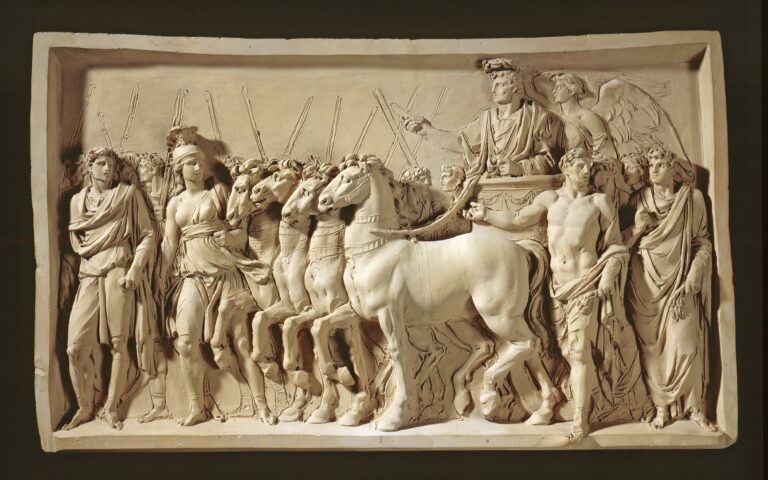
A Roman triumph
The Legacy of Cannae
The Battle of Cannae left a mark on history that has never faded:
Military academies still study the battle today
The term “a Cannae” is still used to describe a complete tactical encirclement
It showed how a smaller, smarter army can defeat a larger one with planning and deception
Hannibal won the battle — but not the war. Rome, wounded but defiant, would eventually regroup and crush Carthage in later battles, most famously at Zama in 202 BCE.
Still, Cannae remains the most devastating military defeat in Roman history, and a reminder that even the most powerful empire can be brought to its knees by a single day of genius.
Final Thoughts
The Battle of Cannae is not just a tale of blood and loss. It is a lesson in patience, planning, and tactical brilliance. Hannibal’s victory stunned the ancient world, and it still inspires and terrifies military thinkers today.
It showed the world that strategy can overcome size, that boldness can defeat tradition — and that Rome, even at its lowest point, had the strength to rise again.