
The idea that a person is “innocent until proven guilty” is strongly associated with modern justice systems, but its roots are sometimes incorrectly traced directly to ancient Rome. Roman law developed many important principles concerning evidence, accusations, trials, punishment, and the rights of defendants, but the Roman legal system did not have a simple rule identical to the modern presumption of innocence.
This makes the subject especially interesting because Roman law influenced later European legal traditions, yet Roman courts operated very differently from modern courts. There was no single Roman constitution or criminal code that established one universal procedure for every trial. Legal procedures changed over the centuries and depended on the type of case, the period of Roman history, the status of the people involved, and the authority hearing the case.
Roman legal thinkers did develop ideas that could sometimes protect an accused person from punishment without adequate proof. A famous maxim associated with Roman legal tradition is “Ei incumbit probatio qui dicit, non qui negat”, meaning roughly that the burden of proof lies with the person who makes the claim, rather than the person who denies it. This is similar in spirit to an important part of modern legal reasoning.
However, this should not be turned into the claim that Roman law had the modern presumption of innocence. Roman trials could involve accusations, witnesses, documents, confessions, arguments by advocates, and other forms of evidence, but procedures were not uniform. In some periods, the accused could face serious disadvantages, and social status could strongly affect how a person experienced the legal system.
The Roman legal tradition nevertheless made major contributions to the development of Western law. Roman jurists carefully discussed proof, testimony, legal responsibility, contracts, property, criminal offenses, and judicial procedure. Their writings were later studied and incorporated into European legal traditions, particularly through the medieval revival of Roman law.
The question, therefore, is not simply “Did Romans believe you were innocent until proven guilty?” A better question is: “What protections did Roman law provide to people accused of wrongdoing, and how did those protections compare with the modern presumption of innocence?”
Understanding that difference helps reveal both the achievements and the limitations of Roman justice.

I. What Did “Innocent Until Proven Guilty” Actually Mean in Roman Law?
The modern principle of presumption of innocence generally means that a person accused of a crime should be treated as innocent unless the prosecution establishes guilt according to the required legal standard. This principle is closely connected with the idea that the burden of proving the accusation belongs to the prosecution.
Ancient Roman law contained ideas that sometimes moved in this direction, but it did not establish the modern principle in exactly this form.
Roman jurists recognized the importance of proof and evidence. An accusation alone was not necessarily sufficient to establish guilt, and legal writers discussed circumstances in which evidence was required before a claim could be accepted. The principle that the person making an assertion should bear the burden of proving it became an important part of Roman legal thought.
One famous formulation is “Ei incumbit probatio qui dicit, non qui negat.” In simplified terms, it means that the person who makes an allegation must provide proof rather than forcing the person who denies it to prove a negative.
This sounds very similar to the modern idea that the accused should not have to prove their own innocence. However, the Roman legal system did not apply this principle through a single, universal criminal procedure comparable to modern courts.
Roman justice changed considerably over time. During the Roman Republic, some criminal cases were handled through formal public courts, while other disputes followed different procedures. Under the Roman Empire, imperial officials and governors increasingly exercised judicial authority, and criminal proceedings could take different forms depending on the circumstances.
The legal position of the accused could therefore vary considerably.
Another important difference was the role of social status. Roman society was highly hierarchical, and citizens, freedpeople, slaves, soldiers, senators, and other groups did not necessarily experience the legal system in the same way. The privileges and punishments available to different social classes could be very different.
This means that Roman law cannot simply be described as a system where everyone had identical legal rights.
Nevertheless, Roman legal thought contributed an important concept: an accusation and proof were not necessarily the same thing. Roman jurists developed increasingly sophisticated discussions about evidence and legal reasoning, helping create traditions that would influence later European law.
The modern phrase “innocent until proven guilty” should therefore be treated as a useful comparison rather than a direct quotation of Roman law.
Roman legal history is better understood as part of a long development in which ideas about proof, accusation, evidence, and judicial responsibility gradually evolved.
5 Main Ideas
I. Roman law did not contain a single modern-style rule stating that everyone was innocent until proven guilty.
II. Roman jurists nevertheless recognized the importance of evidence and proof in legal disputes.
III. The principle that the person making an allegation should provide proof has similarities to modern legal reasoning.
IV. Roman legal procedures varied depending on the period, type of case, and authority handling the trial.
V. Social status strongly affected how different people experienced Roman justice, making the system very different from modern ideals of equal legal treatment.
II. The Burden of Proof in Roman Law: Who Had to Prove the Accusation?
One of the most interesting connections between Roman law and the modern idea of “innocent until proven guilty” concerns the burden of proof. In a modern criminal trial, the prosecution generally has to establish that the accused committed the crime. Roman legal thought also developed important ideas about who should provide evidence for a claim, although Roman procedure was not identical to the modern criminal justice system.
A famous maxim associated with Roman legal tradition states:
“Ei incumbit probatio qui dicit, non qui negat.”
The basic meaning is that the burden of proof rests with the person who makes an assertion, rather than with the person who simply denies it.
This principle is important because it recognizes a basic problem in legal disputes. If someone makes an accusation, it would be unreasonable to automatically treat the accusation as established simply because it was made. The person making the claim must provide some basis for it.
For example, if one person accused another of owing money, the accusation itself would not necessarily establish the debt. Evidence such as documents, witnesses, contracts, or other legally relevant information could be necessary to demonstrate that the claim was valid.
This principle was particularly important in private legal disputes, where Roman jurists developed sophisticated rules concerning contracts, property, inheritance, debts, and other matters. Roman law became highly detailed in determining what different parties needed to establish in court.
However, criminal cases were more complicated.
Roman criminal procedure changed significantly over the centuries. During the Republic, certain serious offenses could be brought before formal courts, while under the Empire, magistrates, governors, and imperial officials increasingly exercised judicial authority. The procedures used could therefore vary considerably.
The accused did not always enjoy the same protections that a defendant would expect in a modern courtroom.
For example, social status mattered enormously. A Roman citizen of high status could have legal privileges unavailable to a slave or another person of lower legal standing. The Roman legal system was not based on the modern principle that every person should have exactly the same legal protections regardless of social position.
Roman law also recognized different types of evidence. Witness testimony, written documents, physical evidence, statements by the parties, and other forms of proof could all play roles in legal proceedings. Roman jurists debated the reliability and importance of different kinds of evidence.
This shows why it is too simplistic to say that Romans had either a complete presumption of innocence or no protection for accused people at all. The reality was somewhere in between and changed over time.
Roman legal reasoning could recognize that an accusation needed support, while Roman criminal procedure could still be very different from a modern criminal trial.
There was also an important distinction between making an accusation and establishing legal responsibility. A person could be accused of wrongdoing without the accusation automatically becoming a legal fact. Courts and officials had to consider the available evidence and applicable law.
The Roman approach to proof eventually became highly influential because later European scholars studied Roman legal texts. During the medieval period, Roman law was rediscovered and systematically studied at universities, especially through the Corpus Juris Civilis, the enormous compilation of Roman law ordered under Emperor Justinian in the sixth century AD.
These later scholars did not simply copy Roman law unchanged. They interpreted, reorganized, and combined Roman legal principles with other legal traditions, helping shape European jurisprudence.
So when people say that the modern principle of “innocent until proven guilty” comes from Rome, the statement needs qualification. Roman law did not create the modern criminal justice system, but Roman jurists developed important ideas about proof, evidence, legal claims, and the responsibilities of the person making an accusation.
Those ideas became part of a much longer legal tradition that eventually influenced modern concepts of justice.
5 Main Ideas
I. Roman legal tradition recognized that the person making a claim generally had a responsibility to provide proof.
II. “Ei incumbit probatio qui dicit, non qui negat” expresses the idea that an assertion requires evidence rather than relying solely on denial.
III. Roman courts could consider witnesses, documents, statements, and other forms of evidence.
IV. Roman criminal procedure varied greatly by period and did not provide every accused person with the protections expected in modern courts.
V. Roman ideas about proof later influenced European legal thought, contributing indirectly to the development of modern principles concerning evidence and accusations.

III. Roman Trials: How Criminal Cases Were Actually Decided in Ancient Rome
To understand whether Romans were truly “innocent until proven guilty,” it is necessary to understand what a Roman trial actually looked like. Ancient Rome did not have one permanent criminal court system that remained unchanged for centuries. Roman legal procedures evolved over time, and the way a person was tried could depend on the period, the type of offense, the person’s legal status, and the authority handling the case.
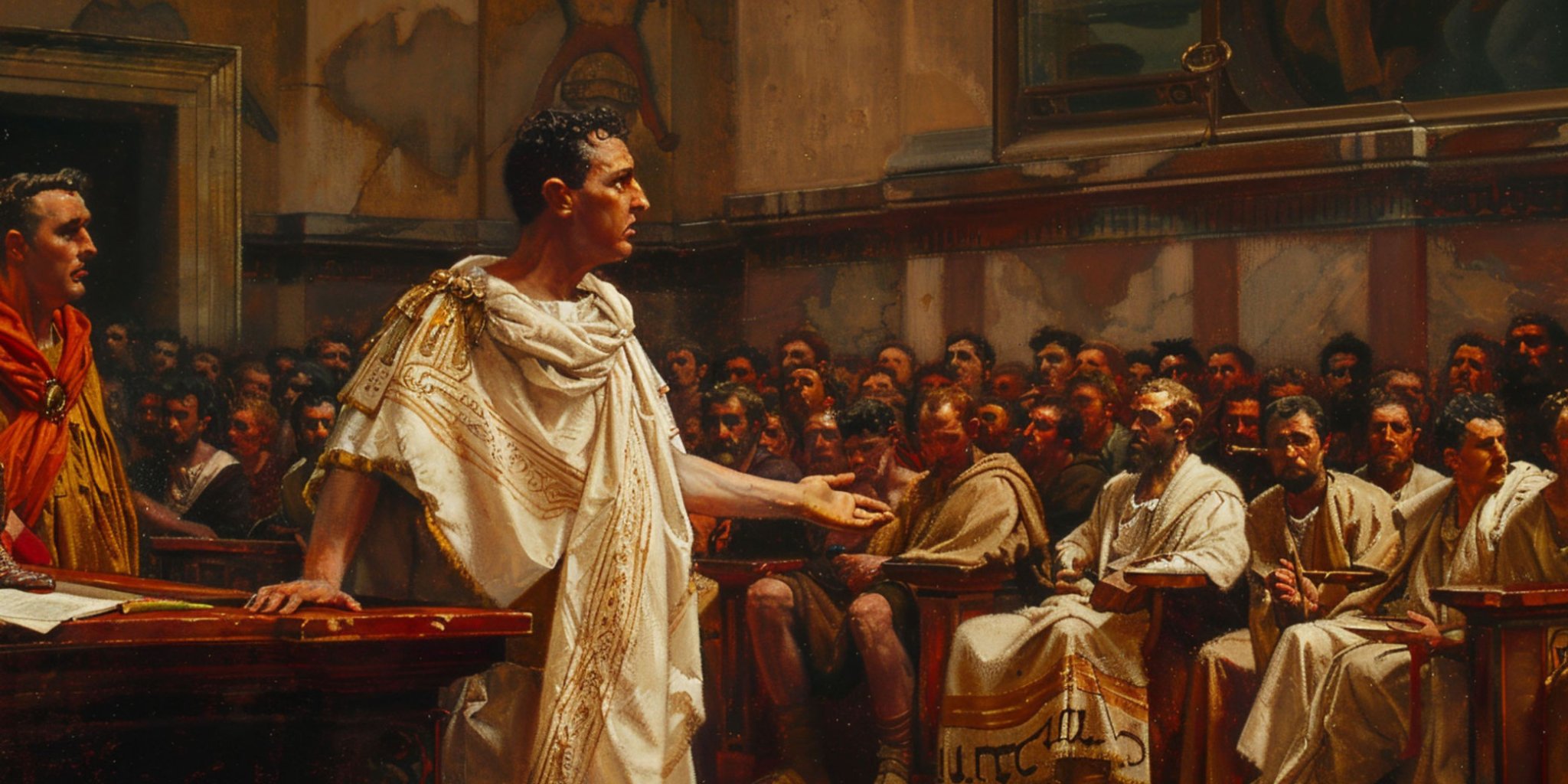
During the Roman Republic, some serious criminal cases were heard by special public courts known as quaestiones perpetuae. These courts developed particularly during the late Republic and dealt with specific categories of offenses. A prosecutor or accuser could bring a case, and the accused had opportunities to defend themselves, often with the assistance of an advocate.
Roman trials could therefore involve formal accusations, speeches, witnesses, documents, and arguments about the evidence. Skilled advocates were extremely important. A successful defense could challenge the credibility of witnesses, question the interpretation of evidence, or argue that the accused had not committed the alleged offense.
Roman courtroom culture was highly rhetorical. Public speaking was an important part of elite Roman education, and famous lawyers such as Cicero became known for their ability to defend clients through persuasive arguments. Cicero’s speeches provide valuable evidence for understanding Roman legal culture, although they were also designed to persuade audiences and therefore cannot be treated as completely neutral descriptions of every case.
The system changed under the Roman Empire. Imperial administration increasingly relied on officials with judicial authority. Governors handled many legal matters in the provinces, while officials in Rome and other parts of the empire could exercise judicial powers. Some cases could ultimately involve the emperor himself.
This meant that Roman justice could be quite flexible, but that flexibility could also create problems. The procedure used in one case might be very different from the procedure used in another.
The social position of the accused was particularly important. Roman society recognized different legal categories, including Roman citizens, non-citizens, freedpeople, and slaves. These categories could affect legal rights, punishments, and access to certain procedures.
This is one of the biggest differences between ancient Roman justice and modern legal systems. Modern legal systems generally aim to establish equal legal rights regardless of social class, although actual implementation varies. Roman law, by contrast, openly recognized differences in legal status.
Evidence was another important part of Roman trials. Judges could consider testimony, documents, physical circumstances, admissions, and other information. However, Roman ideas about evidence did not always match modern standards.
For example, ancient legal systems generally lacked the modern scientific methods used to analyze evidence. There were no modern forensic laboratories, DNA tests, fingerprints, or standardized investigative procedures. Courts therefore relied much more heavily on human testimony, documents, reputation, and argument.
This made credibility extremely important.
A witness’s social position, reputation, relationship with the parties, and consistency could all influence how their testimony was received. Advocates therefore spent considerable effort attacking or defending the credibility of witnesses.
Roman law also recognized the importance of confession and statements by the accused, although the role and treatment of such evidence varied by period and legal context. Later imperial legal practice became increasingly concerned with establishing facts through official investigation.
The result was a legal system that was neither completely arbitrary nor equivalent to modern justice.
Roman courts had rules, procedures, legal specialists, and traditions concerning evidence, but those rules existed within a highly unequal society and changed considerably over time.
Therefore, when discussing “innocent until proven guilty,” the most accurate conclusion is that Roman trials contained some principles compatible with that idea without possessing the modern principle in its complete form.
The Roman legal tradition was an important stage in the long development of Western law, but it should not be confused with the modern criminal justice system.
5 Main Ideas
I. Roman criminal trials changed considerably between the Republic and the Empire.
II. Trials could involve accusations, advocates, witnesses, documents, evidence, and formal legal arguments.
III. Cicero and other Roman advocates demonstrate the importance of courtroom rhetoric and legal defense.
IV. Social and legal status strongly influenced a person’s experience of Roman justice.
V. Roman courts used evidence and legal procedures, but their system was fundamentally different from modern criminal courts.

IV. Roman Judges, Evidence, and False Accusations: What Happened When Someone Was Accused?
Being accused of a crime in ancient Rome did not automatically mean that a person was legally guilty. Roman legal traditions recognized a distinction between an accusation and proof, although the protections available to an accused person were very different from those found in modern legal systems.
A Roman accusation could begin when someone formally brought a charge against another person. In certain public criminal courts, the accuser had an important role in presenting the case. This meant that making an accusation was itself a serious legal act, rather than simply telling an official that someone seemed suspicious.
The person bringing the accusation generally had to establish the claim through evidence and argument. This connects with the Roman legal principle that the person who makes an assertion carries responsibility for proving it. However, the exact rules varied according to the type of legal proceeding and the period of Roman history.
Evidence could take many forms. Witnesses were particularly important, and Roman advocates often spent considerable effort challenging their credibility. A witness might be questioned about their relationship with the accused, their reputation, whether they had personally observed the events, and whether their account was consistent.
Written evidence could also matter. Contracts, letters, financial records, and other documents could be presented in appropriate cases. Roman society was highly literate among its educated classes, and written documents played an increasingly important role in administration and law.
However, Roman courts did not possess modern forensic science. There were no DNA tests, fingerprint databases, modern toxicology, or scientific crime laboratories. Judges therefore had to rely heavily on testimony, documents, circumstances, and the arguments presented by the parties.
This made the credibility of individuals extremely important.
A person’s reputation and social position could influence how their testimony was viewed. Roman society was hierarchical, and the legal system reflected those social divisions. The testimony and legal position of a wealthy Roman citizen could be treated differently from that of a slave or another person with a lower legal status.
This is one of the most important limitations when comparing Roman law with the modern presumption of innocence. Modern legal systems generally attempt to establish a principle that the accused has the same fundamental legal status regardless of wealth or social class. Roman society did not operate according to that principle.
Roman law also recognized that accusations could be malicious or dishonest. Bringing a false accusation could itself have legal consequences in certain circumstances. This was important because the Roman state had an interest in preventing people from using the courts simply to attack personal enemies.
Political and personal rivalries could make accusations especially dangerous. Roman history contains numerous examples of prominent individuals being accused of serious offenses during periods of political conflict. The legal system therefore existed within a society where law and politics were closely connected.
During the Roman Empire, imperial officials also gained substantial judicial authority. In some cases, governors or other officials investigated accusations and determined how proceedings would continue. This could make the process more administrative and less like the formal public courts of the late Republic.
The result was a complicated system in which being accused did not automatically equal being guilty, but neither did every accused person enjoy strong procedural protections.
This distinction is important when explaining the origins of the modern principle. Rome contributed ideas about proof, evidence, accusations, and legal responsibility, but modern concepts of due process and presumption of innocence developed much later through a combination of Roman law, medieval legal traditions, religious and philosophical ideas, and the development of modern states.
Roman law was therefore one part of a much longer story.
The ancient Romans understood that accusations needed evidence and that legal claims should be tested. But their society also accepted major differences in legal status and did not have the modern idea that every defendant should begin a criminal trial with exactly the same legal protections.
5 Main Ideas
I. A Roman accusation did not automatically establish legal guilt; evidence and argument were important parts of the process.
II. Witnesses, documents, statements, and circumstances could all contribute to a Roman legal case.
III. Roman courts lacked modern forensic science and therefore relied heavily on human testimony and documentary evidence.
IV. Social status could strongly affect how an accused person and their evidence were treated.
V. Roman law developed important ideas about accusations and proof, but the modern presumption of innocence developed through a much longer legal history.

V. Roman Punishments and Convictions: What Happened After a Person Was Found Guilty
In ancient Rome, being accused of a crime and being found guilty were not necessarily the same thing. Roman legal procedures could be complicated, and the punishment imposed after conviction depended on the crime, the period of Roman history, the person’s social status, citizenship, and the authority of the court. Although Roman justice was very different from modern criminal justice, the distinction between an accusation and a proven offense was an important part of legal procedure.
Roman punishments could range from fines and confiscation of property to exile, forced labor, imprisonment, corporal punishment, and execution. The severity of the sentence often reflected the seriousness of the offense and the legal status of the defendant. Roman citizens generally possessed protections that were not available to slaves or many non-citizens.
One important punishment was exile. During the Roman Empire, some convicted individuals could be removed from Rome or sent to a particular location. The exact form of exile varied. Some forms involved losing citizenship or property, while others were less severe. For politically important Romans, exile could be a major punishment because it separated them from their families, political networks, and careers.
Fines and confiscation of property were also important punishments. Financial penalties could be imposed for various offenses, while certain serious convictions could result in the loss of property. For wealthy Romans, losing property could be devastating even when the punishment did not involve physical imprisonment.
Another major category involved forced labor. Some convicted people could be sentenced to work in mines or on other demanding projects. This was particularly associated with people of lower legal and social status. Slaves and free citizens did not necessarily receive the same punishments for similar offenses, demonstrating one of the major differences between Roman justice and the principle of equal treatment under modern law.
Execution also existed within the Roman legal system. Methods of execution could vary depending on the period, offense, and status of the condemned person. Crucifixion, for example, was generally associated with slaves, non-citizens, and people of lower status, while Roman citizens could receive different treatment in many circumstances. The famous execution of Jesus by crucifixion took place under Roman authority, although the precise legal and political circumstances remain subjects of historical discussion.
Imprisonment also existed, but Roman prisons were often not designed in the same way as modern correctional institutions. Detention could be used while someone awaited trial, sentencing, or execution, rather than functioning primarily as a long-term rehabilitation system.
Roman law also recognized circumstances that could affect punishment. Factors such as age, status, intent, previous conduct, and the nature of the offense could influence how authorities treated a convicted person. However, this should not be mistaken for a modern standardized sentencing system.
Most importantly, the existence of severe Roman punishments does not mean that every accused person was automatically treated as guilty. A legal accusation could begin a process in which evidence, testimony, arguments, and the authority of the deciding official played a role. At the same time, Roman justice could be highly unequal and politically influenced.
This creates an important distinction for understanding Roman law: Rome had procedures intended to determine guilt, but it did not have the same universal protections and equality before the law expected in modern legal systems.
5 Main Ideas
I. Roman punishments could include fines, confiscation, exile, forced labor, imprisonment, and execution.
II. A person being accused did not automatically mean that the person had been legally convicted.
III. Roman citizenship and social status strongly influenced the punishments a convicted person could receive.
IV. Slaves and lower-status people generally faced harsher forms of punishment than privileged Roman citizens.
V. Roman criminal justice separated accusation from conviction in important ways, but it was far less equal and standardized than modern justice systems.

VI. Roman Citizens, Slaves, and Inequality Before the Law
One of the most important differences between Roman law and modern ideas of justice was that legal treatment depended heavily on a person’s social and legal status. Although Roman jurists developed sophisticated legal principles, Roman society was deeply hierarchical. Being a Roman citizen could provide significant legal advantages, while slaves, foreigners, and people of lower social status could face very different treatment.
Roman citizenship was an important legal status. Citizens possessed rights that non-citizens did not necessarily have, including certain protections in criminal proceedings. During the Republic, the status of citizenship was particularly important when a Roman citizen faced severe punishment. In some circumstances, citizens had protections against certain forms of execution and could appeal or use established procedures connected with their citizenship.
However, citizenship did not mean that every Roman was treated equally. Roman society included major distinctions between senators, equestrians, ordinary citizens, freedpeople, foreigners, and slaves. These distinctions could influence legal proceedings and punishment.
The position of slaves was especially different. Under Roman law, slaves were generally treated as property belonging to their owners rather than as legally independent persons. They could appear in legal situations, but their rights were extremely limited compared with those of free people. The legal system therefore operated within a society where human beings could themselves be legally owned.
Punishment also reflected these social divisions. A slave and a Roman citizen accused of similar offenses could face very different consequences. Corporal punishment and other severe penalties were much more readily imposed on people of lower status. This demonstrates why it can be misleading to describe Roman law simply as an early version of modern equal justice.
Freedpeople occupied an intermediate position. A slave could sometimes be freed through manumission, becoming a freedperson. Freedpeople could acquire important legal rights, but their former status could continue to affect their position in Roman society. Their relationship with their former owner, now their patron, could also create continuing obligations.
Non-citizens were another important group. The Roman Empire eventually contained enormous numbers of people who were not Roman citizens. Provincial inhabitants could be subject to Roman law while also living under local legal traditions. Roman citizenship expanded considerably over time, particularly during the Imperial period. In AD 212, Emperor Caracalla issued the Constitutio Antoniniana, which extended Roman citizenship to nearly all free inhabitants of the empire, although important legal and social distinctions continued to exist.
This complicated system is essential when discussing the idea of “innocent until proven guilty.” A legal principle could exist without being applied equally to every person. Roman law developed procedures for accusations, evidence, trials, and convictions, but the experience of justice could depend enormously on who the defendant was.
We should therefore avoid describing Roman law as either completely arbitrary or completely fair by modern standards. Roman jurists created sophisticated legal concepts, and Roman courts could require accusations and evidence to be examined. At the same time, Roman justice existed inside a society based on status, hierarchy, slavery, and unequal political power.
The Roman legal tradition is historically important precisely because it contains both sides of this story. It contributed concepts that influenced later European legal systems, while also reflecting the inequalities of the ancient world.
5 Main Ideas
I. Roman citizenship could provide important legal protections that were unavailable to many non-citizens.
II. Slaves had extremely limited legal rights and were treated under Roman law primarily as property.
III. Social status could strongly influence both legal proceedings and punishment.
IV. Freedpeople and non-citizens occupied different legal positions from fully privileged Roman citizens.
V. Roman law developed sophisticated legal procedures, but it did not establish equality before the law in the modern sense.